

Doctoral student Marta Arbizu Gómez examines the role of the glymphatic system and NREM sleep in amyloid and tau clearance, and the clinical implications for neuropsychological assessment.
During NREM sleep, the brain activates a coordinated rhythm that drives the glymphatic system. This mechanism, powered by vascular oscillations, or vasomotion, facilitates cerebrospinal fluid clearance and the removal of neurotoxins associated with cognitive decline, such as beta-amyloid and tau protein. We examine recent evidence published in Science (Nedergaard, 2026) and its direct implications for neuropsychological assessment and incorporating sleep into neurorehabilitation programs.
Why is sleep so important for brain health?
Sleep is more than just rest. For years, sleep has been associated with physical recovery, memory consolidation, and emotional balance. However, recent research suggests that sleep may also serve an essential function for brain health: helping the brain clear metabolic waste that accumulates during wakefulness.
This process is especially relevant in the context of neurodegenerative diseases, such as Alzheimer’s disease, in which toxic proteins, including beta-amyloid and tau protein, progressively accumulate. Although many questions remain unanswered, there is growing evidence that disrupted sleep may impair the clearance of these substances and contribute to the risk of cognitive decline.
The article published in Science by Maiken Nedergaard addresses this very question from a novel perspective: sleep as a coordinated biological state in which the brain, blood vessels, and the entire body function in sync.
What happens in the brain while we sleep?
During wakefulness, different chemical systems in the brain—such as norepinephrine, acetylcholine, serotonin, dopamine, and histamine—work relatively independently. Each of these neuromodulators contributes to specific functions: attention, motivation, mood, alertness, or learning.
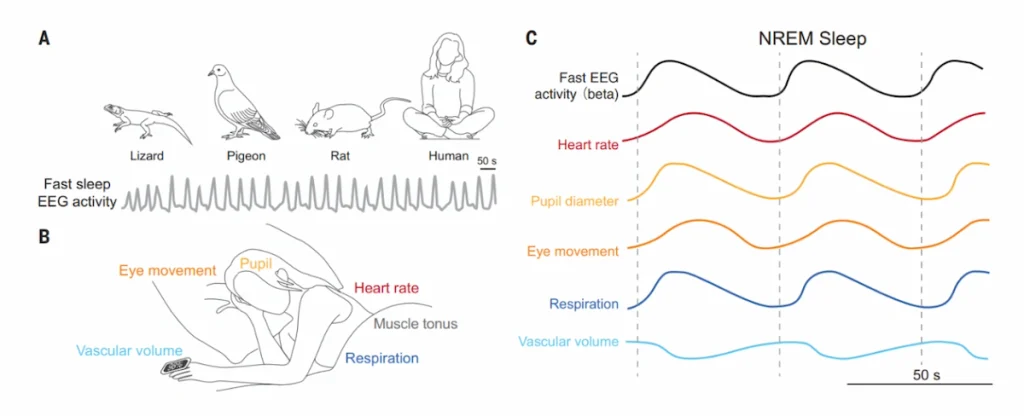
During sleep, however, especially during NREM sleep, these systems appear to reorganize. Instead of acting separately, they begin to oscillate in a coordinated way, following a slow rhythm that repeats approximately every 50 seconds.
This rhythm does not affect brain activity alone. It is also associated with changes in heart rate, breathing, pupil diameter, eye movements, and blood vessel volume. In other words, sleep is not a passive state, but an active process in which the brain and body synchronize.
The glymphatic system: the brain’s “cleaning system”
One of the article’s key points is the role of the glymphatic system. This system can be understood as a brain-wide cleaning network that facilitates the entry and circulation of cerebrospinal fluid through the brain, helping remove metabolic waste.
Unlike other organs, the brain does not have a conventional lymphatic system within it. That is why it needs specific mechanisms to remove waste products. The glymphatic system performs this function by using the spaces surrounding blood vessels to promote the movement of cerebrospinal fluid.
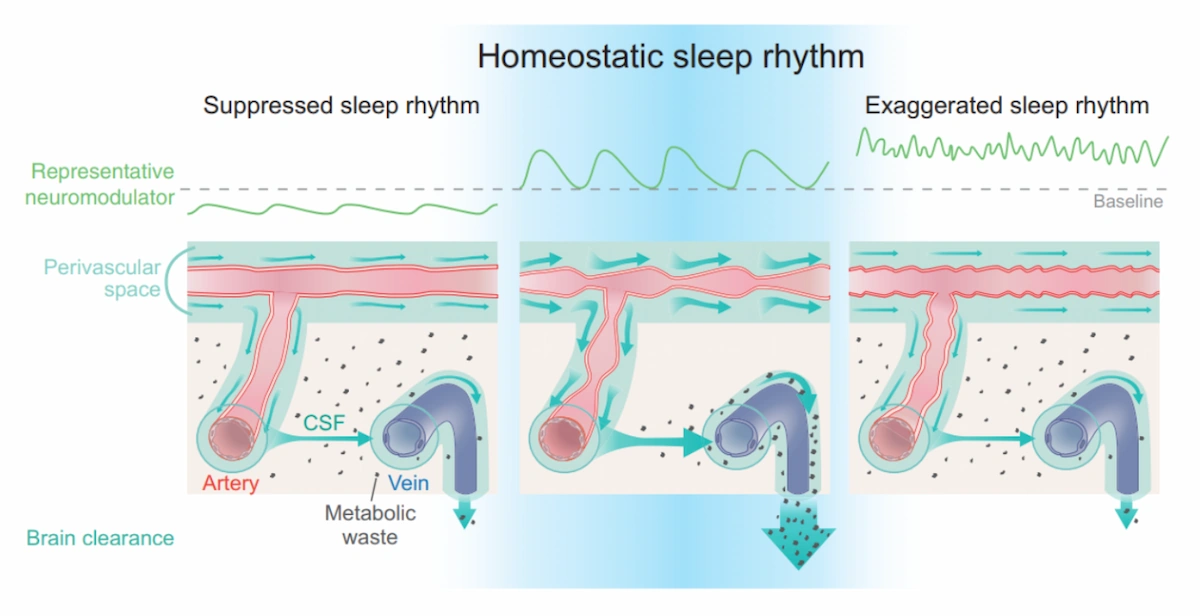
During sleep, cerebral blood vessels undergo small rhythmic contractions and dilations, a phenomenon known as vasomotion. According to the article, these vascular oscillations may act as a kind of mechanical pump that propels cerebrospinal fluid and promotes the removal of potentially harmful proteins.
In this context, getting good sleep may be important not only for feeling rested the next day, but also for keeping active a brain-cleaning system that could play a role in preventing cognitive decline.
How is this sleep rhythm related to dementia?
The article proposes a compelling hypothesis: when the coordinated rhythm of sleep is disrupted, brain clearance may become less efficient.
This can happen for a variety of reasons. Aging, chronic stress, some psychiatric disorders, cardiovascular disease, sleep apnea, substance use, and certain medications can interfere with the neuromodulatory systems that regulate this rhythm. As a result, vasomotion may become less effective, and the glymphatic system may have a reduced capacity to clear waste.
This mechanism could help explain why sleep problems have been associated in numerous studies with a higher risk of cognitive decline and dementia. The issue may not be limited to poor sleep affecting memory or daily performance; in the long term, it could compromise biological processes that are fundamental to keeping the brain healthy.

Subscribe
to our
Newsletter
What are the article’s key takeaways?
The article is not a single clinical trial, but a review of recent evidence that brings together studies on sleep, neuromodulators, blood vessels, the glymphatic system, and dementia.
The main findings can be summarized in four points:
- First, several brain neuromodulators synchronize during NREM sleep. This coordination takes the form of slow oscillations, with cycles lasting about 50 seconds, and is associated with brief episodes of brain activation known as microarousals.
- Second, these neuromodulators not only regulate neuronal activity, but also affect blood vessels. Some promote vasoconstriction and others vasodilation, contributing to rhythmic changes in the volume of cerebral blood vessels.
- Third, these vascular oscillations may provide the mechanical force needed to propel cerebrospinal fluid through the glymphatic system. In this way, sleep may facilitate the removal of waste products, including proteins associated with Alzheimer’s disease.
- Finally, disruptions to these rhythms—whether caused by aging, stress, illness, or medication—may reduce brain clearance and promote the accumulation of neurotoxic proteins. This offers a possible way to better understand the relationship between disrupted sleep and increased dementia risk.
What are the implications for clinical practice?
Although more studies are needed before these findings can be directly applied in clinical practice, the article has important implications:
- First, sleep should be considered a core component of brain health. In older adults, patients with mild cognitive impairment, or people at risk for dementia, assessing sleep quality can provide relevant information about their overall health and how their condition is changing.
- The second implication is that sleep disturbances should not be interpreted solely as secondary symptoms. In some neurodegenerative diseases, sleep problems can emerge years before more obvious cognitive or motor symptoms. This suggests that they may be part of the disease process from its earliest stages.
- Third, some physiological indicators, such as heart rate variability during sleep, could become useful tools for noninvasively studying the state of these brain-body rhythms. If future research confirms this relationship, accessible markers could be developed to identify early disruptions in brain-clearance mechanisms.
Finally, the article invites us to consider the impact of certain medications and substances on sleep architecture. Some medications act on the same neuromodulatory systems involved in these nighttime oscillations, so it will be important to investigate their long-term effects on brain clearance and the risk of cognitive decline.
How does this development relate to NeuronUP?
At NeuronUP, we take a comprehensive approach to cognitive rehabilitation and stimulation, recognizing that brain function does not depend on a single factor. Cognition is influenced by neurological health, emotional well-being, physical activity, cognitive reserve, and basic habits such as sleep.
This article reinforces the importance of addressing cognitive decline from a multidimensional perspective. Cognitive rehabilitation can benefit from personalized programs that consider not only a patient’s neuropsychological profile, but also factors that affect their progress, such as sleep quality, rest, stress, or comorbidities.
In addition, a better understanding of how sleep contributes to brain clearance can help inform more comprehensive interventions. For patients with cognitive decline, sleep care could become an important complement to cognitive therapies, promoting a brain environment that is better suited to learning, plasticity, and maintaining function.
From this perspective, advances in sleep neuroscience and the glymphatic system do not replace cognitive rehabilitation; they complement it. Both approaches point toward the same goal: preserving people’s independence, functioning, and quality of life.
Conclusion
Sleep is much more than a period of rest. According to the evidence reviewed in this article, during sleep the brain activates a coordinated rhythm that synchronizes neuromodulators, blood vessels, and bodily functions. This rhythm may be essential for driving the glymphatic system and facilitating the removal of metabolic waste associated with neurodegenerative diseases.
When this mechanism is disrupted, brain clearance may become less efficient, promoting the accumulation of proteins such as beta-amyloid and tau. This offers a possible biological explanation for the relationship between disrupted sleep and increased dementia risk.
Although there is still a long way to go, these findings reinforce an increasingly clear idea: taking care of sleep means taking care of the brain. In the context of prevention, monitoring, and cognitive rehabilitation, sleep should be central to comprehensive, personalized care.
References
- Nedergaard M. The oscillatory biology of sleep: Linkage to dementia. Science. 2026;392(6800). doi:10.1126/science.aeg2276.
Frequently asked questions about the link between sleep, the glymphatic system, and dementia
1. What is the glymphatic system, and what does it do during NREM sleep?
The glymphatic system is the brain’s cleaning network. It facilitates the circulation of cerebrospinal fluid through perivascular spaces to remove metabolic waste. During NREM sleep, it is preferentially activated through the synchronization of neuromodulators and vascular oscillations (vasomotion), which act as a mechanical pump to clear toxins.
2. How is sleep deprivation related to the accumulation of beta-amyloid and tau protein?
When the sleep rhythm is disrupted by aging, stress, or disease, vasomotion becomes less effective. This reduces the glymphatic system’s ability to drain metabolic waste, promoting the progressive accumulation of neurotoxic proteins such as beta-amyloid and tau protein, which are associated with the development of Alzheimer’s disease and other types of dementia.
3. Why are sleep disturbances considered an early indicator of cognitive decline?
Problems with sleep architecture are not merely secondary symptoms; they often appear years before motor or cognitive impairments become evident. Their persistence compromises the biological mechanisms of brain clearance, making disrupted sleep a modifiable risk factor and an early biomarker of neurodegeneration.
4. What tools or physiological indicators can be used to assess sleep’s impact on the brain?
In clinical practice, in addition to standardized questionnaires on sleep quality, heart rate variability (HRV) is assessed during sleep. HRV is a noninvasive physiological indicator that can be used to evaluate the state of brain-body oscillations and the function of the brain-clearance system in older adults or people with mild cognitive impairment.
5. How does sleep hygiene improve the response to NeuronUP neurorehabilitation programs?
Good sleep creates an optimal biological environment for neuroplasticity and learning. Incorporating rest into NeuronUP’s multidimensional approach enhances the outcomes of cognitive stimulation because a brain without metabolic overload responds more effectively to interventions designed to preserve patients’ functioning.







 DunedinPACNI: Measuring the Pace of Brain Aging with a Single MRI
Leave a Reply