
Can a smartwatch anticipate health risks? Doctoral researcher Marta Arbizu Gómez explains how the SensorFM artificial intelligence model uses wearable data to analyze physiological patterns and their impact on clinical and neuropsychological assessment.
The integration of artificial intelligence and wearable devices is transforming the continuous collection of health data. This article examines the clinical potential of SensorFM, a new foundation model that turns digital biomarker data into information relevant to neurorehabilitation and cognitive assessment. Discover how passive physiological monitoring of variables such as sleep, activity, and emotional state can complement traditional intervention and open new avenues for personalized clinical monitoring.
What information can be extracted from a wearable device?
Smartwatches and fitness trackers continuously record information about our physical activity and physiological functioning. Throughout the day, they can measure movement, heart rate, heart rate variability, oxygen saturation, skin temperature, electrodermal activity, and the different stages of sleep.
However, turning these signals into clinically useful information remains a challenge. Measurements can vary across people, devices, and times of day, and the data often contain gaps when users remove their watch, the battery runs out, or a sensor stops recording properly.
In addition, developing a different algorithm for each health problem requires large quantities of accurately labeled data, which is particularly difficult and costly in healthcare.
To overcome these limitations, a team from Google Research and other institutions developed SensorFM, an artificial intelligence foundation model trained to learn general representations of health from data collected by wearable devices. The study, published as a preprint, examines whether a single model can leverage these signals to make predictions related to different areas of health.
What is a foundation model for health data?
Foundation models are trained on massive amounts of information, usually without requiring a specific label for every data point. During this process, the model learns general patterns that can later be adapted to multiple tasks.
SensorFM follows this approach, but instead of learning from text or images, it uses time series recorded by sensors.
The model was pretrained on:
- More than one trillion minutes of data.
- Information from five million people.
- Participants from more than 100 countries.
- More than 20 Fitbit and Pixel Watch device models.
- Five main sensor types: photoplethysmography, accelerometer, skin temperature, electrodermal activity, and altimeter.
Using these sensors, the researchers derived 34 variables recorded every minute, including heart rate, various measures of heart rate variability, oxygen saturation, steps, skin temperature, and sleep stages.
The model analyzed complete 24-hour windows and learned to reconstruct portions of information that had been artificially masked. In this way, it learned not only the individual values of each signal but also their relationships and how they changed throughout the day.

Subscribe
to our
Newsletter
What did the researchers want to find out?
The study focused on three main questions:
- First, the authors wanted to determine whether simultaneously increasing the amount of data and the model size led to predictable improvements in performance.
- Second, they assessed whether the learned representations could be reused to predict different aspects of health, even when only a small number of labeled samples were available.
- Finally, they analyzed whether SensorFM predictions could be integrated into an artificial intelligence-based personal health assistant to generate more relevant, personalized, and safe responses.
To evaluate the model, they used independent information from 13,985 participants, drawn from three prospective studies focused on metabolic and cardiovascular health, mental health, and sleep.
One model for 35 health-related tasks
SensorFM was evaluated on 35 different tasks grouped into six broad areas:
- Cardiovascular health.
- Metabolic health.
- Mental health.
- Sleep.
- Lifestyle.
- Demographic and physiological characteristics.
The variables analyzed included cardiovascular risk, hypertension, diabetes, insulin resistance, glycated hemoglobin and triglyceride levels, depression, anxiety, perceived stress, and sleep disturbances.
The model was also used to estimate characteristics such as age, body mass index, height, and weight. These variables should not necessarily be interpreted as clinical outcomes in their own right, but rather as a way to assess how much physiological and behavioral information the system had learned.
What were the main findings?
The results show that the model learned a generalizable representation of physiology and behavior recorded by wearables.
SensorFM outperformed traditional supervised models based on manually engineered variables on 34 of the 35 tasks evaluated. In other words, representations learned directly from large amounts of data proved more informative than conventional summaries calculated from the same signals.
In addition, performance improved as the number of participants used for training and the model’s capacity increased together. The largest version achieved the best results on 33 of the 35 tasks.
The authors also observed that larger models relied less on demographic information added later. This suggests that some physiological differences associated with variables such as age or body mass index may already have been represented in the patterns recorded by the sensors.
Learning from fewer clinically labeled data
One of the most relevant findings was the model’s ability to adapt to new tasks using relatively few labeled data points.
In health research, collecting continuous information with a smartwatch is relatively easy, but obtaining confirmed diagnoses, blood test results, or complete clinical questionnaires is much more costly.
Having previously learned general patterns from millions of participants, SensorFM needed fewer labeled examples to develop new predictive models. This efficiency could facilitate research into health problems for which only small clinical cohorts or limited information are available.
However, accuracy continued to improve as more labeled data became available, so the model does not eliminate the need for representative and accurately characterized clinical samples.
Can it reconstruct missing data?
Wearable device data are often incomplete. Users may take off their watch for part of the day, a sensor may disconnect, or signals may contain errors.
SensorFM was specifically trained to work with missing information. In the tests conducted, it outperformed baseline methods on different reconstruction tasks:
- 74.8% for imputing randomly removed data.
- 38.8% for reconstructing intermediate time intervals.
- 39.6% for predicting intervals at the end of a recording.
- 83.7% when complete signals from specific sensors were missing.
The researchers also simulated the loss of a full hour of data. After reconstructing that interval, the model maintained 99.7% accuracy in estimating daily step count, 99.9% accuracy in estimating deep sleep time, and 99.2% accuracy in estimating minutes of light exercise.
This capability could prevent a temporary interruption from distorting the daily summaries provided to users.
Artificial intelligence agents for adapting the model
Although the representations learned by SensorFM could be used with relatively simple statistical models, the researchers also explored an automated strategy to improve its adaptation to each task.
To do this, they created a kind of “classroom” made up of several agents based on language models. These agents generated code, trained different solutions, compared the results, and progressively modified their proposals.
In total, the system ran more than 30,000 automated experiments.
The solutions found by the agents improved performance over linear models on 16 of the 20 classification tasks and on 12 of the 15 regression tasks.
This finding points to the possibility of partially automating the process of developing predictive models. However, generated solutions still need to be rigorously reviewed and validated, especially when applied to health information.
From smartwatch data to a personal health assistant
The researchers then integrated SensorFM predictions into a personal health assistant based on a language model.
The goal was to determine whether the assistant could answer health questions more effectively when it had access not only to demographic data and daily wearable summaries but also to estimates generated by SensorFM.
Thirty-one real profiles were used, and responses were generated under three conditions:
- Demographic data and daily wearable metrics.
- Demographic data, daily metrics, and SensorFM predictions.
- Demographic data, daily metrics, and actual clinical values.
Figure 1 summarizes how the system works and the evaluation design. SensorFM transforms data recorded by the wearable into health predictions, which are added as context for the assistant before it generates a personalized response.
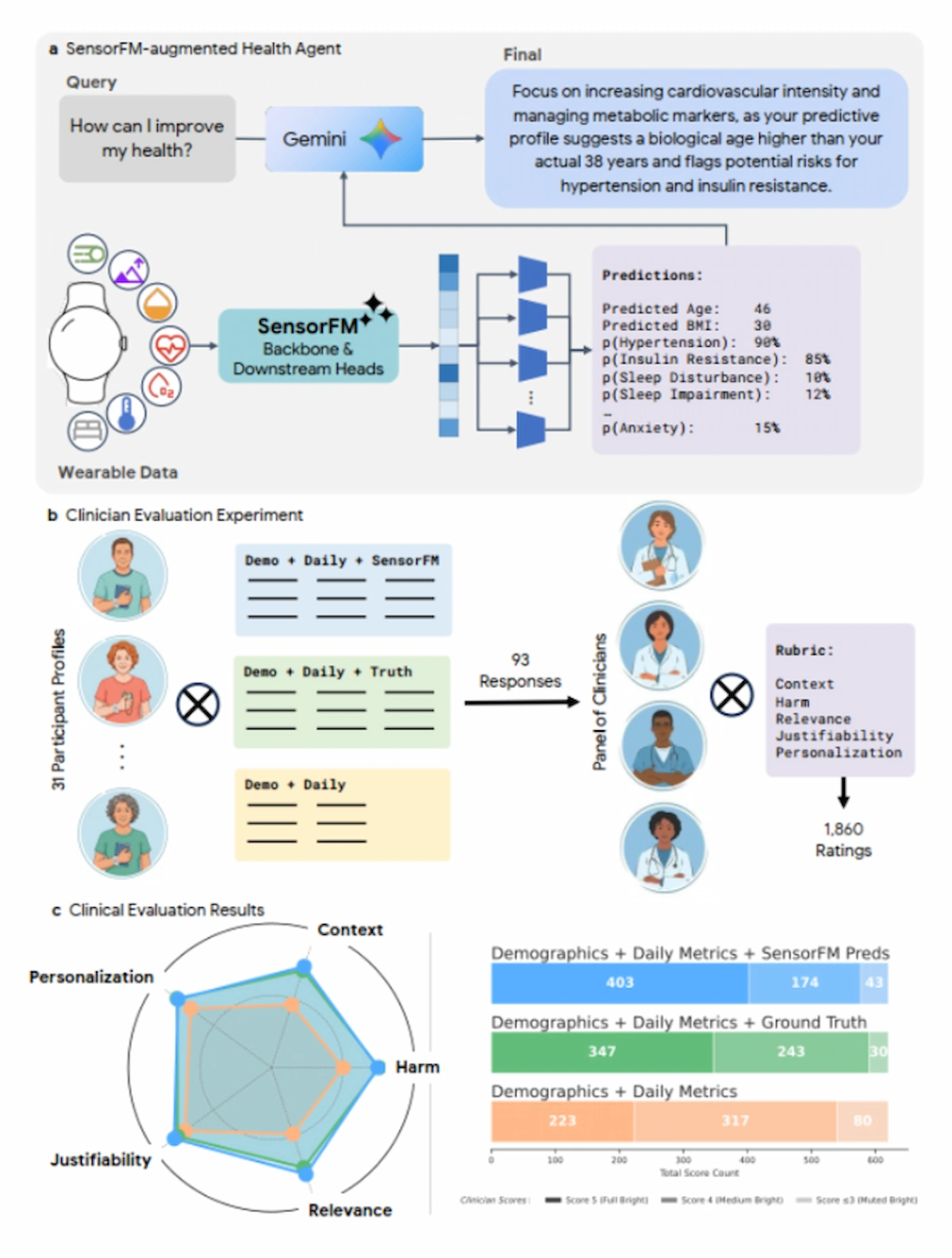
Four healthcare professionals evaluated the responses for context, relevance, personalization, justification, and potential risk. A total of 1,860 clinical ratings were collected.
Responses incorporating SensorFM predictions were significantly better than those based only on daily summaries. In addition, no statistically significant differences were found between responses generated using the model’s predictions and those using actual clinical values.
This finding does not mean that SensorFM can replace a medical evaluation. It indicates that its predictions provided the assistant with useful additional context for generating more specific and coherent responses.
What are the study’s limitations?
Despite the scale of the data used, the findings should be interpreted with caution.
First, the work is a preprint, so it has not yet completed the standard peer-review process.
The model was trained primarily on Fitbit and Pixel Watch devices. It is not guaranteed to work in the same way with other manufacturers, whose sensors and processing methods may differ.
In addition, the study used variables aggregated every minute rather than the original physiological signals. This allows for the analysis of longer periods but may remove high-frequency information relevant to some clinical applications.
Some of the outcomes used to evaluate the model were based on self-reported diagnoses, medication, or screening questionnaires, rather than on confirmed clinical diagnoses in every case. The study population also differed from the general population, with women and wearable device users more heavily represented.
Finally, evaluation of the personal health assistant was limited to static, single-turn responses. Real clinical interaction would require follow-up questions, contextual review, and longitudinal monitoring.
What are the implications for digital health?
This study points to a shift from algorithms designed for a single task toward general models that can reuse the same representation for different health problems.
Wearables provide a longitudinal view of day-to-day functioning, in contrast to the one-time measurements taken during a clinical visit. Combined with appropriately validated models, they could help identify physiological or behavioral changes, identify people who need a more in-depth assessment, and provide more continuous monitoring.
In neurology and neuropsychology, this type of technology could be especially useful for studying changes in sleep, activity, daily routines, autonomic responses, or emotional state. These changes may accompany various neurological and psychiatric conditions, although predictions obtained from wearables should not be considered diagnoses.
How can NeuronUP contribute?
Passive information obtained from wearables can be complemented by cognitive assessments and structured intervention programs.
Platforms such as NeuronUP make it possible to assess and work on domains such as attention, memory, executive functions, language, and social cognition. The future combination of cognitive metrics with longitudinal data on sleep, activity, and physiology could provide a more comprehensive picture of each person’s progress.
This integration could support the personalization of interventions, the detection of functional changes, and the monitoring of treatment response. To make this possible, specific clinical studies, interpretable models, and protocols that ensure user privacy, equity, and safety will be needed.
Conclusion
SensorFM shows that large-scale training on unlabeled wearable device data can generate useful representations for multiple areas of health.
The model outperformed traditional methods on most of the tasks analyzed, was able to reconstruct missing data, and provided additional information to a personal health assistant. However, its predictions should be understood as potential tools for screening, risk stratification, and monitoring—not as replacements for clinical diagnosis.
The findings represent a step toward systems that can transform large amounts of everyday data into personalized information. The next challenge will be to demonstrate that these tools maintain their accuracy, safety, and usefulness when applied to diverse clinical populations and real-world healthcare settings.
References
- Narayanswamy G, Xu MA, Heydari AA, et al. Towards a General Intelligence and Interface for Wearable Health Data. arXiv. 2026. https://doi.org/10.48550/arXiv.2605.22759
Frequently asked questions about AI and wearables in neurorehabilitation
1. What is the SensorFM model, and how is it used in digital health?
SensorFM is an artificial intelligence foundation model developed by Google Research and other institutions. It was trained on more than one trillion minutes of data from wearables. It learns general patterns from biosignals to make predictions applicable to multiple health tasks, ranging from sleep quality to indicators of metabolic and mental health.
2. What benefits do digital biomarkers offer in neurorehabilitation?
Smartwatches and fitness trackers provide a continuous, longitudinal view of users’ daily functioning, recording metrics such as heart rate variability, sleep stages, and physical activity. This passive monitoring complements one-time assessments during appointments, allowing neuropsychologists to identify subtle changes in routines, autonomic responses, or emotional state associated with various conditions.
3. How does artificial intelligence address data loss in smartwatches?
Wearable data often contain gaps because of battery failures or because users take off their devices. Models such as SensorFM are trained to reconstruct this missing information; in simulations in which a full hour of data was missing, the system maintained more than 99% accuracy in estimating deep sleep and daily steps.
4. Can wearable predictions replace clinical diagnosis?
No. Variables estimated by foundation models using wearable data are not, in themselves, clinical outcomes or diagnoses. They serve as screening and monitoring tools that provide valuable additional context for personalizing interventions, but they must always be integrated with structured clinical assessments and oversight by a healthcare professional.



 Foveal Development and Vision: Mechanisms and Implications for Age-Related Macular Degeneration (AMD)

Leave a Reply