
Are we closer to repairing the brain in Parkinson’s disease? Doctoral researcher Marta Arbizu Gómez shares the first results from a transplant of stem cell-derived neurons.
The STEM-PD clinical trial evaluates Europe’s first transplant of embryonic stem cells to regenerate dopaminergic neurons in Parkinson’s disease. Twelve-month results demonstrate graft safety in the putamen and cell survival confirmed by PET imaging, with most participants reducing their levodopa dose. This therapeutic advance opens up new possibilities for neurorehabilitation professionals, underscoring the need to incorporate precise cognitive and functional assessments to monitor patients’ clinical progress.
Loss of dopaminergic neurons and cell replacement therapies
Parkinson’s disease is the second most common neurodegenerative disease worldwide and is characterized by the progressive loss of dopaminergic neurons in a brain region called the substantia nigra. As a result, dopamine levels decrease, and symptoms such as slowness of movement, rigidity, tremor, and balance problems occur.
Current treatments, such as levodopa and deep brain stimulation, help control symptoms, but they do not replace lost neurons or slow the progression of the disease.
For decades, one of the major goals of research has been to develop therapies capable of replacing lost dopaminergic neurons and partially restoring the function of the motor circuit.
Now, a study published in Nature Medicine presents the results of the STEM-PD clinical trial, which for the first time in Europe evaluates the transplantation of dopaminergic progenitor cells derived from human embryonic stem cells.
STEM-PD clinical trial methodology for Parkinson’s disease
The trial included eight people with moderately advanced Parkinson’s disease, who received a bilateral transplant of dopaminergic progenitor cells directly into the putamen, a brain region essential for movement control.
Participants were divided into two groups that received different cell doses and were followed for one year. Because the cells came from a donor, all participants also received immunosuppressive therapy to prevent rejection.
The primary goal was not yet to demonstrate clinical efficacy, but to answer a fundamental question: Is the procedure safe?

Subscribe
to our
Newsletter
What do the study results reveal?: Cell transplant safety and the challenge of immunosuppression
The results are promising from a safety standpoint.
During the first 12 months:
- No tumors or abnormal growth of the transplanted tissue appeared.
- No graft-induced dyskinesias were observed, a complication of particular concern following previous cell transplant experiences.
- The surgery enabled the cells to be placed correctly in all patients.
However, the study also highlighted one of the main challenges of these types of therapies: immunosuppression.
One of the eight participants died from a severe fungal infection while receiving immunosuppressive treatment. The researchers concluded that this event was related to immunosuppression and not to the transplanted cells, although it underscores the need to optimize these protocols in future trials.
Neuronal survival measured using PET imaging
In addition to assessing safety, the researchers used positron emission tomography (PET) to determine whether the transplanted cells remained alive and began producing dopamine.
The images showed increased F-DOPA uptake in the transplanted areas, especially in patients who received the higher cell dose. This finding is one of the main pieces of evidence that the new neurons survive and begin to integrate functionally into the brain.
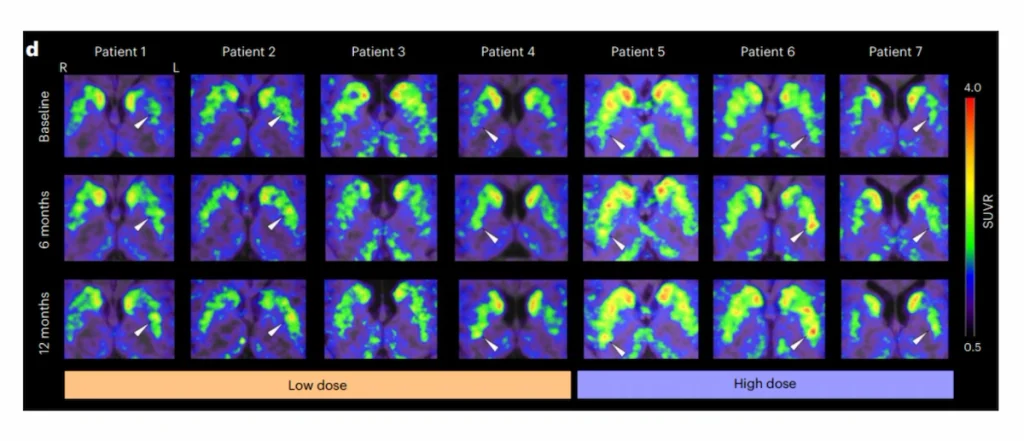
However, dopamine levels remained well below those observed in healthy individuals, so both the dose and the procedure will likely need to be optimized in future studies.
Observed clinical improvements
Although the study was not designed to demonstrate efficacy, some encouraging clinical results emerged.
At 12 months:
- most patients were able to reduce their daily dose of dopaminergic medication;
- several participants showed some improvement in motor symptoms;
- daily time spent in the OFF state decreased, especially in the group treated with the higher dose.
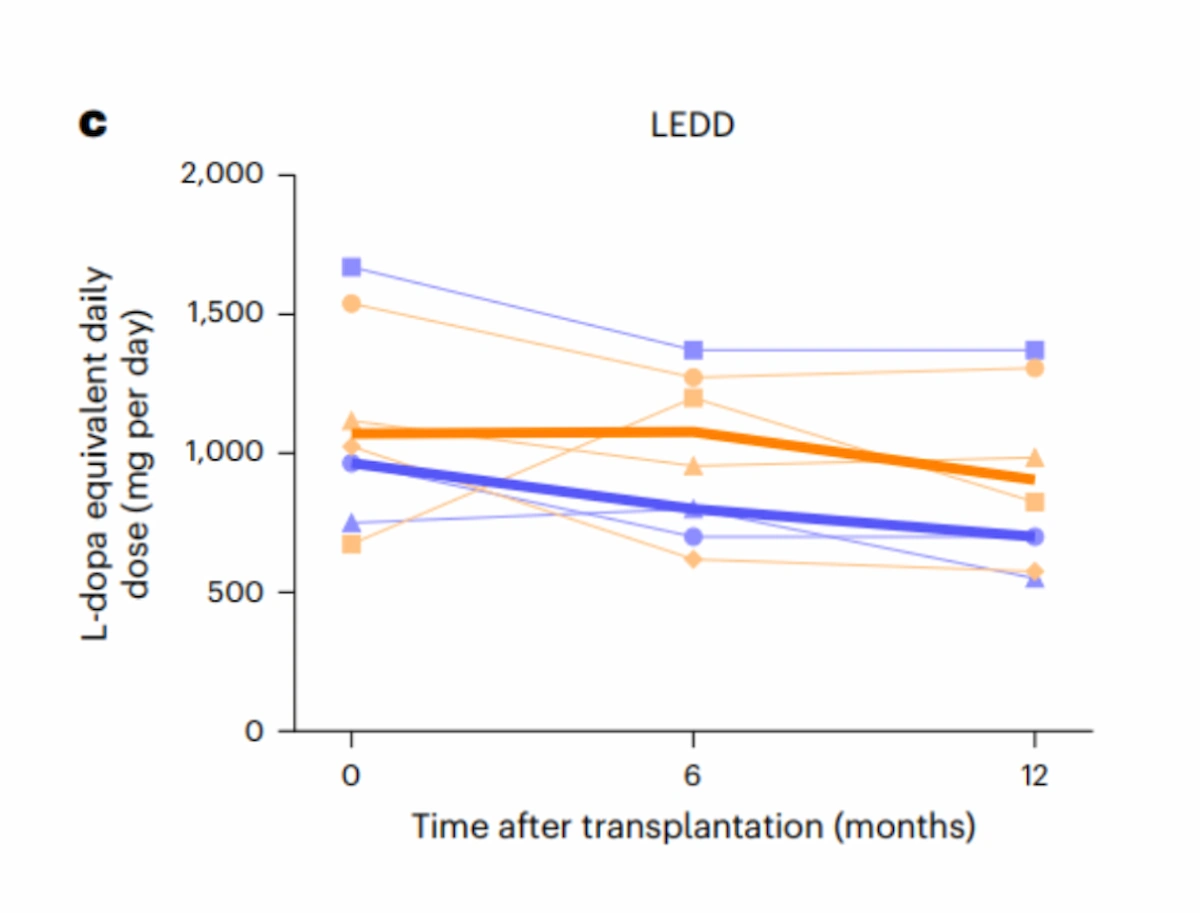
However, the authors emphasize that these data should be interpreted with caution. The number of participants is very small, and it is still too early to know whether these improvements will last.
Follow-up will continue for three years to determine whether clinical benefits increase as the cells mature and form new connections in the brain.
What does this study mean for the future of Parkinson’s disease?
This trial represents an important step toward therapies that can partially repair the brain, rather than simply relieve symptoms.
Although many questions remain—including the optimal dose, how long the cells survive, and how to reduce the risks associated with immunosuppression—the results support the development of new cell therapies for Parkinson’s disease.
In addition, this work confirms results recently obtained by other international research groups, reinforcing the idea that replacing dopaminergic neurons with stem cells could become a new treatment strategy for some patients in the future.
How can NeuronUP contribute?
Although cell therapies aim to restore damaged brain circuits, it will be equally important to have tools that can accurately measure their functional impact.
Platforms such as NeuronUP can support follow-up with these patients through repeated cognitive and functional assessments, making it possible to monitor their progress and complement rehabilitation interventions as these new therapies are incorporated into clinical practice.
References
- Paul G, Bjartmarz H, Kirkeby A, et al. Human embryonic stem cell-derived dopaminergic cells for Parkinson’s disease: a phase 1/2 open-label trial. Nature Medicine. 2026. https://doi.org/10.1038/s41591-026-04525-0
Frequently asked questions about cell therapy for Parkinson’s disease
1. What does the STEM-PD trial for Parkinson’s disease involve?
It is the first clinical trial in Europe designed to evaluate the safety and feasibility of transplanting dopaminergic progenitor cells derived from human embryonic stem cells directly into the putamen of patients with moderately advanced Parkinson’s disease.
2. What are the risks and safety results of this cell therapy?
During the first year of follow-up, the procedure proved safe with regard to the graft: no tumors or abnormal tissue growth were detected, and no dyskinesias induced by the new cells appeared. However, the main current risk is the immunosuppressive treatment needed to prevent rejection, which led to the death of one of the eight participants due to a severe fungal infection.
3. How do researchers determine whether stem cells survive after transplantation?
Researchers use advanced neuroimaging techniques, specifically positron emission tomography (PET) scans with the 18F-FDOPA tracer. In the STEM-PD study, these images confirmed increased uptake in the transplanted areas, showing that the new neurons survive and begin to integrate into the motor circuit.
4. Does a dopaminergic neuron transplant cure Parkinson’s disease or reduce medication?
The primary objective of this clinical phase was to assess safety, not definitive efficacy. Nevertheless, 12 months after the procedure, most participants were able to reduce their daily levodopa dose, spent less time in the OFF state, and showed some improvement in their motor symptoms, particularly those who received the higher cell dose.
5. What role does neurorehabilitation play after cell replacement therapy?
Although cell therapies aim to restore the structure of motor circuits, it is vital to measure long-term functional and cognitive impact. Stimulation platforms such as NeuronUP are essential for conducting repeated assessments, monitoring the patient’s actual progress, and complementing medical treatment with tailored rehabilitation strategies.





 Sleep to Clean the Brain: The Link Between Sleep, the Glymphatic System, and Dementia

Leave a Reply