

Doctoral researcher Marta Arbizu Gómez presents the latest advances in blood biomarkers for Alzheimer’s disease, highlighting how plasma p-tau217 can predict symptom onset with remarkable accuracy.
p-tau217 is a blood biomarker that reflects the pathological accumulation of tau protein associated with Alzheimer’s disease. It can predict disease onset with an error of only 3 to 4 years. This advance supports early neurorehabilitation and personalized cognitive stimulation with NeuronUP.
Why is it important to predict Alzheimer’s disease before symptoms appear?
Alzheimer’s disease (AD) begins long before the first cognitive symptoms appear. For years or even decades, pathological proteins such as β-amyloid and tau protein accumulate in the brain, progressively altering neuronal structure and function. Although it is true that removing these protein deposits from the brain does not reverse the disease, the course of the disease is modulated by these deposits.
In recent years, advances in biomarkers have made it possible to detect these alterations in very early stages of the disease. However, one of the most important questions for research and clinical practice remains difficult to answer: when will symptoms appear? And, even more importantly, can we treat the disease in high-risk patients even before the first symptoms appear?
Two people may have similar levels of brain pathology but progress very differently. While some individuals remain cognitively stable for many years, others develop cognitive impairment over a relatively short period.
Until now, estimating this point in time required complex techniques such as positron emission tomography (PET) to visualize amyloid or tau in the brain. These tests are expensive and very difficult to access because of the production of the tracers needed to perform the imaging, so they were available only at a few elite centers worldwide.
In this context, blood biomarkers are becoming a promising tool. The reason is that many of the protein deposits in the brain can also be “inferred” from the same proteins or others in serum. A recent study published in Nature Medicine proposes an innovative approach: using a single blood test to estimate how many years remain before Alzheimer’s symptoms appear.
How was this blood biomarker research conducted?: Methodology of the p-tau217 clock model
To develop this model, the researchers analyzed longitudinal data from two large research cohorts on aging and Alzheimer’s disease:
- Knight Alzheimer Disease Research Center (Knight ADRC).
- Alzheimer’s Disease Neuroimaging Initiative (ADNI).
In total, more than 900 participants were included, many of whom were followed for several years with clinical evaluations and multiple blood samples.
The biomarker analyzed was plasma p-tau217, a phosphorylated form of tau protein that has become one of the most reliable blood markers of Alzheimer’s pathology.
Rather than simply assessing whether the biomarker was present, the researchers developed a mathematical approach called the “clock model”. This type of model makes it possible to transform the biomarker level into a temporal estimate of disease progression.
In other words, the model converts a biological value—the concentration of p-tau217—into an estimate of how many years have passed since detectable pathology began.

Subscribe
to our
Newsletter
Plasma p-tau217 results: Accuracy in predicting cognitive decline
The results show that the level of p-tau217 in the blood can estimate when the clinical symptoms of Alzheimer’s disease will appear with remarkable accuracy.
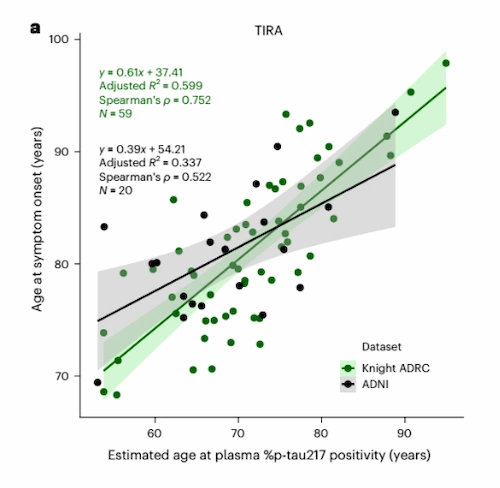
Specifically, the model was able to predict the age at symptom onset with an approximate mean error of 3 to 4 years.
In addition, the researchers observed a particularly interesting phenomenon: the age at which the biomarker becomes positive influences the rate of disease progression.
For example:
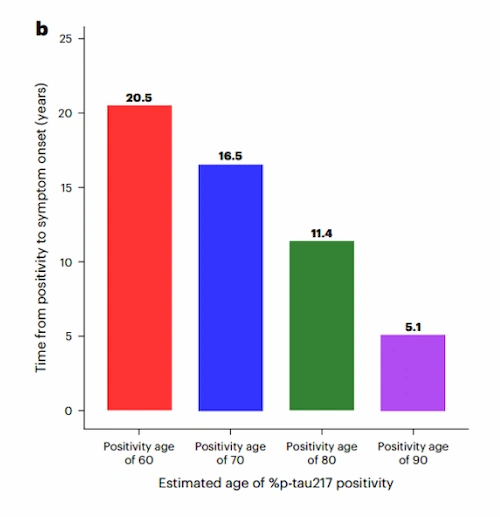
- If the biomarker becomes positive at around age 60, symptoms usually appear approximately 20 years later.
- If positivity appears at age 80, the interval until symptoms appear is reduced to about 11 years.
This suggests that the brain can tolerate the accumulation of pathology for longer when it begins at younger ages, whereas progression toward cognitive decline may be faster at older ages.
This effect is clearly shown in the following figure, which presents the mean time until symptom onset according to the age at which the biomarker becomes positive.
Overall, the models showed a significant association between the estimated age of biomarker positivity and the actual age at symptom onset, reinforcing the potential of this approach for understanding the temporal course of Alzheimer’s disease.
This relationship between when the biomarker appears and the age at symptom onset is clearly shown in the following figure.
What are the implications of this advance for research and clinical trials?
Although these models are not yet designed to predict the future of a specific person in clinical practice, they may have a very important impact on research.
One of the main challenges in Alzheimer’s clinical trials is selecting participants who will develop symptoms during the study period. If researchers can estimate more precisely when cognitive decline will appear, it will be possible to:
- Recruit participants with a greater likelihood of progression during the trial.
- Reduce the duration and cost of clinical studies.
- Assess the effect of new treatments more precisely.
In this regard, blood biomarkers could become key tools for accelerating the development of disease-modifying therapies.
How is this advance related to NeuronUP?
Advances in biological biomarkers and digital cognitive rehabilitation tools are not independent approaches, but complementary ones.
Early detection of pathology through biomarkers such as p-tau217 makes it possible to identify people in the early stages of the disease, when cognitive interventions may have a greater impact.
In this context, evidence-based cognitive stimulation platforms such as NeuronUP can play a fundamental role:
- Adapting rehabilitation programs to the stage of disease progression.
- Monitoring functional changes in the patient over time.
- Complementing biomedical advances with interventions focused on cognitive function and quality of life.
Integrating biological biomarkers with digital rehabilitation tools opens the door to a more personalized and multidisciplinary approach to Alzheimer’s disease treatment.
Conclusion
This study shows that a simple blood test based on plasma p-tau217 could help estimate the time until Alzheimer’s symptoms appear.
Although more research is still needed before these models can be applied in individual clinical practice, the findings represent an important step toward a more precise understanding of the temporal course of the disease.
As blood biomarkers continue to advance, they are likely to play a central role in early detection, clinical trial design, and the personalization of therapeutic interventions.
Combined with cognitive rehabilitation tools such as those developed by NeuronUP, these advances may contribute to a more comprehensive and effective approach to managing Alzheimer’s disease.
References
- Petersen KK, Milà-Alomà M, Li Y, Du L, Xiong C, Tosun D, Saef B, Saad ZS, Du-Cuny L, Coomaraswamy J, Mordashova Y, Rubel CE, Meyers EA, Shaw LM, Dage JL, Ashton NJ, Zetterberg H, et al. Predicting onset of symptomatic Alzheimer’s disease with plasma p-tau217 clocks. Nature Medicine. 2026. doi:10.1038/s41591-026-04206-y.
Frequently asked questions about blood biomarkers and Alzheimer’s disease
1. What is the p-tau217 biomarker, and why is it key to diagnosis?
p-tau217 is a phosphorylated form of tau protein detectable in blood plasma that has become established as one of the most reliable markers of Alzheimer’s pathology. Its importance lies in its ability to “infer” pathological protein deposits in the brain through a blood test that is much more accessible than PET.
2. How accurately can a blood test predict symptom onset?
According to the study by Petersen et al. (2026), the mathematical “clock” model developed can estimate the age at clinical symptom onset with a mean margin of error of only 3 to 4 years. This model converts the concentration of p-tau217 into an estimate of how many years have passed since detectable pathology began.
3. Can a blood test diagnose Alzheimer’s disease?
Currently, p-tau217 can “infer” brain pathology with high reliability, but it is used mainly to estimate disease progression and symptom onset, complementing the traditional clinical diagnosis.
4. How does age influence Alzheimer’s progression after a positive p-tau217 result?
The research shows that progression is slower when pathology begins at younger ages:
- If the biomarker is positive at age 60, the interval until symptoms is about 20.5 years.
- If positivity appears at age 80, the time until cognitive decline is reduced to 11.4 years.
This suggests that the brain tolerates the accumulation of pathology better when it begins earlier in life.
5. What role does cognitive stimulation play after early biomarker-based diagnosis?
Early detection through p-tau217 makes it possible to identify people when cognitive interventions have their greatest potential impact. Evidence-based platforms such as NeuronUP can:
- Adapt rehabilitation programs to the specific stage of progression detected.
- Monitor the patient’s functional changes over the long term.
- Complement biomedical advances with an approach focused on quality of life and cognitive function.





 Generalized Anxiety Disorder (GAD): Neuropsychological Profile and Clinical Assessment
Leave a Reply