
Doctoral student Marta Arbizu Gómez reveals how cellular transcriptomics uncovers molecular mechanisms and risk genes shared by Alzheimer’s and Parkinson’s disease, and their clinical impact.
This article explores how recent advances in cellular transcriptomics reveal that Alzheimer’s and Parkinson’s disease share fundamental molecular mechanisms, challenging their traditional clinical separation. By studying gene networks, the research identifies common pathological pathways—such as neuroinflammation and mitochondrial dysfunction—depending on the type of brain cell, and confirms the overlap of classic risk genes such as APOE and SNCA. These findings transform our understanding of neurodegeneration and underscore the need to take a multidimensional approach to cognitive assessment and stimulation using clinical platforms such as NeuronUP.
Are Alzheimer’s and Parkinson’s disease really that different?
Alzheimer’s disease (AD) and Parkinson’s disease (PD) have traditionally been studied as two distinct neurodegenerative disorders. Alzheimer’s is primarily associated with memory impairment, the accumulation of β-amyloid and tau, and the disruption of cortical networks related to cognition. Parkinson’s, by contrast, is characterized by motor symptoms, the loss of dopaminergic neurons, and the accumulation of α-synuclein.
However, in clinical practice and neuropathology, this distinction is not always so clear-cut. Many people with Parkinson’s develop cognitive impairment or dementia, while Lewy bodies, one of the hallmark pathological features of Parkinson’s, are also found in some brains affected by Alzheimer’s. This has prompted an increasingly relevant question:
Could Alzheimer’s and Parkinson’s disease share common biological mechanisms?
The study published in GigaScience addresses this question from an innovative perspective: analyzing not just individual genes, but gene modules that work together in different types of brain cells.

Subscribe
to our
Newsletter
How was the research conducted? Cellular transcriptomics: a new approach
To explore the molecular similarities between the two diseases, the researchers used large single-nucleus transcriptomics datasets, a technique that makes it possible to study which genes are active in individual cells from postmortem brain tissue.
Specifically, they analyzed:
- 70,634 brain nuclei from people with Alzheimer’s and control participants.
- 340,902 brain nuclei from people with Parkinson’s and control participants.
- Different cell types, including neurons, astrocytes, microglia, oligodendrocytes, and oligodendrocyte precursor cells.
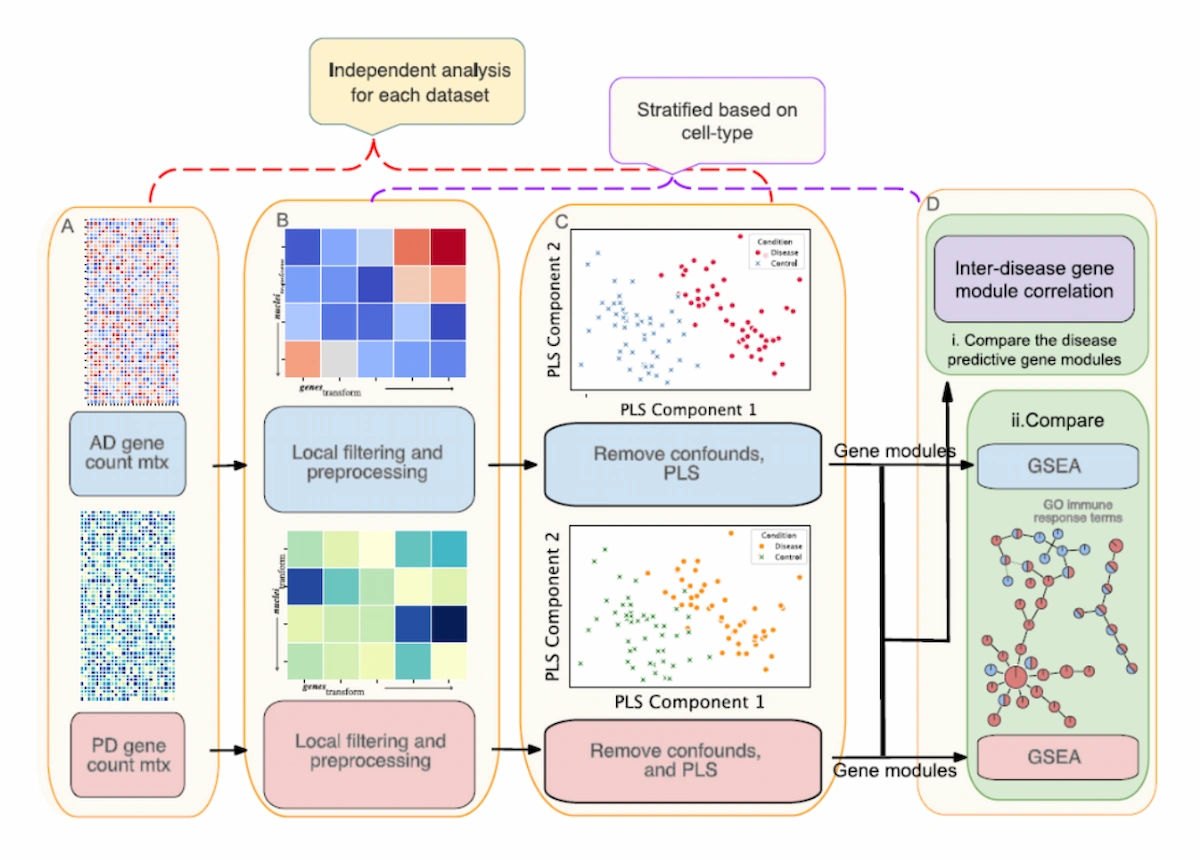
Unlike traditional gene expression studies, which typically assess genes one at a time, this study used a multivariate approach based on transcriptomic modules. In other words, the authors identified groups of genes that change in a coordinated way and can distinguish healthy brain tissue from tissue affected by disease.
They then compared the modules associated with Alzheimer’s with those associated with Parkinson’s to identify potential shared mechanisms.
What do the key findings reveal? Shared molecular mechanisms
The results show that Alzheimer’s and Parkinson’s disease share more molecular mechanisms than previously detected using traditional approaches.
One of the main findings is that the overlap between the two diseases is not uniform throughout the brain, but instead depends on cell type. This matters because the same genetic or molecular alteration can have different consequences depending on whether it occurs in a neuron, a glial cell, or a cell involved in myelination.
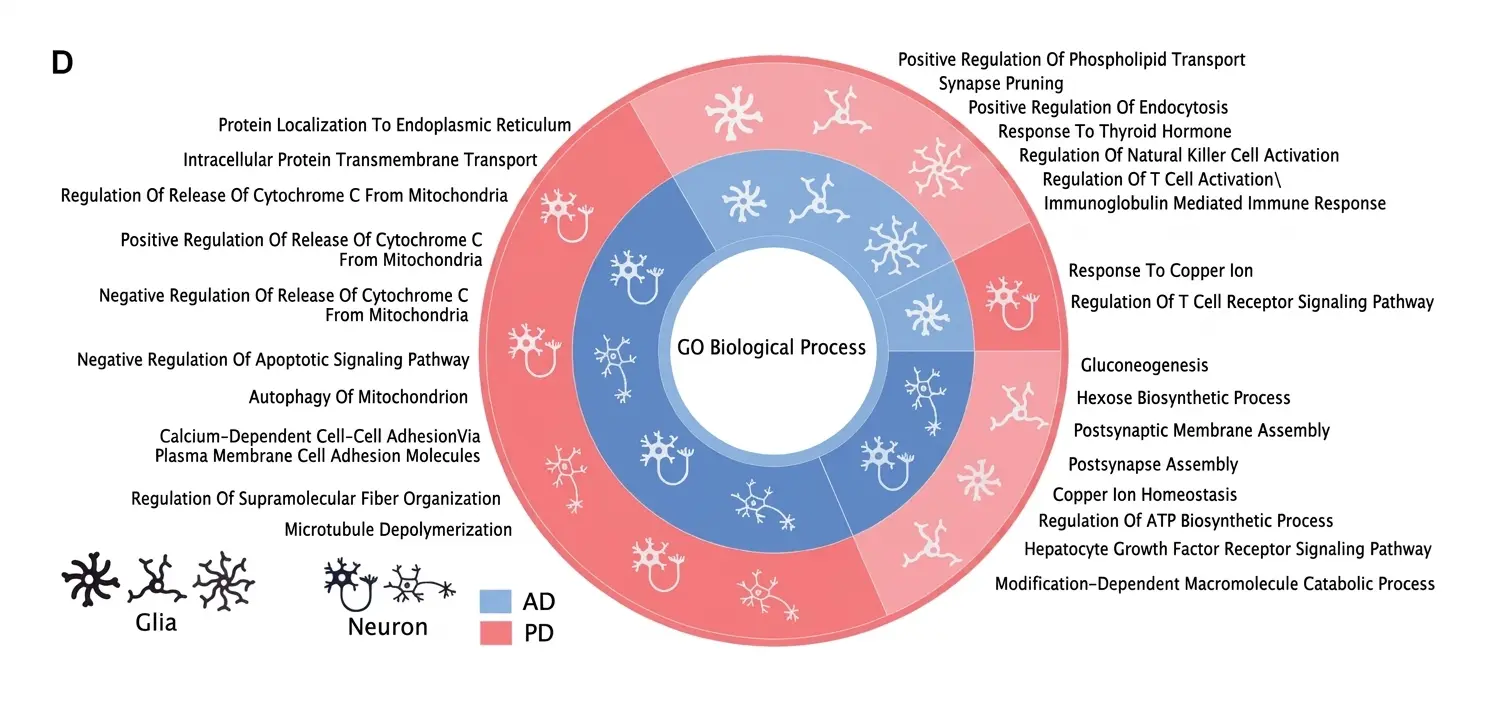
In neurons, the modules shared by Alzheimer’s and Parkinson’s disease were associated with:
- cytoskeletal alterations,
- microtubule dynamics,
- mitochondrial transport,
- mitochondrial stress,
- apoptotic processes.
These processes are essential for neuronal survival. Neurons depend on a stable internal structure and efficient energy transport along their projections. When these systems fail, vulnerability to neurodegeneration increases.
In microglia, the immune cells of the central nervous system, the authors identified common mechanisms related to:
- immune activation,
- T-cell activation,
- neuroinflammation,
- synaptic pruning,
- lipid transport.
This finding supports the idea that brain inflammation and synapse loss are relevant processes in both Alzheimer’s and Parkinson’s disease.
In oligodendrocytes, the cells responsible for producing myelin, researchers found shared alterations in processes related to myelination and axon maintenance. This suggests that loss of white matter integrity and impaired neuronal communication may be common mechanisms in both diseases.
Finally, in astrocytes, researchers observed pathways related to the processing of heavy metals such as zinc, copper, and iron, as well as oxidative stress mechanisms. These alterations could contribute to cellular damage and the accumulation of misfolded proteins.
Classic genes (APOE and SNCA): new connections
Another interesting aspect of the study is that genes traditionally associated with one disease also appear in modules related to the other.
For example, APOE, one of the best-known Alzheimer’s risk genes, was relevant not only in modules associated with Alzheimer’s, but also in modules related to Parkinson’s. Similarly, SNCA, a gene linked to α-synuclein and Parkinson’s, also appeared in modules associated with Alzheimer’s.
This does not mean that the two diseases are the same, but rather that some genes may participate in common biological networks related to neurodegeneration. The key lies not only in the gene itself, but also in its cellular context and the set of genes with which it interacts.
Why study modules instead of individual genes?
The authors compared their module-based approach with the classical analysis of differential expression. The latter identifies genes whose activity increases or decreases in the disease, but analyzes them individually.
The result was clear: the traditional analysis detected much less overlap between Alzheimer’s and Parkinson’s disease. In contrast, the module-based approach identified a broader set of shared processes.
This is especially relevant in complex diseases such as neurodegenerative diseases, in which damage is rarely caused by a single gene, but rather by altered biological networks. Studying modules offers a better understanding of how disease actually works in the brain.
Clinical implications for research and clinical practice
This study reinforces the idea that neurodegenerative diseases should not be understood as completely isolated conditions. Although Alzheimer’s and Parkinson’s have different clinical manifestations, they may share pathways of cellular damage.
From a research perspective, this opens up several possibilities:
- Identifying shared therapeutic targets across different neurodegenerative diseases.
- Better understanding why some people with Parkinson’s develop cognitive impairment.
- Studying neurodegeneration from a more integrated perspective, taking cell types, gene networks, and shared biological processes into account.
- Exploring biomarkers that are not limited to a single disease, but instead reflect common mechanisms of brain damage.
In addition, the study highlights the importance of omics techniques and advanced computational models for interpreting complex biological data. Combining transcriptomics, artificial intelligence, and neurobiology makes it possible to detect patterns that may go unnoticed using more traditional methods.
How does this advance relate to NeuronUP?
At NeuronUP, we work with cognitive rehabilitation and stimulation tools grounded in scientific evidence. Although this study focuses on molecular mechanisms, its findings have important implications for the clinical understanding of cognitive impairment.
The fact that Alzheimer’s disease and Parkinson’s disease share pathways related to inflammation, myelination, energy metabolism, and synaptic loss reinforces the need to take a multidimensional approach to neurodegeneration.
In this context, platforms such as NeuronUP can contribute through:
- Cognitive assessments across multiple domains, such as memory, attention, executive functions, language, and visuospatial skills.
- Personalized interventions tailored to each patient’s cognitive and functional profile.
- Longitudinal monitoring to track changes in cognitive performance over time.
- Multidomain intervention programs, especially relevant when different diseases share mechanisms of brain impairment.
Studies like this help connect molecular research with clinical practice, reminding us that cognitive impairment does not depend on a single process, but on the interaction among multiple biological, brain, and functional systems.
Conclusions on pathological convergence
The study shows that Alzheimer’s and Parkinson’s disease share relevant molecular mechanisms when examined from a cellular transcriptomic perspective. Similarities are particularly evident in processes related to mitochondrial function, the neuronal cytoskeleton, neuroinflammation, synaptic pruning, myelination, and oxidative stress.
These findings do not erase the differences between the two diseases, but they do challenge an overly compartmentalized view of neurodegeneration. Understanding shared mechanisms may help identify new therapeutic targets, improve patient classification, and advance more personalized interventions.
In the context of NeuronUP, these results reinforce the importance of comprehensively assessing and addressing cognition, recognizing that different diseases can converge in similar functional impairments.
References
- Bhattacharya A, Fon EA, Dagher A, Iturria-Medina Y, Stratton JA, Savignac C, Stanley J, Hodgson L, Ait Hammou B, Bennett DA, Bzdok D. Cell type transcriptomic modules reveal shared molecular mechanisms in Alzheimer’s and Parkinson’s disease. GigaScience. 2026;15:giag059. doi:10.1093/gigascience/giag059.
Frequently asked questions about cellular transcriptomics, Alzheimer’s, and Parkinson’s disease
1. What biological mechanisms do Alzheimer’s and Parkinson’s disease share?
Both neurodegenerative diseases share significant changes in mitochondrial function, the neuronal cytoskeleton, neuroinflammation, synaptic pruning, myelination, and oxidative stress. These shared mechanisms vary depending on the type of brain cell affected.
2. Why is it more effective to analyze transcriptomic modules rather than individual genes?
Analyzing cellular transcriptomic modules makes it possible to identify groups of genes (biological networks) that change in a coordinated way, rather than isolated genes. This multivariate approach has been shown to reveal substantially greater pathological overlap between Alzheimer’s and Parkinson’s disease than traditional differential expression methods.
3. How do classic genes such as APOE and SNCA function in both diseases?
Transcriptomic studies reveal significant genetic overlap: the APOE gene, a well-known risk factor for Alzheimer’s, is involved in modules associated with Parkinson’s. Conversely, the SNCA gene, typically linked to α-synuclein and Parkinson’s, is also involved in pathological networks in Alzheimer’s.
4. What role do glial cells (microglia and astrocytes) play in shared neurodegeneration?
In microglia, Alzheimer’s and Parkinson’s disease share pathways involving immune activation, neuroinflammation, synaptic pruning, and lipid transport. In astrocytes, both diseases show common alterations related to oxidative stress and the processing of heavy metals (zinc, copper, and iron), contributing to cellular damage.
5. What are the clinical implications of these findings for neurorehabilitation and cognitive stimulation?
Understanding that both diseases share pathways involving inflammation, metabolic dysfunction, and synaptic loss underscores the need to address neurodegeneration in a multidimensional way. This reinforces the value of clinical tools such as NeuronUP for implementing multidomain intervention programs and comprehensive cognitive assessments tailored to each patient’s profile.




 Spain’s New Dependency Law 2026 and Its Impact on Cognitive Rehabilitation

Leave a Reply