

Doctoral student Marta Arbizu explores how using A40-PO nanoparticles to clear beta-amyloid by modulating the blood-brain barrier opens new avenues for understanding and treating the disease.
Recent research proposes an innovative strategy for Alzheimer’s disease: modulating the blood-brain barrier with nanoparticles (A40-POs) to reactivate the clearance of beta-amyloid into the blood through the LRP1 receptor. The results show a rapid reduction in amyloid burden and sustained recovery of memory and learning. Below, we examine the key findings of this promising biomedical advance and why multidomain cognitive assessment and comprehensive neurorehabilitation remain essential to translating these findings into functional improvements for patients.
The active role of the blood-brain barrier in Alzheimer’s disease
Alzheimer’s disease (AD) is classically associated with the accumulation of beta-amyloid (Aβ) in the brain, the formation of plaques, alterations in the tau protein, and the progressive decline of cognitive functions such as memory, orientation, and executive functions.
For years, much of therapeutic research has focused on directly removing these Aβ plaques. However, clinical results have been complex and have shown that Alzheimer’s disease cannot be understood solely as a problem of protein accumulation, but rather as a broader disorder involving inflammation, vascular damage, synaptic dysfunction, and the brain’s clearance mechanisms.
In this context, the blood-brain barrier takes center stage. This barrier acts as a selective boundary between the blood and the central nervous system: it protects the brain from potentially harmful substances, while also regulating the transport of necessary molecules and the removal of waste products.
The study published in Signal Transduction and Targeted Therapy proposes an innovative idea: instead of trying to cross the blood-brain barrier to deliver a drug to the brain, could we modulate the barrier itself so that it regains its ability to clear beta-amyloid?
LRP1 receptor mechanisms in beta-amyloid clearance
One of the mechanisms involved in Aβ clearance is the LRP1 receptor, which is present in the blood-brain barrier. This receptor helps transport beta-amyloid from the brain into the blood, helping maintain the balance between production and clearance.
The problem is that this system appears to deteriorate in Alzheimer’s disease. In the animal models analyzed, the authors observed that with age and disease progression, Aβ accumulation in the brain increased and the functional availability of LRP1 in the vascular endothelium decreased. At the same time, the PACSIN2-associated transport pathway was reduced, while a Rab5-related pathway increased, which is more closely associated with degradation processes and disrupted cellular trafficking.
To understand this strategy, it is helpful to visualize LRP1’s role in the blood-brain barrier. Under appropriate conditions, this receptor can promote the transport of beta-amyloid from the brain into the blood through a PACSIN2-associated transcytosis pathway. However, when cellular trafficking is disrupted, LRP1 may be diverted to less efficient pathways, such as those associated with Rab5, reducing Aβ clearance.
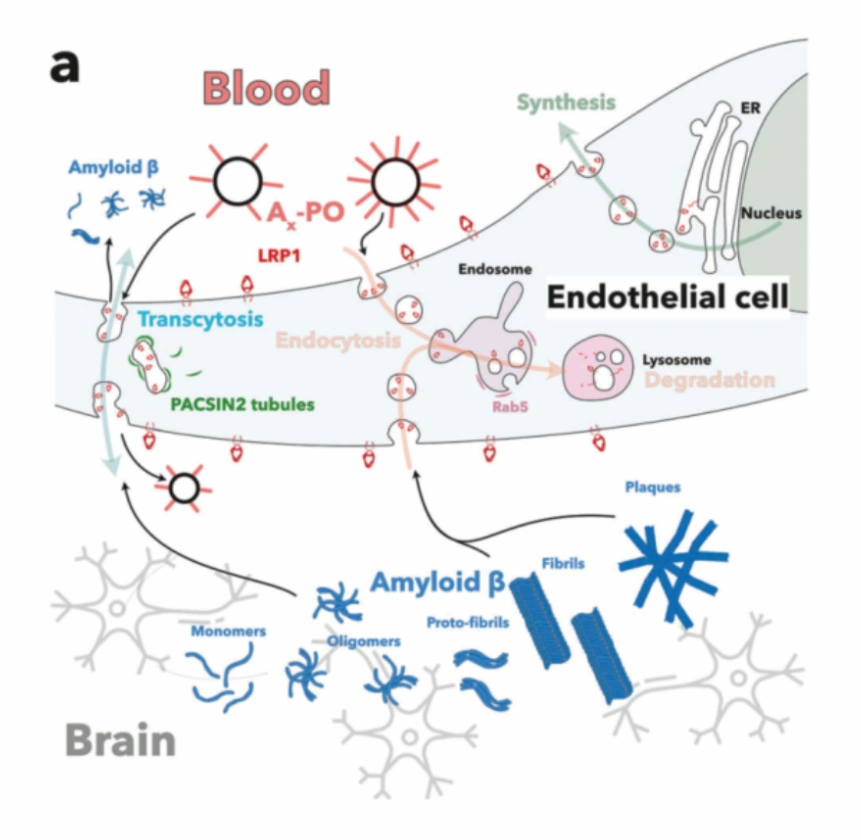
Put simply, under healthy conditions, the blood-brain barrier helps “remove” beta-amyloid from the brain. In Alzheimer’s disease, this transport machinery becomes dysregulated, allowing Aβ to become trapped and accumulate.
How was the research conducted? A40-PO nanoparticles
To try to restore this mechanism, the researchers designed nanoparticles called A40-POs. These are angiopep-2-targeted polymersomes that bind to LRP1 and are designed with a specific ligand density: neither too low nor too high.
This point is key. The authors propose that the strength of receptor binding—what they call “avidity”—determines which pathway LRP1 follows inside the cell. An excessively strong bond may favor degradation pathways, while an intermediate-strength bond may promote transcytosis, or transport across the blood-brain barrier.
Therefore, A40-POs were designed to promote intermediate binding to LRP1 and reactivate the PACSIN2 pathway, with the goal of restoring Aβ transport from the brain into the blood.
The study was conducted in APP/PS1 mice, a preclinical model of Alzheimer’s disease. The animals received A40-POs intravenously and were compared with several control groups: saline, angiopep-2 alone, polymersomes without a ligand, and polymersomes with a higher ligand density.
Key results: Reduced Aβ burden and cognitive recovery
The results were striking because of how quickly the effect occurred. Two hours after A40-PO administration, the authors observed a nearly 50% reduction in brain Aβ, along with an approximately eightfold increase in plasma Aβ. This pattern suggests that the treatment not only reduced Aβ in the brain, but also promoted its movement into the blood.
Imaging techniques confirmed this reduction. Using PET-CT, the researchers observed a clear decrease in the Aβ-associated signal after treatment. In addition, three-dimensional brain analysis showed an approximately 41% reduction in Aβ volume after 12 hours.
The results show a very clear pattern: after A40-PO administration, beta-amyloid concentration decreases in the brain and increases in plasma. This change, observed just hours after treatment, supports the hypothesis that the strategy promotes Aβ movement from the brain into the bloodstream.
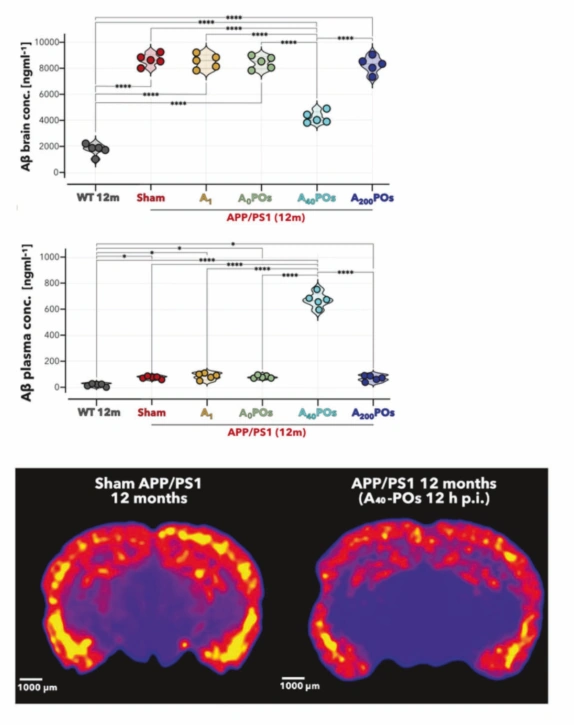
Another important finding was the partial restoration of the blood-brain barrier phenotype. After treatment, colocalization of LRP1 with endothelial cells increased, PACSIN2 increased, and Rab5 decreased. This suggests that A40-POs not only act on Aβ but also modify the vascular machinery involved in its transport.
| Outcome assessed | Main finding |
|---|---|
| Brain Aβ | Nearly 50% reduction at 2 hours |
| Plasma Aβ | Approximately 8-fold increase |
| PET-CT imaging | Significant decrease in Aβ signal |
| 3D brain imaging | Approximately 41% reduction in Aβ volume |
| Blood-brain barrier | Greater LRP1-CD31 colocalization, increased PACSIN2, and reduced Rab5 |
| Cognition | Improved learning and spatial memory |
| Duration of effect | Cognitive benefit maintained for up to 6 months |
Did this Aβ clearance lead to cognitive improvement?
One of the most important aspects of the study is that biological changes were accompanied by behavioral improvements. Mice treated with A40-POs performed better in the Morris water maze, a test used to assess learning and spatial memory.
Compared with untreated APP/PS1 mice, the animals that received A40-POs found the platform sooner, followed more efficient paths, and showed better memory for its location. In addition, their performance was similar to that of healthy mice during several phases of the experiment.
The effect also appeared to persist over time. Six months after treatment, the treated mice continued to show better cognitive performance than untreated APP/PS1 mice, with performance close to that of healthy controls.

Subscribe
to our
Newsletter
Clinical implications of the study
This study proposes a relevant conceptual shift: the blood-brain barrier should not be understood solely as a barrier that prevents drugs from entering the brain, but as an active structure that can be altered by disease and potentially repaired.
Rather than focusing only on removing plaques that have already formed, this strategy aims to restore a physiological function: the ability of the cerebral vascular system to transport and clear beta-amyloid. This opens an interesting avenue for future therapies that target not only the pathological protein but also the environment that promotes its accumulation.
However, it is important to interpret the results with caution. The study was conducted in animal models, so we do not yet know whether this strategy will be safe, effective, and applicable to people with Alzheimer’s disease. Its effects will also need to be studied in more complex models and, subsequently, in clinical trials.
How does this advance relate to NeuronUP?
This study reinforces an idea that is increasingly prominent in Alzheimer’s research: the disease must be addressed from multiple dimensions. Biomedical advances may help modify pathological mechanisms, such as beta-amyloid accumulation or vascular dysfunction, but a patient’s clinical course must also be assessed in terms of cognitive, emotional, and functional abilities.
In this context, tools such as NeuronUP can provide value in several areas:
- Multidomain cognitive assessment, making it possible to evaluate areas such as memory, attention, executive functions, language, orientation, and visuospatial skills.
- Longitudinal monitoring, tracking changes in cognitive performance over time.
- Design of personalized interventions, tailored to each patient’s profile and functional needs.
- A complement to biomedical advances, helping assess whether biological changes translate into real-world improvements in daily life.
Thus, while biomedical research advances toward new ways of modifying disease mechanisms, neuropsychology and cognitive rehabilitation remain essential to understanding the functional impact of these advances.
Conclusion
The study by Chen and colleagues proposes an innovative strategy for Alzheimer’s disease: modulating the blood-brain barrier to restore beta-amyloid clearance. In animal models, A40-POs rapidly reduced brain Aβ burden, increased its presence in plasma, partially restored vascular transport mechanisms, and were associated with sustained cognitive improvements.
Although this is preclinical research, its results open a promising avenue: treating the blood-brain barrier not as an obstacle, but as an active therapeutic target. Combined with cognitive assessment and rehabilitation tools, advances of this kind could contribute in the future to a more comprehensive and personalized approach to Alzheimer’s disease.
References
- Chen J, Xiang P, Duro-Castano A, Cai H, Guo B, Liu X, Yu Y, Lui S, Luo K, Ke B, Ruiz-Pérez L, Gong Q, Tian X, Battaglia G. Rapid amyloid-β clearance and cognitive recovery through multivalent modulation of blood–brain barrier transport. Signal Transduction and Targeted Therapy. 2025;10:331. doi:10.1038/s41392-025-02426-1.
Frequently asked questions about the blood-brain barrier, beta-amyloid clearance, and Alzheimer’s disease
1. How does the blood-brain barrier clear beta-amyloid from the brain?
Under healthy conditions, the LRP1 receptor in the blood-brain barrier acts as a transporter, promoting the movement of beta-amyloid from the brain into the bloodstream through a PACSIN2-associated transcytosis process. In Alzheimer’s disease, this clearance system becomes dysregulated.
2. What are A40-PO nanoparticles, and what is their function in Alzheimer’s disease?
A40-POs are polymersomes (nanoparticles) targeted to the LRP1 receptor through angiopep-2 and designed with intermediate “avidity,” or binding strength. Their therapeutic goal is to reactivate the vascular transport machinery so it can efficiently remove beta-amyloid accumulated in the brain and move it into the blood.
3. Does reducing brain beta-amyloid lead to real cognitive improvements?
In preclinical studies with APP/PS1 mice, A40-PO administration reduced beta-amyloid volume by 41%. This resulted in significant behavioral improvement on learning and spatial memory tasks, with cognitive benefits maintained for up to six months after treatment.
4. Why is comprehensive cognitive assessment needed for these new drugs?
Although biomedical therapies modify underlying pathological mechanisms, such as protein accumulation or vascular dysfunction, multidomain assessment tools such as NeuronUP are essential for determining whether these cellular changes lead to measurable functional and cognitive changes in the patient over time.




 How to Protect Your Brain Throughout Life and Reduce Dementia Risk

Leave a Reply