

Marta Arbizu Gómez analyzes the efficacy and safety of monoclonal antibodies against beta-amyloid in the treatment of Alzheimer’s disease; a review of the scientific evidence examining their real-world clinical impact against the expectations of professional neurorehabilitation.
Marta Arbizu Gómez analyzes a systematic review published in the Cochrane Database of Systematic Reviews (2026) on the efficacy and safety of monoclonal antibodies targeting beta-amyloid in people with mild cognitive impairment or mild dementia due to Alzheimer’s disease. Despite the high level of scientific expectation, the research reveals that the clinical benefit of these drugs is modest and limited in daily life, opening a debate about the “amyloid paradox.” The article examines these results, associated risks, and the need to integrate these biological treatments with professional cognitive rehabilitation strategies to optimize patient independence.
Why do we need disease-modifying treatments for Alzheimer’s disease?
Alzheimer’s disease (AD) is the leading cause of dementia worldwide and one of the greatest public health challenges. Despite decades of research, most treatments available to date have been symptomatic; that is, they help relieve symptoms but do not slow disease progression.
In this context, monoclonal antibodies targeting beta-amyloid (Aβ) have generated considerable expectation. These drugs are designed to remove amyloid plaques from the brain, one of the most relevant biological features of Alzheimer’s disease.
The key question is:
Does removing amyloid translate into a real improvement for patients?
The systematic review published in 2026 in the Cochrane Database of Systematic Reviews addresses this question directly.
How was the research conducted?
To answer this question, the authors conducted a systematic review of randomized phase 3 clinical trials in people with:
- Mild cognitive impairment (MCI) due to Alzheimer’s disease,
- mild dementia due to Alzheimer’s disease.
Only studies lasting at least 12 months were included, allowing both benefits and risks to be assessed in a slowly progressive disease.
The treatments analyzed include some of the most relevant drugs in recent research and clinical practice:
- Aducanumab,
- Lecanemab,
- Donanemab,
- Gantenerumab,
- Crenezumab,
- Solanezumab.
The outcomes assessed were especially relevant to clinical practice:
- Cognitive function,
- dementia severity,
- functional ability,
- adverse effects (including ARIA),
- mortality.

Subscribe
to our
Newsletter
What do the key results reveal?
Clinical benefit: modest and limited
The results show that anti-amyloid antibodies may produce some benefits in cognitive and functional outcomes, but these are small and, in many cases, of limited clinical relevance
This suggests that, although the biological mechanism is promising, its impact on patients’ daily lives remains modest.
Safety: no major differences in serious events
Regarding safety, the data are relatively reassuring:
- Serious adverse events: no clear differences versus placebo (RR ≈ 1.03),
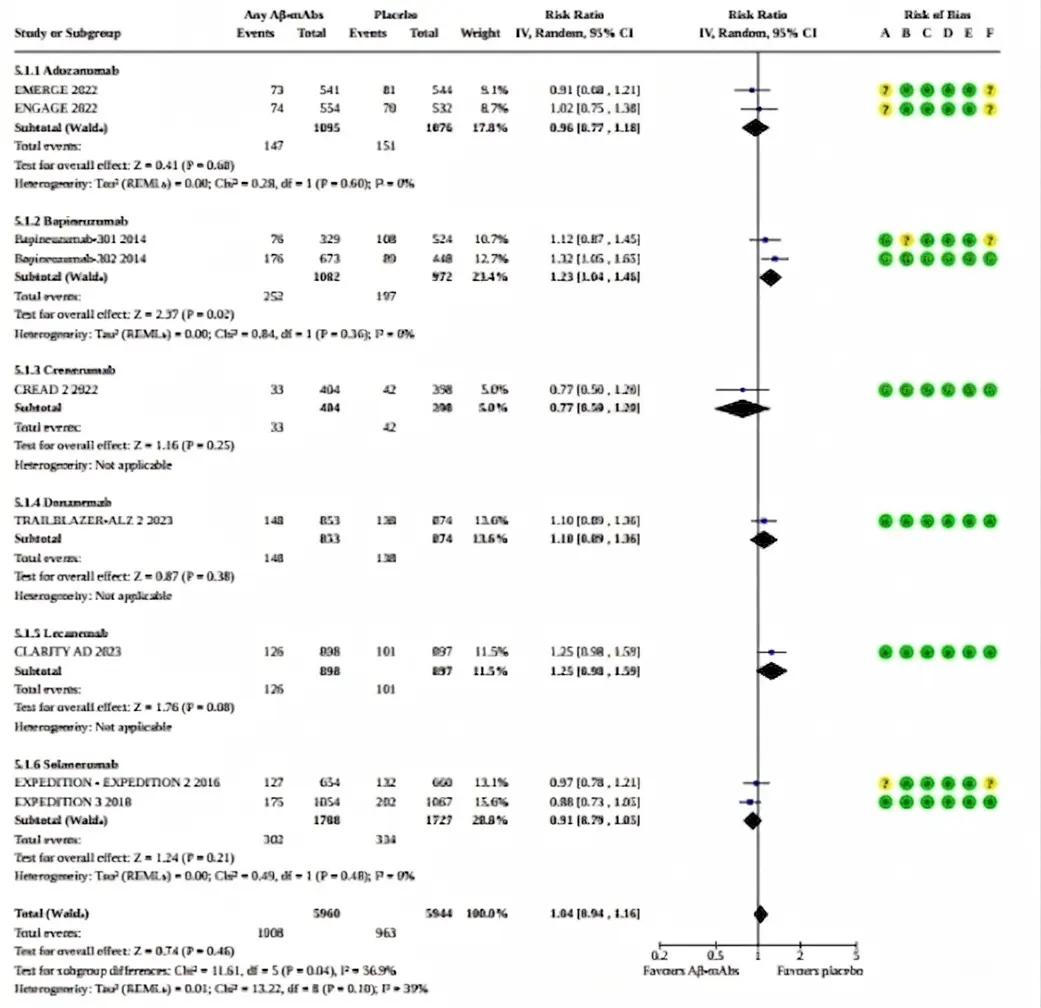
- Mortality: no significant differences were observed either (RR ≈ 1.17).
This indicates that, overall, these treatments do not clearly increase the risk of death or serious events, although monitoring is required for specific effects such as amyloid-related imaging abnormalities (ARIA).
This lack of differences in mortality is observed consistently across the included clinical trials:
The amyloid paradox
One of the most relevant findings is the so-called “amyloid paradox”:
- The drugs remove beta-amyloid plaques from the brain,
- But this does not translate into proportional clinical improvements.
In other words, modifying a biological marker does not necessarily imply a significant change in the clinical progression of the disease.
What are the implications for clinical practice?
These results have important implications:
Careful patient selection
For the neuropsychologist assessing patients with MCI or mild dementia, these data have a direct implication: if a patient is receiving or considering lecanemab or donanemab, cognitive intervention is not complementary—it is essential. The drugs produce statistically detectable but subclinical effects on the ADAS-Cog and CDR-SB scales. Cognitive rehabilitation acts precisely on the functional gaps that the drug does not close: attention, working memory, and instrumental activities of daily living. The combination is not a future option; it is the clinically coherent practice today.
Realistic expectations
It is essential to explain to patients and families that these treatments:
- Do not cure the disease,
- Do not completely stop its progression,
- Offer modest benefits.
Assessing the benefit-risk balance
Given the cost, the need for monitoring, and the limited effect, the treatment decision should be individualized.
How does this advance relate to NeuronUP?
At NeuronUP, we work on developing tools for cognitive rehabilitation based on scientific evidence. These types of biomedical advances fit directly with our vision of comprehensive treatment.
Anti-amyloid antibodies may:
- Act on the biological basis of the disease,
- Slow deterioration, even if only modestly.
Meanwhile, NeuronUP helps to:
- Optimize the patient’s cognitive function,
- Maintain independence for as long as possible,
- Personalize the intervention according to the cognitive profile.
The combination of biological treatments + cognitive intervention represents the future of Alzheimer’s care.
Conclusion
Monoclonal antibodies targeting beta-amyloid represent an important advance in Alzheimer’s research. However, this Cochrane review shows that:
- Their clinical impact is limited,
- They do not clearly reduce mortality or serious events,
- There is a disconnect between biological effect and clinical benefit.
Overall, these results call for a cautious yet hopeful approach in which pharmacological treatments are integrated with nonpharmacological strategies, such as cognitive rehabilitation, to provide more comprehensive and effective care.
References
- Nonino F, Minozzi S, Sambati L, Del Giovane C, Baldin E, Bassi MC, De Santis C, Gonzalez-Lorenzo M, Vignatelli L, Filippini G, Richard E. Amyloid-beta-targeting monoclonal antibodies for people with mild cognitive impairment or mild dementia due to Alzheimer’s disease. Cochrane Database of Systematic Reviews. 2026; Issue 4. Art. No.: CD016297. doi:10.1002/14651858.CD016297.
Frequently asked questions about Do Anti-Amyloid Antibodies Really Work for Alzheimer’s? Evidence, Benefits, and Risks
1. What is the “amyloid paradox” mentioned in the study?
It refers to the finding that, although monoclonal antibodies successfully remove beta-amyloid plaques from the brain, thereby achieving their biological objective, this does not translate into a proportional or significant clinical improvement in daily life or in the progression of the patient’s disease.
2. What are the main risks or adverse effects of these drugs?
Although the Cochrane review indicates that there are no significant differences in overall mortality versus placebo, these treatments require ongoing monitoring because of the risk of developing amyloid-related imaging abnormalities (ARIA), such as microhemorrhages or cerebral edema.
3. Which patients should be considered for this type of treatment?
Given that the clinical benefit is modest and the cost and risk are considerable, extremely careful selection is required. Use appears to be most relevant in very early stages (mild cognitive impairment or mild dementia), and the decision should be fully individualized.
4. How does NeuronUP complement the arrival of these new drugs?
The drugs act on the biological basis of the disease, but nonpharmacological intervention is essential. NeuronUP tools help optimize remaining cognitive function and personalize rehabilitation, allowing the combination of biological therapy and cognitive stimulation to provide a comprehensive and more effective approach.
If you enjoyed this blog post about Do Anti-Amyloid Antibodies Really Work for Alzheimer’s? Evidence, Benefits, and Risks, you may also be interested in these NeuronUP articles:





 Meet Carolina Sastre, the Clinical Rigor and Heart Behind NeuronUP
Leave a Reply