

Occupational therapist and University of Burgos professor Olalla Saiz, together with several of her students, proposes a cognitive intervention program for people with Williams syndrome.
What is Williams syndrome?
Williams syndrome is a neurodevelopmental disorder caused by missing genetic material on chromosome 7. It is a rare genetic disease, affecting 1 in every 7,500 newborns, according to the Williams Syndrome Association of Spain.
Characteristics of Williams syndrome
- Typical facial features:
- Starburst pattern in the iris,
- narrow forehead,
- fold at the inner corner of the eye,
- short, upturned nose,
- full lips,
- relatively small chin,
- full, slightly sagging cheeks,
- prominent periorbital area.
- Intellectual disability,
- Hypercalcemia (high blood calcium levels) in childhood
- 75% of cases have stenosis (abnormal narrowing) of some blood vessels.
Neurological and behavioral aspects
The main neurological and behavioral aspects of this disorder are:
- Cognitive deficit (mild to moderate),
- impaired executive functions (attention, working memory, planning, problem-solving, cognitive flexibility, inhibition, etc.),
- developmental delay from an early age (developmental milestones are reached later),
- friendly personality: enthusiastic, uninhibited, and sociable,
- tendency toward anxiety,
- sensory integration difficulties (visual, auditory, olfactory, tactile, gustatory, proprioceptive, and vestibular),
- learning difficulties at school (in learning to read and write, logical-mathematical concepts, visuospatial orientation, and processing speed),
- attention difficulties, sometimes combined with impulsivity and hyperactivity.
Cognitive intervention program for people with Williams syndrome
Goals of the cognitive intervention in children with ASD
The main goals of the cognitive intervention program for people with Williams syndrome that we propose are:
- Improve visuospatial function,
- improve sustained attention.
Structure of the intervention session
- There is a 45-minute session to work with a group of 6 users, with 4 therapists assisting.
- The session begins by explaining that they will be working with tablets and how the tablets work.
- The aim is for them to develop and work on sustained attention and visuospatial orientation through playful activities.
- The session is divided into 4 activities, whose difficulty can be increased or decreased.
Schedule
Below, we explain the two ways the session can be organized; the best option will be chosen for each individual:
| Option 1 | Option 2 |
|---|---|
| 5 minutes of explanation | 5 minutes of explanation |
| 4 activities of 10 minutes each | 4 activities of 10 minutes each |
The main reason for this division is that each activity has different levels, so a user can progress through different phases. Or, if they don’t enjoy the game or find it frustrating, they can switch to another activity.
All the games are beneficial for the user, so none is more important or takes priority over another.
The goal of the session is for the user to participate, enjoy themselves, and work on the functions mentioned.
Cognitive stimulation activities for people with Williams syndrome
Below, we explain in detail the activities chosen for the NeuronUP session:
1. The Neighbor’s Garden
What does it involve?
The first activity in the cognitive intervention program for people with Williams syndrome that we propose is The Neighbor’s Garden.
What does this activity work on?
This activity works on spatial relations.
Play by levels
The game is divided into 12 phases, with phase 1 being the easiest and phase 12 the hardest. The user moves up or down a level automatically based on their correct answers and mistakes, with three lives per phase.
2. Intertwined
What does it consist of?
This activity involves forming a geometric shape by moving its vertices so that none of its sides cross.
What does this activity do?
It’s ideal for working on spatial visualization and planning.
Play by levels
The game is divided into 9 phases, with phase 1 being the easiest and phase 9 the hardest. The user moves up or down a level automatically based on their correct answers and mistakes.
3. Organize the Bookcase
What does it consist of?
It involves copying the position of the objects in the model. However, you have to be careful when copying, since the bookcase is a mirror image, so the model has to be copied in reverse.
The model is on the right, and the bookcase to organize is on the left. Could your user do it?
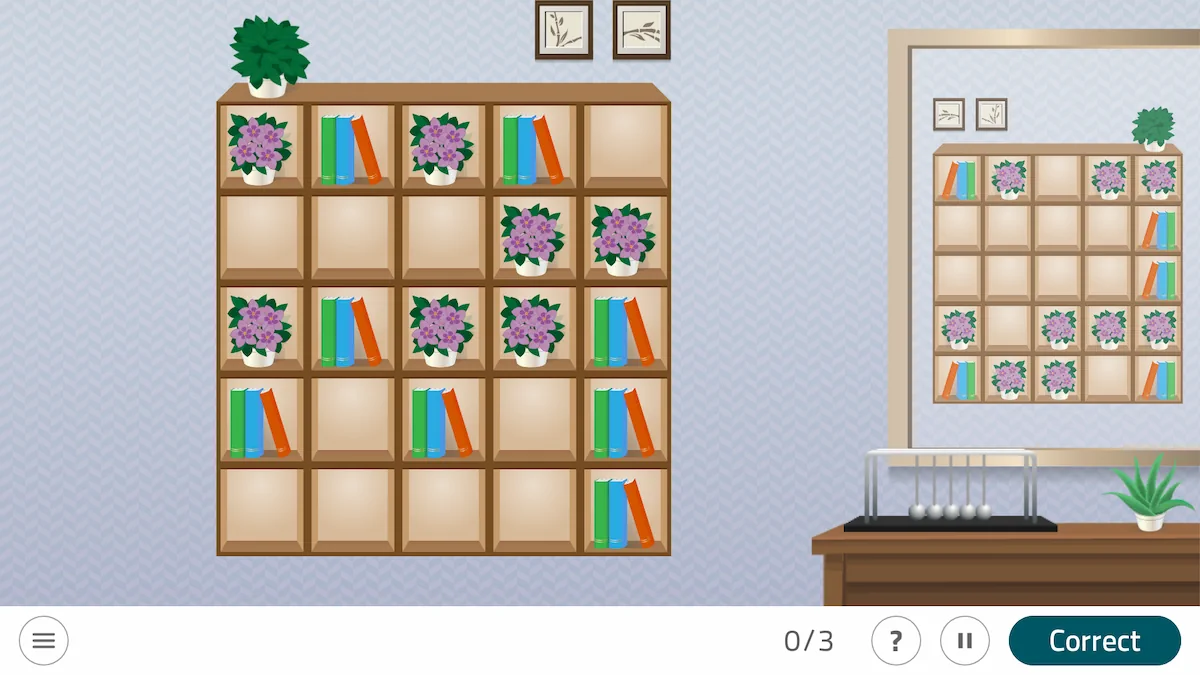
This is how it should look:
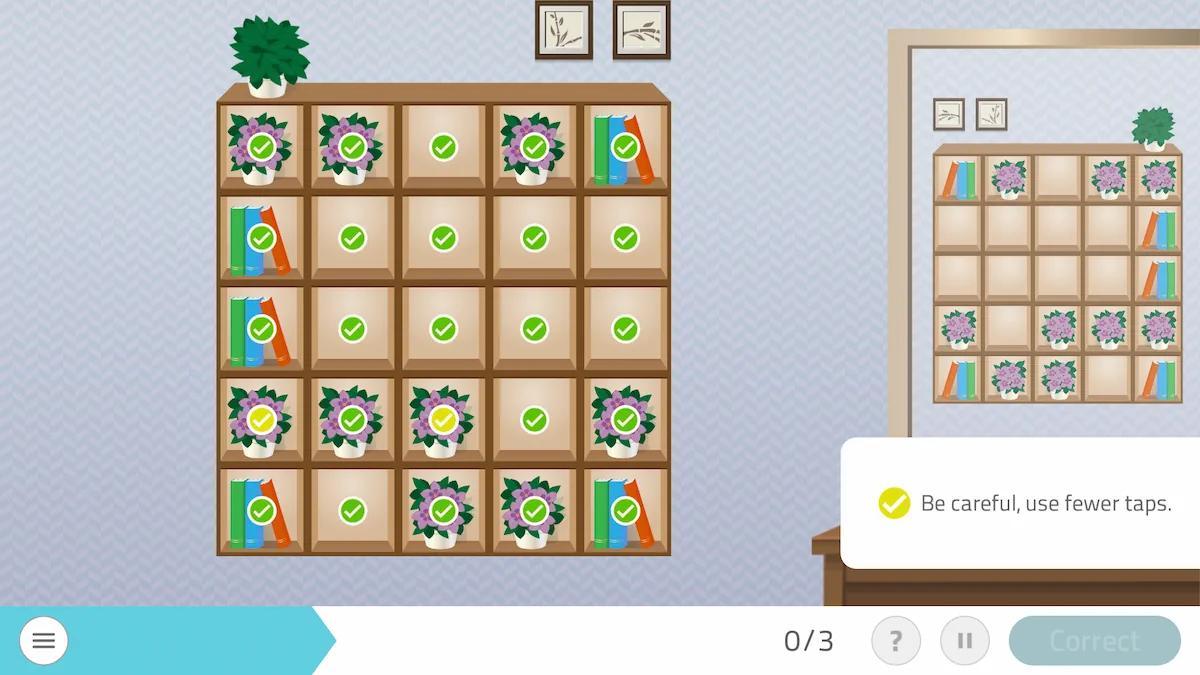
What does this activity do?
This activity is designed to work on the recovery of sustained attention, spatial relations, selective attention, and hemineglect.
Play by levels
The game is divided into 12 phases, with phase 1 being the easiest and phase 12 the hardest. The user moves up or down a level automatically based on their correct answers and mistakes.
4. Copy Letter Matrixes
The last activity in the cognitive intervention program for people with Williams syndrome that we propose is Copy Letter Matrixes.
What does it consist of?
This NeuronUP exercise involves copying the content of one grid into another, specifically copying letters from one grid to another. It isn’t just copying meaningless symbols; it helps the user become familiar with the shapes of letters or reinforce their knowledge of them.
What does this activity do?
It works on sustained attention.
Customizing the activity
You can adapt the activity to fit each user’s needs. You can edit:
Parameters
- Grid size,
- number of empty squares,
- different colors.
General settings
You can also configure general settings, such as the mode of operation (correction or free mode and maximum number of errors allowed), the maximum time, whether or not to show a visible timer for the activity, and an inactivity alert. You can also edit the instructions.
In addition to Olalla Saiz, Nora Ferreriro, Iria Mancha, Laura Menéndez, and Celia Nalda contributed to this article.
If you enjoyed this post on the cognitive intervention program for people with Williams syndrome, we recommend taking a look at these posts:





“This article has been translated. Link to the original article in Spanish:”
Programa de intervención cognitiva para personas con el Síndrome de Williams

 NeuronUP Forecasts Cognitive Decline Risk One Year Earlier

Leave a Reply