
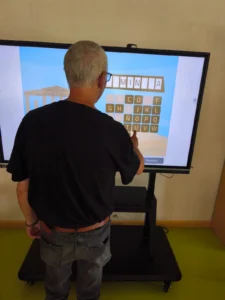
Óscar and Verónica, Educator and Occupational Therapist at the Espartales Sur Residence, explain how they approach personalized cognitive stimulation in people with severe mental illness from a multidisciplinary perspective, using digital tools such as NeuronUP.
About the Espartales Sur Residence in Alcalá de Henares
The Espartales Sur Residence is part of the public Social Care Network for people with severe and long-lasting mental illness of the Community of Madrid. It is a specialized centre that offers a safe, structured environment for people who need ongoing support in their recovery process and in managing their condition.
Objectives of the Espartales Sur Residence
Its main objectives are:
- To provide accommodation, board, care and support, as well as help in improving personal and social autonomy.
- To offer supervision and support 24 hours a day, in a living environment that is as homelike and normalized as possible.
- To offer the personal and social care and support residents need in order to improve their situation and quality of life.
- To enable the process of psychosocial rehabilitation and community integration, supporting the development of their personal and social autonomy as far as possible.
- To prevent situations of helplessness or lack of social and emotional support, helping residents to rebuild social ties or create new ones.
- To make it possible for residents to remain in the community in the best possible conditions.
The atmosphere of the residence is fundamental. The aim is to create a safe, respectful and supportive environment where residents feel valued and understood. There are house rules designed to guarantee everyone’s wellbeing, promoting individual responsibility and peaceful coexistence.
Profile of the users of the Espartales Sur Residence
The Espartales Sur Residence takes in people with mental health conditions such as schizophrenia, bipolar disorder, severe depression and personality disorders, among others, who may have significant difficulty living independently or who require constant supervision. Users are usually referred by Mental Health Services following an assessment of their needs.
Residents at Espartales Sur are between 18 and 65 years old. All of them have been diagnosed with a severe and long-lasting mental illness. The centre currently houses a total of 30 people: 11 women and 19 men.
Team of the Espartales Sur Residence
We are an interdisciplinary team made up of:
- Psychologist: provides individual and group therapy, emotional support and coping strategies.
- Occupational therapist: supports residents in activities of daily living so they gain autonomy, and helps them find meaningful activities.
- Educators: facilitators of wellbeing, autonomy and inclusion, accompanying each person through their rehabilitation process and the improvement of their quality of life.
- Management: responsible for running and organizing the centre, supervising the team and fostering a therapeutic, inclusive environment.
- Administration: responsible for the viability, efficiency and regulatory compliance of the institution.
Programs and activities of the Espartales Sur Residence
Life in the residence is designed to be structured and therapeutic. Daily routines are established that include:
- Individual and group therapies, such as art therapy, music therapy or sport.
- Psychosocial rehabilitation activities, such as cognitive stimulation workshops, household management, social skills and assertive communication.
- Occupational and leisure activities, such as group outings to encourage social interaction.
- Promotion of autonomy, through training in basic and instrumental activities of daily living (ADLs) or by gradually withdrawing support, among other approaches.
Rehabilitation and recovery process at the Espartales Sur Residence
The ultimate goal is the rehabilitation and recovery of residents. Length of stay varies depending on each person’s needs. We work with every resident on an individualized recovery plan that takes their goals and strengths into account. Progress is reviewed regularly and adjustments are made as needed, always with functionality and autonomy in mind.
In short, the Espartales Sur Residence is a space for comprehensive care, rehabilitation and constant support, designed to help residents manage their illness, develop their abilities and live as full and inclusive a life as possible.

Subscribe
to our
Newsletter
Cognitive stimulation program for severe mental illnesses at the Espartales Sur Residence
The purpose of cognitive stimulation is to slow cognitive decline and maintain and/or strengthen preserved abilities. It can be applied in neurodegenerative and mental illnesses and in normal ageing.
After our assessments and through direct observation, we found that cognitive functions are a very common need to work on among residents.
The aim is for the cognitive training carried out in this programme to transfer to the user’s everyday activities and tasks.
Cognitive stimulation with NeuronUP at the Espartales Sur Residence
The rehabilitation platform NeuronUP has helped us optimize our work, because it allows us to run individualized sessions and to prepare and schedule them in advance. It also makes it possible to adapt the complexity of the activities and to track the results obtained.
The application adapts to the different resident profiles, strengthening the various cognitive areas and always adjusting the level to each person. The platform’s format is simple and intuitive and, because it can be used on different electronic devices, it is easy to use and motivating for participants.
At our centre, NeuronUP is used in the Occupational Therapy and Education areas, mainly in individual sessions. Each session focuses on one cognitive area (attention, memory, language, executive functions, etc.) and consists of 5 exercises lasting 3 minutes each.
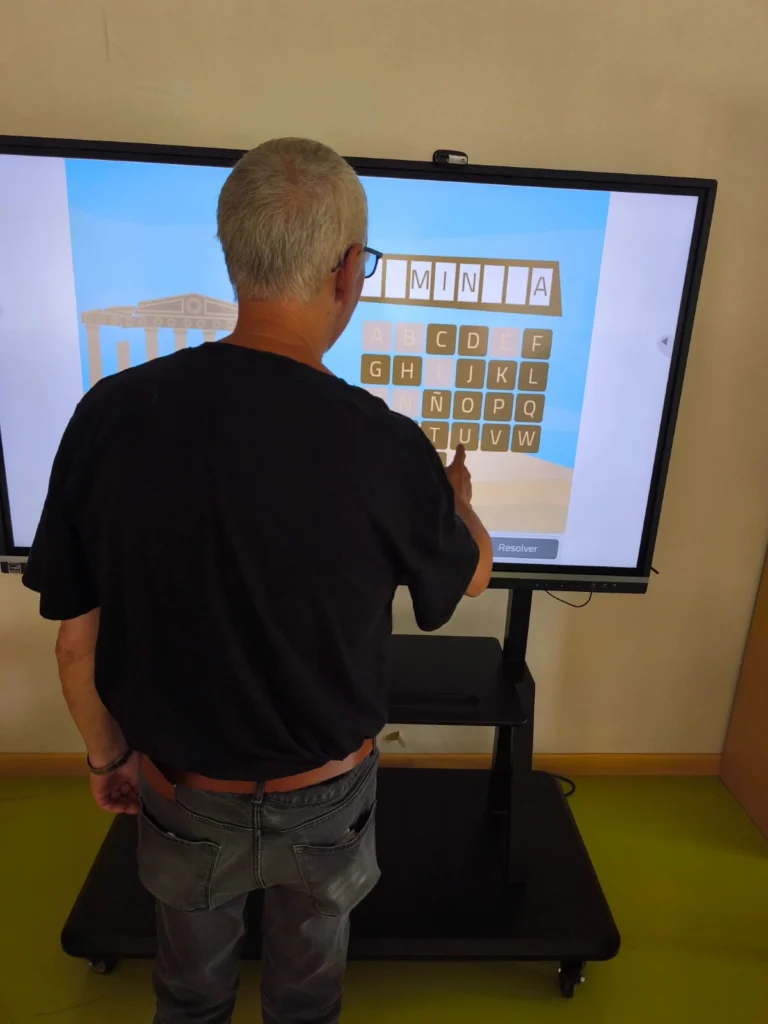
Exercises are chosen based on the results obtained in previous sessions, on how meaningful they are for participants and, above all, on the area we want to work on.
The results of each session are recorded in the database and, if a participant struggles with an exercise or is unable to complete it, the professionals running the workshop will adapt that session for the next time it is delivered.
Example of a session with NeuronUP
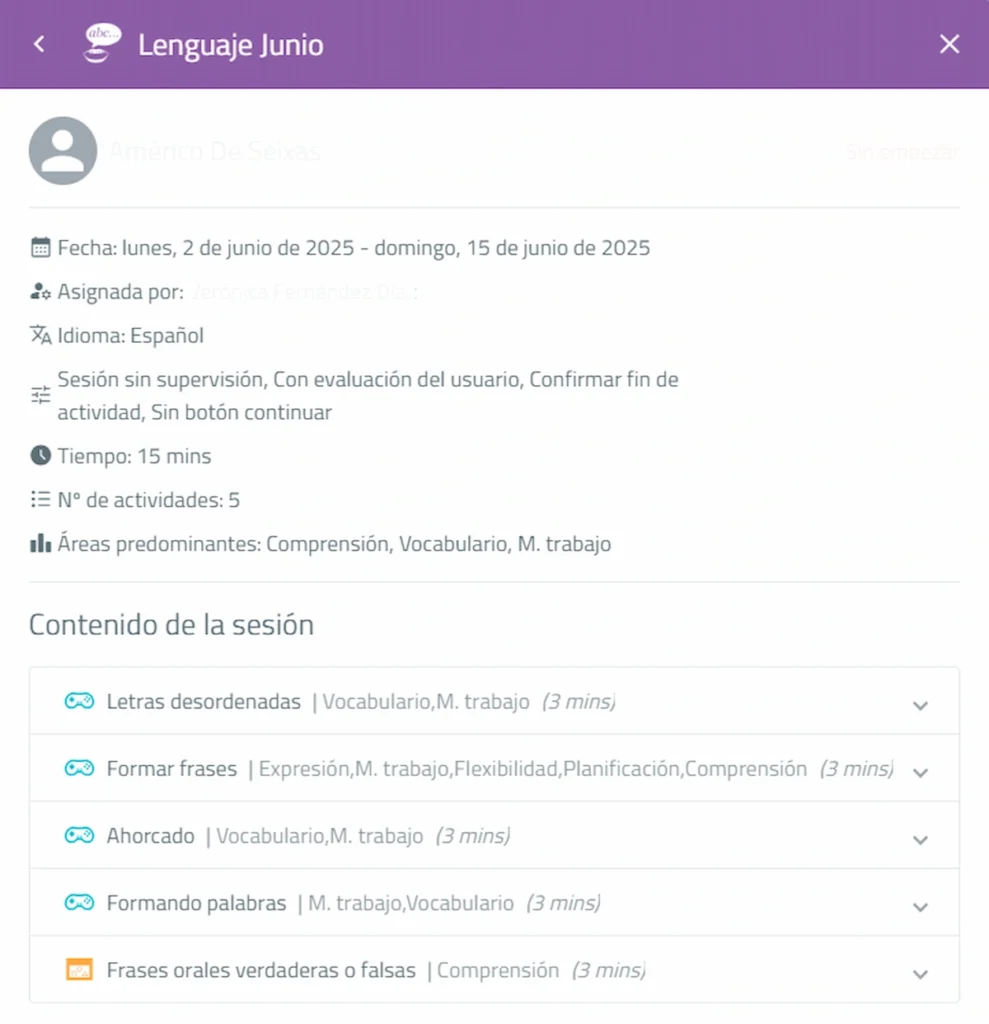
In this case, the session targets the language area, although other areas such as vocabulary and working memory also feature heavily. As explained above, the session lasts 15 minutes and consists of 5 exercises of 3 minutes each.
The NeuronUP activities used in this session focused on language are:
- Word Scramble, a game in which the letters shown must be rearranged to form a word. It is designed to work on vocabulary and working memory.
- Form Sentences, an activity in which users have to order the words shown to build coherent syntactic structures. It trains working memory, flexibility, planning and comprehension.
- Hangman, a game in which hidden words must be guessed by choosing their letters one by one. As with the first activity, it works on vocabulary and working memory.
- Making Words, an activity that involves forming words by arranging fragments, syllables and individual letters. It works on working memory and vocabulary.
- True or False (Auditory), comprehension worksheets in which users say whether the sentences presented aloud are correct or incorrect compared with the image shown.
People at our centre take part in short sessions because some of them have difficulty concentrating, which in our view is a factor that has a negative impact on their level of participation.
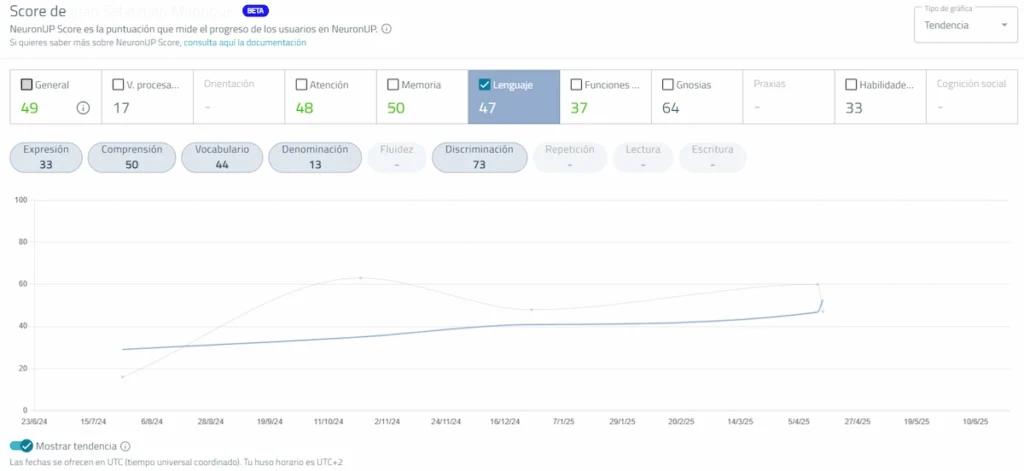
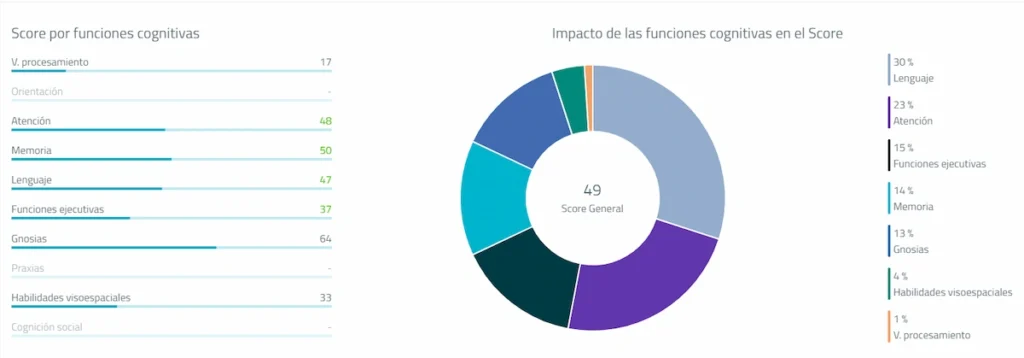
Professionals can analyse users’ results in order to adapt the therapy according to their progress, supporting a continuous, structured intervention. Sessions are organized so that we can reinforce the cognitive areas that are most affected. In addition, thanks to the application’s digital results section, we can assess each participant’s progress over time.
Conclusion
Professionals can analyse users’ results in order to adapt the therapy according to their progress, supporting a continuous, structured intervention. Sessions are organized so that we can reinforce the cognitive areas that are most affected. In addition, thanks to the application’s digital results section, we can assess each participant’s progress over time.
If you enjoyed this blog post about the personalized cognitive stimulation in people with severe mental illness: Espartales Sur Residence, you will likely be interested in these NeuronUP articles:



“This article has been translated. Link to the original article in Spanish:”
Estimulación cognitiva personalizada en personas con enfermedad mental grave: Residencia Espartales Sur

 HRV Biofeedback to Improve Cognition in Older Adults: An Evidence-Based Tool

Leave a Reply