

In this article, we suggest some cognitive rehabilitation activities after acquired brain injury.
Acquired brain injury is damage to brain cells that occurs after birth. It can have a variety of causes and, depending on where the damage is located, different processes will be affected.
Characteristics of acquired brain injury
It is characterized by its sudden onset and by the wide range of after-effects it causes, depending on the area of the brain injured and the severity of the damage. These after-effects lead to perceptual abnormalities and physical, cognitive, and emotional impairments. It’s also worth noting that it does not affect a developing brain (children) in the same way as a fully developed brain (adults).
Causes of acquired brain injury
The main cause of brain injury is stroke, followed by traumatic brain injury and conditions such as anoxia, brain tumors, or infections.

Subscribe
to our
Newsletter
Cognitive rehabilitation activities after acquired brain injury
NeuronUP’s cognitive stimulation program allows neuropsychologists, occupational therapists, and speech-language pathologists to adapt each activity to the specific characteristics and needs of people who have suffered a brain injury.
The examples of cognitive rehabilitation activities after acquired brain injury described here were developed by NeuronUP and designed to train cognitive functions:
1. Get Dressed
How do you play?
This activity involves dressing the silhouette appropriately, taking into account both where and in what order each garment goes and the type of situation.
Play by levels
There are 6 phases. At the easier levels, there are fewer commands and more prompts from the program to complete the activity correctly, while at the harder levels there are fewer prompts and the clothing requirements are more complex.
Customizing the activity
You can also customize the activity to suit each user’s abilities.
Parameters
On the other hand, there are the parameters, where you can select the number of garments, the setting, whether to add any kind of distractor, the errors that can be made, how the garments are presented, and more.
General settings
On the one hand, you can adjust the general settings, such as the number of exercises, the maximum time, whether or not to show a visible timer for the activity, editing the instructions, and more.
Adaptability
Finally, you can choose whether the garments are moved by dragging or simply by tapping on the garment to select it. You can choose one option or the other depending on the user’s functional abilities.
What does this activity work on?
This cognitive stimulation exercise works on the following cognitive functions:
- Decision-making,
- body schema,
- planning,
- dressing.
2. Emotion recognition
How do you play?
This activity involves recognizing the emotions shown and matching them with the terms that describe them.
What does this activity work on?
This activity is designed to work on the following cognitive functions:
- Social cognition,
- vocabulary,
- reasoning.
Format
This exercise is also available in both digital and paper format.
3. Form Sentences
How do you play?
This game involves putting the words shown in order to form coherent syntactic structures.

Play by levels
At the easier levels, sentences will have only two or three words, while at the harder levels the user will need to be able to form a sentence with a large number of words.
Customizing the activity
You can also customize the activity to suit each user’s abilities.
General settings
On the one hand, you can adjust the general settings, such as the number of exercises, the maximum time, whether or not to show a visible timer for the activity, editing the instructions, and more.
Parameters
On the other hand, there are the parameters, where you can select the number of words and the number of hints given.
Adaptability
Finally, you can choose whether the words are moved by dragging or simply by tapping on the word to select it. You can choose one option or the other depending on the user’s functional abilities.
What does this activity work on?
The activity Form Sentences is designed to work on the following cognitive functions:
- Expression,
- comprehension,
- flexibility,
- working memory,
- planning.
4. Maze with Alternating Instructions
How do you play?
In this activity, you have to go through a maze of figures following different instructions alternately.
Instructions for the following example:
Get from the starting point to the target by alternating these rules to move forward:
- Same letter, but different size,
- same size, but different letter.
*You can’t move diagonally or repeat squares.

What does this activity work on?
This worksheet works specifically on attention:
- Alternating attention,
- selective attention.
Format
This exercise is also available in both digital and paper format.
5. Task Sequencing
How do you play?
In this worksheet, you have to put in order the different steps needed to carry out an activity. In the following example, you have to put in order the steps for washing your face after waking up:
Text version
Task Sequencing is also available with text. In this case, you have to put in order the steps for doing laundry.
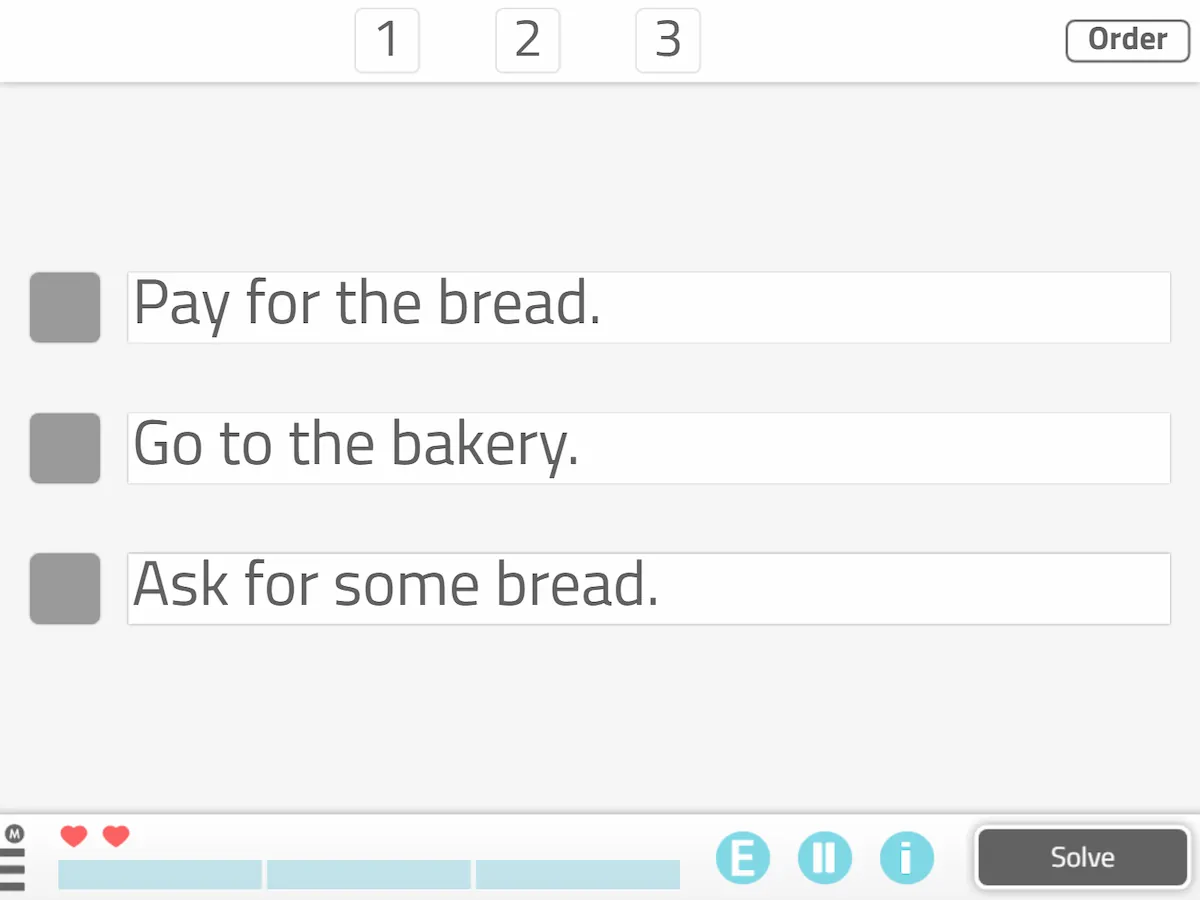
What do these two activities work on?
These two exercises for putting the steps of activities in order work on:
- Planning,
- reasoning,
- comprehension (text exercise).
Format
Both can be done in digital and paper format.
Don’t forget: All activities of daily living can be broken down into steps!
If you enjoyed this article on cognitive rehabilitation activities after brain injury, you may also be interested in the following:
“This article has been translated. Link to the original article in Spanish:”
Actividades de rehabilitación cognitiva tras un daño cerebral adquirido

 Motor learning: what it is, factors, methodology, and objective

Leave a Reply