

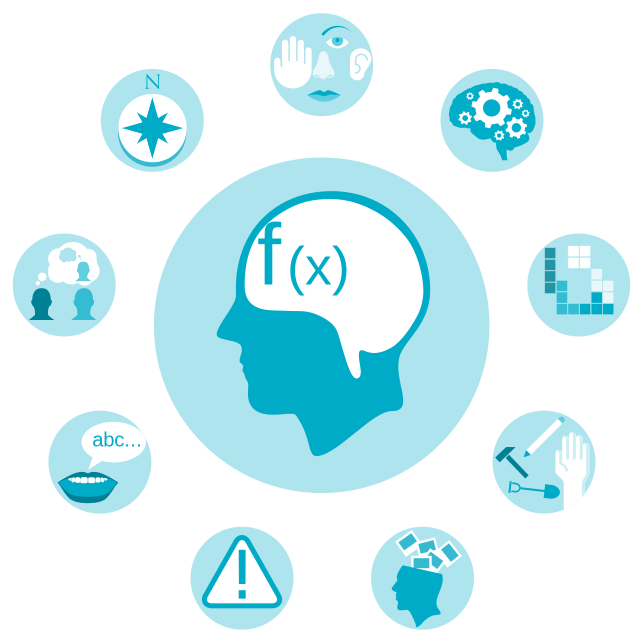
Processing speed is how quickly a person takes in information, processes it, and responds during simple tasks they can complete accurately. It is measured by time: not so much whether the answer is correct, but how long it takes to give it.
It is one of the broad abilities in current models of intelligence, such as the Cattell-Horn-Carroll model (McGrew, 2009), and one of the indices in the Wechsler scales. It also affects almost all other abilities: when processing is slow, information is lost before it can be used, and attention, working memory, and reasoning are less efficient (Salthouse, 1996). At NeuronUP, it is a distinct area that is addressed alongside attention and executive functions.
In brief
- Measures how long it takes to complete simple tasks accurately, not whether someone knows how to do them.
- It increases during childhood, peaks in early adulthood, and then gradually declines.
- A low score does not mean low intelligence.
- Slowed processing may have treatable causes, such as sleep deprivation, anxiety, or certain medications.
- It is measured with timed tests such as Coding, Symbol Search, the SDMT, or TMT-A.
Components of processing speed
The Cattell-Horn-Carroll model distinguishes several abilities related to speed (McGrew, 2009):
| Ability | What it measures | Example of a test |
|---|---|---|
| Processing speed (Gs): perceptual speed | How quickly a person compares or locates stimuli | Symbol Search, cancellation tasks |
| Processing speed (Gs): fluency in simple tasks | How quickly a person completes simple, repetitive tasks | Coding (matching symbols and numbers) |
| Processing speed (Gs): numerical facility | Speed with very simple calculations | Simple timed addition problems |
| Reaction and decision speed (Gt) | Time needed to respond to a stimulus, with or without a choice | Simple and choice reaction time |
| Psychomotor speed (Gps) | Speed of movement | Finger tapping |
Verbal fluency, such as naming all the animals a person can think of in one minute, depends in part on speed, but is considered primarily a measure of memory retrieval and executive function.
Examples of processing speed
- Following a group conversation without losing track.
- Reading movie subtitles before they disappear.
- Reacting in time when a pedestrian crosses without looking.
- Doing calculations when paying at a store.
- Copying what the teacher writes on the board before it is erased.
- Making quick decisions in a sport or game.
Slow processing speed is not always apparent in the result, but rather in the time and effort involved: the person reaches the correct answer, but takes longer, tires sooner, and has trouble keeping up when things move quickly.
Slow processing speed: signs and causes
Common signs include taking longer to respond, losing track during fast-paced conversations, needing to reread, not finishing tests on time, or tiring sooner during tasks that require concentration. These signs do not always indicate a neurological problem. Before concluding that processing speed is impaired, it is important to rule out reversible or treatable causes (Ponsford et al., 2023):
- Sleep deprivation or sleep disorders, such as sleep apnea.
- Anxiety, depression, or ongoing stress.
- Medications with sedating effects and alcohol or other substance use.
- Uncorrected vision or hearing problems.
- Fatigue and pain.
Consult a healthcare professional if the slowing appears suddenly, worsens in a short period of time, or interferes with school, work, or independence.
Processing speed and attention
They are closely related, but they are not the same. Attention determines which information receives cognitive resources; processing speed determines how quickly a person works with that information. A person may be highly attentive and still process information slowly. The relationship between the two is discussed in the article Attention and processing speed: Are they part of the same process or distinct mechanisms?
Processing speed in the brain and across the lifespan
Processing speed does not depend on a specific brain region, but on the quality of neural connections. White matter, made up of myelinated axons that connect distant brain regions, allows information to travel quickly between them; in early childhood, myelination has been associated with processing speed (Chevalier et al., 2015). This is why processing slows in diseases and injuries that cause widespread damage to white matter, such as multiple sclerosis, traumatic brain injury, or cerebral small vessel disease.
Processing speed increases rapidly during childhood and adolescence, peaks in early adulthood, and then gradually declines (Kail and Salthouse, 1994). According to Salthouse’s theory (1996), this slowing explains many of the cognitive changes associated with normal aging.
Processing speed in children: the WISC-V index
At school, processing speed often appears in reports as the WISC-V Processing Speed Index, which is derived from the Coding and Symbol Search subtests. A low score does not mean low intelligence: it indicates that the child needs more time to complete simple, repetitive tasks. This is common in children with ADHD or dyslexia, and may also occur in gifted children with an uneven profile.
It may support accommodations such as extended time on tests, fewer copying tasks, or shorter instructions. It should also not be confused with what was previously called “sluggish cognitive tempo,” now known as cognitive disengagement syndrome, which describes daydreaming and behavioral slowness, not a low test score (Becker et al., 2023).
Conditions that affect processing speed
- Multiple sclerosis: Along with episodic memory, processing speed is the cognitive domain most often affected (Benedict et al., 2020), and the Symbol Digit Modalities Test (SDMT) is the standard measure (Benedict et al., 2017). Learn more on the multiple sclerosis page.
- Acquired brain injury: Following a traumatic brain injury or stroke, slowed processing and mental fatigue are among the most persistent consequences.
- Parkinson’s disease and vascular cognitive impairment: Bradyphrenia, or slowed thinking associated with subcortical disorders, is characteristic. Learn more on the Parkinson’s disease page.
- Aging and dementia: Slowed processing is a normal part of aging, but it is more pronounced in cognitive impairment and Alzheimer’s disease.
- Neurodevelopmental disorders: Many children with ADHD, dyslexia, or dyscalculia process information more slowly, which affects reading, tests, and timed tasks.
- Mental health: Depression and schizophrenia often involve psychomotor slowing.
How processing speed is assessed
It is measured with simple tasks in which time is what matters. It is important to distinguish the motor component from the cognitive component, because a person may be slow due to a movement problem rather than slow processing:
| Test | What it assesses | Comment |
|---|---|---|
| Coding and Symbol Search | Processing speed on simple tasks | Index in the Wechsler scales (WISC-V, WAIS-IV) |
| Symbol Digit Modalities Test (SDMT) | Rapidly matching symbols and numbers | Standard measure in multiple sclerosis |
| Trail Making Test (Part A) | Visual scanning and sequencing speed | Spanish NEURONORMA norms |
| Simple and choice reaction time | Speed of responding to a stimulus | Computerized format |
| Finger tapping | Motor speed | Helps distinguish motor from cognitive slowing |
NeuronUP Assessment includes the Perceptual-Motor Speed Test (Simple Reaction Time), the Response Selection Speed Test, the Motor Speed Test (Finger Tapping), the Symbol-Digit Association Test, the Trail Making Test, the Color Trails Test, and the SPAIN General Battery, which specifically assesses processing speed.
How processing speed is addressed
In healthy older adults, the ACTIVE study found that those who had trained their processing speed had a lower risk of dementia ten years later (Edwards et al., 2017), although dementia was defined using tests and interviews. At 20 years, when clinical diagnoses were used, the lower risk was seen only in those who also received booster sessions (Coe et al., 2026), and a Cochrane review could not determine the effect of computerized training on processing speed in healthy older adults (Gates et al., 2020). The findings are promising, but not conclusive.
Following a brain injury, the INCOG 2.0 guidelines recommend strategies applied to everyday activities and consideration of methylphenidate to improve processing speed (Ponsford et al., 2023). One such strategy, time pressure management, teaches people to anticipate demanding situations and make more time for themselves, and has shown efficacy in a trial involving people who had experienced a stroke (Fasotti et al., 2000; Winkens et al., 2009). In practice:
- Establish a baseline: Record starting times and adjust exercise speed to each person’s performance.
- Accuracy first, then speed: Reduce the time available only when the person completes the task accurately.
- Teach strategies for saving time: Ask the person to repeat information, prepare tasks in advance, and reduce the amount of information they need to process at once.
- Manage fatigue: Use short sessions with breaks, at the time of day when the person performs best.
- Apply skills to daily life: Practice with real-life tasks, such as shopping or reading, and measure change in those activities.
On the blog, you can find worksheets and games for practicing processing speed, such as In or out and Fast Partners for adults, or Racing with Partners for children.
NeuronUP activities for practicing processing speed
These are some NeuronUP activities that train processing speed, with versions for adults and children. Difficulty adapts to performance, and response times are recorded in each session.
Fast Partners
Processing speed · Selective attention
Match the elements shown as quickly as possible.
In or out
Processing speed · Sustained attention
Determine the position (outside/inside) of different shapes in relation to one another.
Avoid the Ticket
Processing speed · Flexibility
Select the characteristics of the squares as quickly as possible.
Racing with Partners
Processing speed · Selective attention
Match each picture with its partner as quickly as possible.
Hungry Animals
Processing speed · Sustained attention
Quickly decide whether each shape is inside or outside the others.
Monster Escape!
Processing speed · Flexibility
Choose the squares that match the indicated feature as quickly as possible.
Frequently asked questions about processing speed
Is processing speed an executive function?
Not exactly. It is a basic ability that affects the performance of executive functions, attention, and memory. In models of intelligence, it is a distinct ability, and at NeuronUP it is a separate area.
What does it mean to have low processing speed?
It means the person needs more time to understand, decide, and respond during simple tasks, even if they arrive at the correct answer. This may be noticeable in fast-paced conversations, timed tests, or copying tasks.
Does low processing speed mean low intelligence?
No. It is just one of the abilities measured by intelligence scales, and it may be low in people with average or high overall ability, for example, some children with ADHD or giftedness.
What does the WISC-V Processing Speed Index measure?
How quickly a child completes simple, repetitive visual tasks, such as matching symbols and numbers (Coding) or finding identical symbols (Symbol Search).
What can cause slowed thinking?
Causes range from reversible factors, such as sleep deprivation, anxiety, depression, or certain medications, to neurological conditions such as multiple sclerosis, Parkinson’s disease, or brain injury. This is why it is important to seek advice if the slowing appears suddenly or worsens.
What is bradyphrenia?
It is slowed thinking. It is characteristic of subcortical disorders, such as Parkinson’s disease or vascular cognitive impairment.
Can processing speed be improved?
Training with timed tasks improves speed on the tasks practiced, and findings in older adults are promising but not conclusive. When slowed processing is due to an injury, training is combined with strategies to compensate for it in daily life.
References
- Becker, S. P., Willcutt, E. G., Leopold, D. R., Fredrick, J. W., Smith, Z. R., Jacobson, L. A., Burns, G. L., Mayes, S. D., Waschbusch, D. A., Froehlich, T. E., McBurnett, K., Servera, M., & Barkley, R. A. (2023). Report of a work group on sluggish cognitive tempo: Key research directions and a consensus change in terminology to cognitive disengagement syndrome. Journal of the American Academy of Child & Adolescent Psychiatry, 62(6), 629–645. https://doi.org/10.1016/j.jaac.2022.07.821
- Benedict, R. H. B., DeLuca, J., Phillips, G., LaRocca, N., Hudson, L. D., Rudick, R., & Multiple Sclerosis Outcome Assessments Consortium. (2017). Validity of the Symbol Digit Modalities Test as a cognition performance outcome measure for multiple sclerosis. Multiple Sclerosis Journal, 23(5), 721–733. https://doi.org/10.1177/1352458517690821
- Benedict, R. H. B., Amato, M. P., DeLuca, J., & Geurts, J. J. G. (2020). Cognitive impairment in multiple sclerosis: Clinical management, MRI, and therapeutic avenues. The Lancet Neurology, 19(10), 860–871. https://doi.org/10.1016/S1474-4422(20)30277-5
- Chevalier, N., Kurth, S., Doucette, M. R., Wiseheart, M., Deoni, S. C. L., Dean, D. C., O’Muircheartaigh, J., Blackwell, K. A., Munakata, Y., & LeBourgeois, M. K. (2015). Myelination is associated with processing speed in early childhood: Preliminary insights. PLOS ONE, 10(10), e0139897. https://doi.org/10.1371/journal.pone.0139897
- Coe, N. B., Miller, K. E. M., Sun, C., Taggert, E., Gross, A. L., Jones, R. N., Felix, C., Albert, M. S., Rebok, G. W., Marsiske, M., Ball, K. K., & Willis, S. L. (2026). Impact of cognitive training on claims-based diagnosed dementia over 20 years: Evidence from the ACTIVE study. Alzheimer’s & Dementia: Translational Research & Clinical Interventions, 12(1), e70197. https://doi.org/10.1002/trc2.70197
- Edwards, J. D., Xu, H., Clark, D. O., Guey, L. T., Ross, L. A., & Unverzagt, F. W. (2017). Speed of processing training results in lower risk of dementia. Alzheimer’s & Dementia: Translational Research & Clinical Interventions, 3(4), 603–611. https://doi.org/10.1016/j.trci.2017.09.002
- Fasotti, L., Kovacs, F., Eling, P. A. T. M., & Brouwer, W. H. (2000). Time pressure management as a compensatory strategy training after closed head injury. Neuropsychological Rehabilitation, 10(1), 47–65. https://doi.org/10.1080/096020100389291
- Gates, N. J., Rutjes, A. W. S., Di Nisio, M., Karim, S., Chong, L.-Y., March, E., Martínez, G., & Vernooij, R. W. M. (2020). Computerised cognitive training for 12 or more weeks for maintaining cognitive function in cognitively healthy people in late life. Cochrane Database of Systematic Reviews, 2020(2), CD012277. https://doi.org/10.1002/14651858.CD012277.pub3
- Kail, R., & Salthouse, T. A. (1994). Processing speed as a mental capacity. Acta Psychologica, 86(2–3), 199–225. https://doi.org/10.1016/0001-6918(94)90003-5
- McGrew, K. S. (2009). CHC theory and the human cognitive abilities project: Standing on the shoulders of the giants of psychometric intelligence research. Intelligence, 37(1), 1–10. https://doi.org/10.1016/j.intell.2008.08.004
- Ponsford, J., Velikonja, D., Janzen, S., Harnett, A., McIntyre, A., Wiseman-Hakes, C., Togher, L., Teasell, R., Kua, A., Patsakos, E., Welch-West, P., & Bayley, M. T. (2023). INCOG 2.0 guidelines for cognitive rehabilitation following traumatic brain injury, Part II: Attention and information processing speed. Journal of Head Trauma Rehabilitation, 38(1), 38–51. https://doi.org/10.1097/HTR.0000000000000839
- Salthouse, T. A. (1996). The processing-speed theory of adult age differences in cognition. Psychological Review, 103(3), 403–428. https://doi.org/10.1037/0033-295X.103.3.403
- Winkens, I., Van Heugten, C. M., Wade, D. T., Habets, E. J., & Fasotti, L. (2009). Efficacy of time pressure management in stroke patients with slowed information processing: A randomized controlled trial. Archives of Physical Medicine and Rehabilitation, 90(10), 1672–1679. https://doi.org/10.1016/j.apmr.2009.04.016
Related articles
- Attention and processing speed: Are they part of the same process or distinct mechanisms?
- Worksheet for practicing processing speed in adults: In or out
- Game for practicing processing speed in adults: Fast Partners
- Game for practicing processing speed in children: Racing with Partners
- Attention: what it is, types, and how it is addressed