


”Memory is the diary that we all carry with us”.
Oscar Wilde
It is a brain function that is essential for our learning and, therefore, for our survival. Thanks to it, we can better adapt to the needs of our environment.
From a morphological point of view, memory is closely related to the hippocampus, but it should be noted that several regions of the brain influence the process. It is interesting to mention that the meaning of words is stored in the right hemisphere, childhood memories are preserved in the temporal cortex, or that the frontal lobes are responsible for perception and thinking.
Types of memory
We have three different types according to the multi-store theory by Richard Atkinson and Richard Shiffrin, which states that information passes through different stores as it is processed. Therefore, we make the following division.
Sensory memory
Short-lived, it records information through the senses. It processes a large number of stimuli, which remain for the time necessary for their selection and identification for subsequent processing.
Short-term memory
Also known as operative or working memory. Its capacity is limited, and it can retain a few elements for a short period of time. This type is broken down into four parts.
- Visuospatial sketchpad. It is responsible for the active maintenance of information (images). It would take place, for example, when learning a route.
- Episodic buffer. It is a system specialized in integrating information coming from various sources. In this way, it represents visual, verbal, spatial, and temporal information.
- Phonological loop. It operates with verbal information. It facilitates the maintenance of the inner speech process involved in short-term memory, as happens when we memorize a phone number.
- Executive system. Its task is to control and regulate the working memory system.
Long-term memory
It is the one that allows us to retain information for the longest time. Within this, we distinguish between two types.
- Explicit or declarative memory: it is the store of information in a conscious way. In this type of memory we distinguish episodic memory (it is characterized by the fact that what we remember are facts or events, lived experiences located in space and time) and, on the other hand, semantic memory (it consists of recognizing the meaning of objects, vocabulary, or general knowledge).
- Implicit memory or procedural memory: it refers to actions or sequences of learned acts, most of which we do automatically without the need to think about each gesture or movement we make (it is often difficult to verbalize them).
What is memory for?
Memory is the storehouse of our recollections and our experiences. Thanks to it, we remember who we were with yesterday, where we have been on vacation, the conversations we have had before, our academic knowledge, professional experience, etc.
Thanks to memory, we are who we are, we learn and we change according to the relationships we have and the needs of our environment.
Therefore, diseases such as Alzheimer’s, where memory is gradually lost, little by little, end up gradually erasing the essence of the person.
Assessment and cognitive stimulation of memory
Seeing a specialist in cases of cognitive impairment is essential. The professional will put their experience at your service to find the best method to work on memory through cognitive stimulation.
Cognitive stimulation brings together all those activities aimed at maintaining or improving mental functioning and slowing down deterioration through different exercises with the help of stimulation programs. At NeuronUP we have a wide variety of cognitive stimulation exercises focused on memory training.
NeuronUP exercises to rehabilitate memory
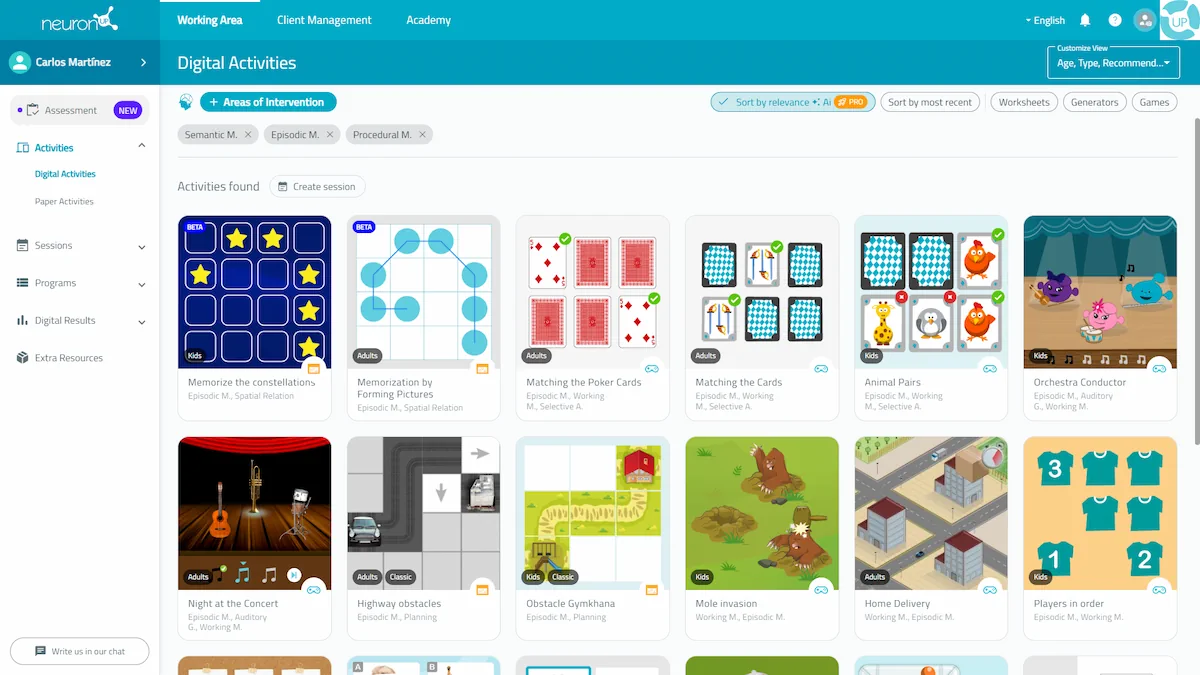
At NeuronUP we offer various activities to exercise memory, for example, in conditions such as Alzheimer’s. Regarding episodic memory, one of the exercises is Animal pairs, which involves finding the pairs among all the face-down cards by turning them over two at a time and, if they do not match, turning them face down again. Another exercise example, in this case to work on semantic memory and widely used by our users with people with Alzheimer’s, involves matching items with the category they belong to.
Check out our articles on memory
NeuronUP activities for training alternating attention in adults
Discover the best NeuronUP activities for training alternating attention in adults. Why train alternating attention in adults Alternating attention is one of the most complex and essential executive functions in everyday life: it allows us to shift our focus of concentration between different tasks, stimuli, or rules quickly and smoothly. In the field of neuropsychological …
New Cognitive Stimulation Activities for Children in 2026
At NeuronUP, we are sharing a roundup of the new cognitive stimulation activities for children that we have published during these months of 2026. Why it is important to work on new cognitive stimulation activities for children Maintaining young children’s motivation during rehabilitation and cognitive stimulation sessions is one of the greatest challenges we face …
New high-ecological-value activities!
Today we are presenting two new activity packs designed with high ecological value, created to train cognitive functions within everyday and meaningful situations for users. These activities recreate familiar contexts, making it easier for people to transfer what is practiced in session to their daily lives. At a clinical level, they make it possible to …
Activities for children with autism with high ecological validity
At NeuronUP, we are expanding our children’s catalog with four activities for children with autism, specially designed for autism intervention. These children’s activities for autism stand out for their high ecological value, as they allow key skills to be trained in contexts very close to everyday life, promoting the generalization of learning beyond the therapeutic …
The Most-Used NeuronUP Games in 2025
Discover which NeuronUP cognitive rehabilitation and cognitive stimulation games neurorehabilitation professionals used most with their clients in 2025. List of the 10 Most-Used NeuronUP Games in 2025 1. Making Words What is the game, and what does it work on? This NeuronUP game consists of building words by arranging fragments, syllables, or individual letters scattered …
Christmas Special: 5 Festive Cognitive Stimulation Activities
This year we have a gift for you. We’ve published 5 Christmas activities for you to work with your users during this magical season. Discover them now! Christmas activities for children Christmas activities for adults 1. The lost gifts This worksheet aims to work on planning and includes a total of 25 levels, with the …
Bibliography
- Atkinson, R.C.; Shiffrin, R.M. (1968). «Chapter: Human memory: A proposed system and its control processes». En Spence, K.W.; Spence, J.T., eds. The psychology of learning and motivation 2. New York: Academic Press. pp. 89-195
- Ruiz-Vargas, J. M. (2010). Short-term memory. In: Manual de psicología de la memoria, pp. 147-179. Madrid: Síntesis.
- TirapuUstárroz, J. y Grandi, F. (2016). On working memory and declarative memory: proposal for a conceptual clarification. PanamericanJournal of Neuropsychology, 10 (3): 13-31.
- Tirapu-Ustárroz, J. y Muñoz-Céspedes, J.M. (2005). Memory and executive functions. Revista de Neurología, 41 (8): 475-484.
- Cowan, N. (2008). What are thedifferencesbetweenlong-term, short-term, and workingmemory? Progress in BrainReserarch, 169: 323-338.
