

Neuropsychologist Vanessa Triviño Burbano explains how chronic occupational stress alters working memory and inhibitory control, presenting the neurobiological basis of burnout, its neuropsychological assessment, and neurorehabilitation with NeuronUP.
Learn how burnout syndrome is no longer considered a simple state of occupational exhaustion, but has become established as a complex phenomenon that profoundly compromises the brain’s functional architecture and an individual’s cognitive efficiency. Based on recent scientific evidence, this article analyzes in detail how chronic stress impairs critical processes such as working memory, inhibitory control, and cognitive flexibility.
It also explores the underlying neurobiological mechanisms—marked by cortisol dysregulation—and presents a real clinical case in which digital neurorehabilitation with NeuronUP proves to be a key tool for recovering affected executive functions.
What is burnout, and how does it affect overall cognitive efficiency?
Over the past few decades, burnout syndrome has become a contemporary mental health concern, especially in settings characterized by high cognitive demands, pressure, and emotional overload. Although it has traditionally been conceptualized as a state of occupational exhaustion, it is now considered a complex phenomenon that affects both psychological well-being and an individual’s cognitive functioning.
The World Health Organization (WHO, 2019) defines burnout as the result of chronic occupational stress that has not been successfully managed, characterized by exhaustion and reduced professional efficacy. This definition has implications for executive functions, that is, the processes that enable people to plan, regulate behavior, make decisions, and adapt to environmental demands.
In clinical practice, people with burnout do not only report feeling exhausted; they also experience difficulties concentrating, organizing tasks, sustaining attention, making decisions, and regulating their emotions. These manifestations suggest that burnout involves more profound functional impairment, linked to the functioning of the prefrontal cortex and cognitive regulation systems.
Recent scientific evidence supports this view, showing that burnout is associated with impairments in working memory, attention, processing speed, and executive control, positioning it as a relevant phenomenon within clinical neuropsychology (Gavelin et al., 2022). From this perspective, burnout requires moving beyond emotional distress and examining how chronic stress affects the brain’s functional architecture and an individual’s ability to function adaptively.
Burnout and chronic occupational stress: beyond emotional distress
One of the main contributions of recent research (Gavelin et al., 2022) has been to demonstrate that burnout is not merely an experience of tiredness, but a condition that progressively affects cognitive efficiency. This decline does not occur abruptly; rather, it develops gradually as the individual is exposed to sustained demands without sufficient recovery. During this process, the person begins to perceive that their performance is declining, that it is becoming harder to concentrate, and that tasks that were once simple now require greater mental effort.
This phenomenon can be explained by the theory of allostatic load, which proposes that prolonged exposure to stress causes cumulative wear and tear in the biological systems responsible for maintaining internal balance. At the cognitive level, this wear and tear translates into lower efficiency in information processing, directly affecting performance on tasks that require executive control. Recent studies have shown that people with burnout exhibit executive function impairments even in the absence of major psychiatric disorders, suggesting that this syndrome has an independent impact on cognition (Pihlaja et al., 2022).
In addition,this cognitive impairment contributes to a vicious cycle: as the person performs less effectively, their sense of inefficacy increases, which raises stress and deepens burnout. This cycle is particularly relevant in settings such as education or healthcare, where cognitive performance is essential for professional functioning.
Executive functions: the control system affected by burnout
Executive functions are the core of higher-order cognitive functioning. They direct behavior toward goals, regulate impulses, organize information, and support adaptation to changing situations. These functions include working memory, inhibitory control, cognitive flexibility, planning, and decision-making, and they depend primarily on the prefrontal cortex.
According to Gavelin et al., (2022), when these functions are impaired, the impact extends to multiple areas of daily life. The person may experience difficulties initiating tasks, sustaining attention, prioritizing activities, or regulating emotions. In the context of burnout, these impairments are not incidental; they are central to the individual’s experience. In fact, evidence indicates that executive difficulties largely explain the reduced performance observed in people with burnout.
Working memory impairment and mental overload
For example, working memory is one of the functions most sensitive to chronic stress. This ability makes it possible to hold and manipulate information for a brief period, which is essential for completing complex tasks, following instructions, and solving problems. In burnout, this function is compromised, creating a sense of mental overload.
People may forget what they were doing, lose the thread of a conversation, or feel overwhelmed by multiple simultaneous demands. This phenomenon affects not only performance but also self-perception, as the person begins to feel less competent. Empirical evidence confirms that burnout is associated with significant working memory impairment, which directly affects cognitive efficiency.
Loss of inhibitory control and clinical impulsivity
Inhibitory control makes it possible to regulate impulses, filter irrelevant stimuli, and maintain emotional control. In burnout, this function is weakened, resulting in greater irritability, impulsivity, and difficulty managing stress.
From a neurocognitive perspective, this impairment is related to reduced prefrontal cortex efficiency and greater influence from emotional systems. Recent studies have shown that people with burnout require greater cognitive effort to maintain executive control, suggesting reduced processing efficiency (Pihlaja et al., 2023). This increase in cognitive cost contributes to mental fatigue and progressive performance decline.
Mental rigidity and reduced cognitive flexibility
Cognitive flexibility is essential for adapting to new situations, changing strategies, and solving problems efficiently. In burnout, this ability is reduced, resulting in mental rigidity and difficulty coping with change.
Recent research has shown that burnout is associated with poorer performance on tasks requiring cognitive flexibility, especially in high-demand contexts (Farahat et al., 2022). This rigidity affects not only the ability to adapt, but also increases the perception of stress, as the individual feels less capable of responding to environmental demands.

Subscribe
to our
Newsletter
Neurobiological basis of burnout: cortisol and prefrontal impairment
Sustained activation of the stress system causes changes in key brain structures, including the prefrontal cortex, amygdala, and hippocampus. These changes affect emotional regulation and cognitive control.
A central mechanism in this process is dysregulation of the hypothalamic-pituitary-adrenal (HPA) axis, which is responsible for the physiological stress response. In situations of chronic stress, this axis loses its ability to regulate itself effectively through negative feedback, leading to persistent cortisol hypersecretion. Prolonged exposure to elevated cortisol is particularly damaging to the prefrontal cortex and hippocampus, regions with a high density of glucocorticoid receptors, compromising the integrity of neural networks involved in cognitive processing. Consequently, this dysregulation results in impaired executive performance, particularly on tasks requiring working memory, inhibitory control, and cognitive flexibility (Cano-López et al., 2023).
Recent studies have identified changes in biomarkers associated with brain plasticity, such as brain-derived neurotrophic factor (BDNF). For example, professionals with burnout have been found to show reduced levels of this factor, which is associated with poorer cognitive performance (Cortés-Álvarez et al., 2024). This finding reinforces the idea that burnout involves functional impairment of the brain.
Neuropsychological assessment of burnout and chronic stress
Burnout assessment should include both measures of emotional exhaustion and tests of cognitive functioning. This approach makes it possible to identify specific impairments in executive functions and design personalized interventions.
Recent literature emphasizes the importance of integrating clinical, cognitive, and functional assessment to understand burnout’s impact on the individual (Schmidt et al., 2024). This multidimensional approach is key to accurate diagnosis.
Successful case of executive function rehabilitation for burnout with NeuronUP
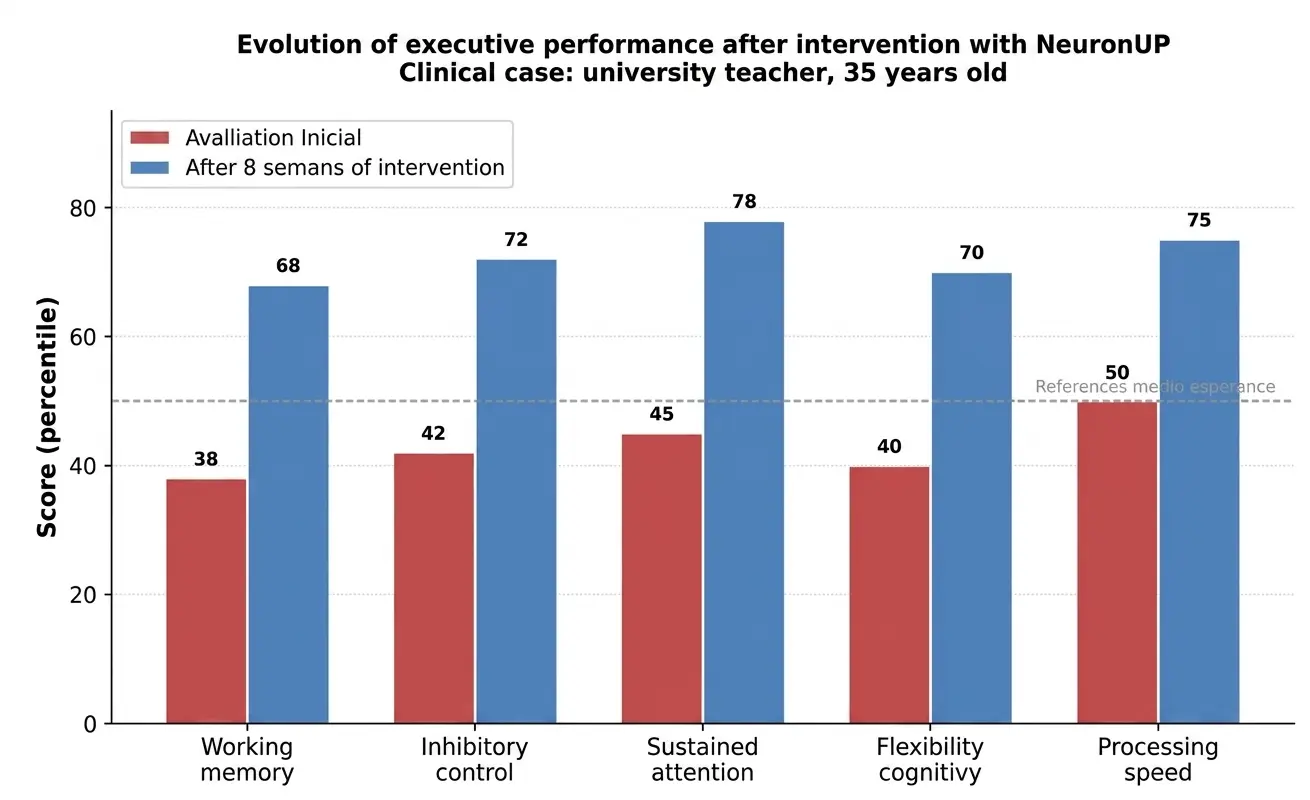
Consider the case of a 35-year-old university instructor who reports feeling constantly exhausted and having difficulty concentrating and organizing her classes. During the neuropsychological assessment, impairments in working memory and inhibitory control are identified, along with a high burnout score.
In this case, the intervention included cognitive training with NeuronUP, emotional regulation techniques, and adjustments to the workload.
After several weeks, a significant improvement in cognitive functioning and perceived efficacy was observed, demonstrating the importance of a comprehensive approach.
Neurorehabilitation makes it possible to intervene directly on affected executive functions. Cognitive training programs, combined with emotional regulation techniques, have proven effective in improving cognitive performance.
In addition, neuroplasticity supports functional recovery of the brain, especially when intervention is initiated early (Gavelin et al., 2022). This positions neurorehabilitation as a key tool in the treatment of burnout.
The future of neurorehabilitation in burnout treatment
Burnout syndrome is a complex, multidimensional phenomenon that extends beyond emotional exhaustion, directly and significantly affecting cognitive functioning, particularly executive functions.
Recent evidence has shown that chronic stress not only causes psychological distress, but also alters the efficiency of the brain systems responsible for planning, decision-making, emotional regulation, and adapting to the environment (Gavelin et al., 2022). In this sense, burnout should be understood as a condition that compromises an individual’s ability to respond flexibly and effectively to the demands of everyday life, affecting both professional performance and overall well-being.
From a clinical neuropsychology perspective, this finding implies a paradigm shift in how burnout is assessed and treated. Addressing only the emotional component of the syndrome is no longer sufficient; a detailed assessment of cognitive functioning, especially executive functions, must be incorporated to understand the true impact of sustained stress on the individual. This approach makes it possible to identify specific profiles of cognitive impairment, facilitating the design of more precise, personalized interventions focused on functional recovery.
Likewise, understanding burnout as a neurocognitive phenomenon helps explain why many people, even after reducing their perceived stress levels, continue to experience difficulties in their daily performance. This is because the impact of chronic stress on the brain does not disappear immediately; rather, it requires active recovery processes, supported by neuroplasticity, to restore balance between emotional and cognitive systems (Pihlaja et al., 2023). In this context, neurorehabilitation takes on a central role, as it allows direct intervention on affected executive functions, promoting recovery of skills such as sustained attention, working memory, cognitive flexibility, and inhibitory control.
From an applied perspective, this means that intervention programs should go beyond general stress management strategies and incorporate structured cognitive training, emotional regulation, and the reorganization of functional habits, with the goal of optimizing performance in real-world settings. In addition, evidence suggests that early interventions can prevent progressive deterioration of executive functions, positioning burnout not only as a problem to treat, but also as an opportunity to implement preventive strategies in work and educational settings.
Looking ahead, burnout may be considered an early indicator of executive dysfunction, opening new avenues of research in mental health and neuropsychology. The integration of emerging technologies, such as digital cognitive stimulation platforms, neurofeedback, and artificial intelligence, could significantly enhance assessment, monitoring, and intervention processes, enabling a more dynamic and personalized approach to the syndrome.
Ultimately, addressing burnout from a neuropsychological perspective means recognizing that emotional well-being and cognitive functioning are deeply interconnected. Comprehensive recovery requires not only relieving subjective distress, but also restoring the ability to think, plan, and adapt efficiently. In an increasingly demanding global context, this perspective represents not only a clinical advance, but also a key strategy for promoting sustainable human performance and long-term mental health.
References
- Cano-López, I., Pérez, M. I., & Puig-Pérez, S. (2023). Burnout is related to executive dysfunction in primary healthcare professionals working in rural areas. Revista de Neurología, 76(3), 91–99. https://doi.org/10.33588/rn.7603.2022283
- Cortés-Álvarez, N. Y., Orozco-Núñez, E., & Rodríguez-Ramírez, S. (2024). Job burnout, cognitive functioning, and brain-derived neurotrophic factor expression among hospital Mexican nurses. Nursing Open, 11(6), e2192. https://doi.org/10.1002/nop2.2192
- Farahat, S. A., Amin, O. R., Hamdy, H. S., & Abd El-Fatah, N. A. (2022). The impact of work-related stress on the cognition domain of executive functioning of health care workers during the COVID-19 pandemic. International Archives of Occupational and Environmental Health, 95, 1079–1090. https://doi.org/10.1007/s00420-021-01814-8
- Gavelin, H. M., Eskilsson, T., Boraxbekk, C.-J., Neely, A. S., & Järvholm, L. S. (2022). Cognitive function in clinical burnout: A systematic review and meta-analysis. Work & Stress. https://doi.org/10.1080/02678373.2021.2002972
- Organización Mundial de la Salud. (2019). Clasificación Internacional de Enfermedades, undécima revisión (CIE-11): QD85 Síndrome de desgaste ocupacional. https://icd.who.int/browse11
- Pihlaja, M., Uusitalo, L., Saarinen, M. M., Tuovinen, T., & Kiviniemi, A. M. (2022). Occupational burnout is linked with inefficient executive functioning, elevated average heart rate, and decreased physical activity in daily life. Brain Sciences, 12(12), 1723. https://doi.org/10.3390/brainsci12121723
- Pihlaja, M., Peräkylä, J., Erkkilä, E. H., Tapio, E., Vertanen, M., & Hartikainen, K. M. (2023). Altered neural processes underlying executive function in occupational burnout-Basis for a novel EEG biomarker. Frontiers in human neuroscience, 17, 1194714. https://doi.org/10.3389/fnhum.2023.1194714
- Schmidt, S. L., Andreatini, R., & de Almeida, R. M. M. (2024). Attention deficits in healthcare workers with non-clinical burnout: An exploratory investigation. International Journal of Environmental Research and Public Health, 21(2), 239. https://doi.org/10.3390/ijerph21020239
Frequently asked questions about burnout syndrome and executive functions
1. Exactly how does burnout syndrome affect executive functions?
Burnout syndrome alters the brain’s functional architecture, directly affecting the prefrontal cortex and cognitive regulation systems. Chronic occupational stress weakens essential executive processes such as working memory, inhibitory control, and cognitive flexibility. Clinically, this translates into severe difficulties concentrating, organizing priority tasks, making adaptive decisions, and regulating emotions in the workplace. It also creates a vicious cycle in which reduced cognitive performance increases the sense of inefficacy, deepening the state of burnout.
2. What are the neurobiological bases of cognitive impairment caused by chronic stress?
The central neurobiological mechanism of burnout is dysregulation of the hypothalamic-pituitary-adrenal (HPA) axis, which loses its capacity for self-regulation through negative feedback. This produces sustained cortisol hypersecretion that is highly damaging to the prefrontal cortex and hippocampus, regions with a high density of glucocorticoid receptors. As a result, the integrity of neural networks is compromised and critical biomarkers of brain plasticity, such as brain-derived neurotrophic factor (BDNF), decrease, directly affecting executive performance.
3. Is there evidence of burnout’s impact on professionals?
Yes, recent scientific literature shows specific epidemiological and clinical data from Spanish-speaking settings:
- In Spain: Research led by Cano-López et al. (2023) demonstrates that burnout syndrome is directly related to executive dysfunction in primary healthcare professionals working in rural areas.
- In Mexico: A study by Cortés-Álvarez et al. (2024) of hospital nursing staff found that occupational burnout significantly reduces expression of BDNF, which directly correlates with poorer performance on cognitive tests.
4. How does cognitive stimulation with NeuronUP help rehabilitate burnout?
Structured neurorehabilitation makes it possible to directly target the executive functions weakened by chronic stress. Combining digital cognitive training programs delivered through platforms such as NeuronUP with emotional regulation techniques stimulates brain neuroplasticity and supports functional recovery. As demonstrated in the clinical case of the 35-year-old university instructor, after 8 weeks of neuropsychological intervention combined with workload adjustments, clinically significant improvement was achieved in the percentiles for working memory, sustained attention, processing speed, cognitive flexibility, and inhibitory control.







 Medical Expo Guadalajara 2026: the leading event for healthcare innovation in Mexico
Leave a Reply