

Neuropsychologist Valeria Medina shares the scientific and clinical keys to overcoming the traditional stagnation in the treatment of eating disorders (EDs), proposing a paradigm shift focused on cognitive rehabilitation and the training of the underlying mental processes.
As neuropsychologist Valeria Medina explains in the NeuronUP training session “From Behavior to the Brain: New Keys for Intervening in Eating Disorders”, the key to breaking this maladaptive cycle lies in moving toward a neurocognitive model. This article provides an in-depth analysis of neuroanatomical alterations and how to implement cognitive rehabilitation in eating disorders (EDs) using professional cognitive stimulation tools.
What are eating disorders (EDs)?
Eating disorders (EDs) are conditions that manifest as persistent alterations linked to emotions and individuals’ social behavior . According to the American Psychiatric Association (APA, 2023), this spectrum of disorders severely affects health and is classified as follows:
- Anorexia nervosa,
- Bulimia nervosa,
- Binge-eating disorder,
- Pica and rumination disorder,
- Avoidant/Restrictive Food Intake Disorder,
- Other specified eating disorders.
The current state of ED treatment
The clinical treatment of EDs frequently encounters a glass ceiling. Healthcare professionals and the numerous centers dedicated to treating these disorders often experience significant frustration when patients show chronic stagnation or high relapse rates.
Historically, interventions have been designed under a paradigm focused almost exclusively on weight control, body shape, and food restriction. However, current neuropsychological practice demonstrates that sustainable recovery depends not only on these factors, but also on directly intervening on the underlying mental processes—inhibitory control, flexibility, and decision-making—that sustain eating dysregulation.
Clinical classification and multidimensional consequences of EDs
To design an effective cognitive stimulation strategy, it is imperative to understand the complexity and diversity of clinical profiles according to the APA’s updated diagnostic criteria. EDs are not a homogeneous entity, but rather a spectrum of persistent conditions associated with severe alterations in the behavioral, emotional, and social domains:
- Anorexia nervosa (AN): Clinically characterized by an obsessive and persistent concern about body shape and weight, leading to extreme restrictive behaviors. Physically and neurobiologically, its proximal consequences include the absence of menstruation in women, dizziness, and marked cognitive impairment.
- Bulimia nervosa (BN): Manifests through a pattern of recurrent binge-eating episodes accompanied by an intense sense of loss of control, usually followed by maladaptive compensatory behaviors.
- Binge-eating disorder (BED): Defined by recurrent binge-eating episodes occurring at least once a week for a minimum period of three months. Unlike bulimia, BED occurs without associated compensatory behaviors, with a constant “loss of control” during eating.
- Other manifestations of the spectrum: Include conditions such as pica, rumination disorder, Avoidant/Restrictive Food Intake Disorder, and other specified EDs.
As an additional clinical note regarding systemic comorbidity, it is important to bear in mind that people with binge-eating disorder or bulimia nervosa face a chronic risk of developing obesity and metabolic syndrome. This exponentially increases the likelihood of diabetes, hypertension, and cardiovascular disease, conditions that are psychologically worsened by intense feelings of guilt, sadness, and disgust after binge-eating episodes.

Subscribe
to our
Newsletter
Neurobiological bases of EDs: why dysregulation occurs
The self-regulation difficulties that characterize bulimia nervosa (BN) and binge-eating disorder (BED) are not due to a lack of commitment or willpower on the part of people with EDs. Neuroimaging and functional connectivity research demonstrates the existence of specific neuroanatomical alterations in the brain circuits that modulate appetite and executive behavior.
Based on key scientific reviews (Ahn et al., 2022), we can localize the neurobiological conflict in three main brain structures:
1. Orbitofrontal and prefrontal cortex: the braking system
This anatomical region is ultimately responsible for executive control and applying the cognitive brake in response to environmental stimuli. In people with EDs, weakened connectivity is evident in these networks. When this essential modulatory function fails, the brain is structurally unable to suppress the automatic motor response toward food, preventing the person from stopping eating even when they consciously want to do so.
2. Ventral striatum and mesocorticolimbic circuit: the drive system
It constitutes the core of the brain reward system. In people with impulsive-compulsive profiles, such as BN and BED, this structure shows marked hyperactivity in response to hedonic stimuli. The ventral striatum releases dopamine massively at the mere presence of images or thoughts of high-calorie foods, motivating an automatic and urgent approach response that directly competes with the individual’s self-regulation systems.
3. Hypothalamus: the integration center
The hypothalamus acts as the central nucleus of the body’s metabolic integration. It is the region responsible for processing and integrating peripheral hormonal signals of hunger and satiety, such as ghrelin and leptin. In clinical contexts involving EDs with obesity comorbidity, this structure is frequently altered, perpetuating the biological dysregulation of appetite.
The connection between EDs and obesity: a bidirectional intersection
A critical aspect for neurorehabilitation professionals is analyzing the intersection between EDs, specifically bulimia nervosa and binge-eating disorder. Far from being independent conditions, they operate as disorders with shared components that reinforce one another bidirectionally.
Recent studies, such as Camacho-Barcia et al. (2024), confirm that BN and BED are the psychiatric diagnoses most closely associated with the development and maintenance of overweight. Recurrent binge-eating episodes accompanied by a sense of loss of control directly contribute to increased adiposity and make metabolic stabilization more difficult.
This vicious cycle is based on a complex network of correlated clinical and neuropsychological factors:
- Appetite dysregulation at the hypothalamic level.
- The constant presence of emotional eating as a coping strategy.
- Neurocognitive patterns resembling food addiction, especially to ultra-processed products.
- A profile of neurocognitive impulsivity, characterized by attentional biases toward food-related stimuli and marked alterations in behavioral inhibition circuits.
The systems conflict in eating disorders: Bottom-up vs. Top-down processing
From the perspective of cognitive functioning (Adams et al., 2017), the persistence of dysregulated behaviors in BN, BED, and obesity is explained by the imbalance between two brain processing systems:
| Clinical system | Processing type | Neurocognitive mechanism | State in the person with an ED |
|---|---|---|---|
| Impulsive system | Bottom-up | Strongly guided by the hedonic value of food and the immediate urgency of reward. | Hyperactive: Generates automatic and intense approach responses to high-calorie stimuli. |
| Reflective system | Top-down | Deliberate control supported by frontal and frontostriatal networks responsible for applying the brake. | Hypoactive / Insufficient: Unable to modulate the impulsive response originating in subcortical structures. |
This imbalance demonstrates that the core of the problem lies not only in the intensity with which the patient experiences the reward of food, but also in the difficulty of modulation and inhibition by higher-order control networks. Unless these functions are rehabilitated, the circuit maintains symptoms chronically over time.
The paradigm shift in multidisciplinary ED treatment
Recognition of these neurobiological mechanisms has made the old clinical approach focused exclusively on weight obsolete. The current intervention paradigm requires focusing on the cognitive processes that maintain binge-eating behavior.
To achieve a truly holistic, person-centered approach, it is essential to establish an interdisciplinary working model in which three major therapeutic pillars coexist:
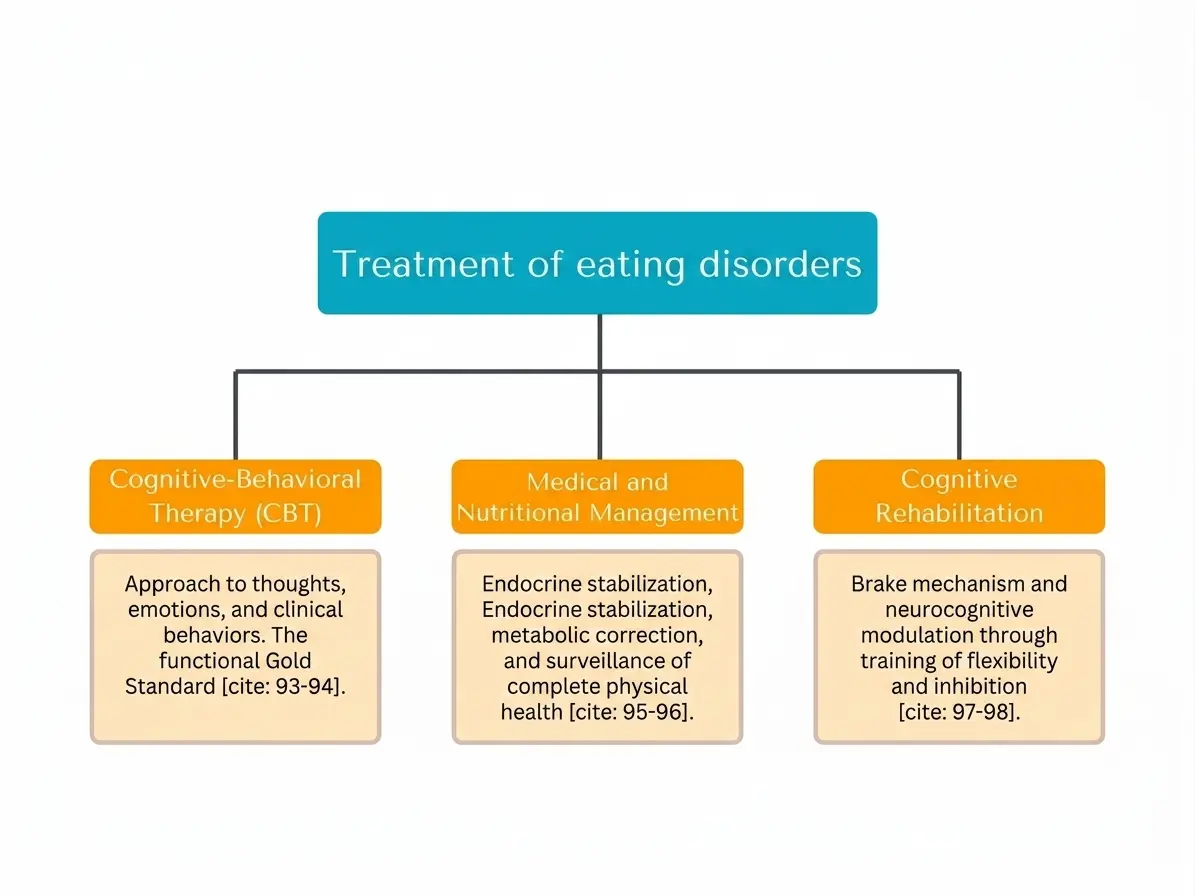
Within this clinical ecosystem, cognitive rehabilitation has emerged as the essential adjunctive tool that bridges the gap between purely medical interventions and traditional psychotherapy, providing the patient’s brain with the functional structure necessary to assimilate therapeutic change.
Target executive functions: the three pillars of cognitive rehabilitation in EDs
When a cognitive stimulation professional designs a program for people with EDs, they must direct therapeutic goals toward strengthening three target executive functions:
1. Inhibitory control
Aimed at systematically and guidedly strengthening the ability to suppress immediate impulsive responses. Clinical training exposes the patient to highly palatable stimuli and foods, reflexively teaching the frontal networks to stop the automatic motor approach response.
2. Cognitive flexibility
Its fundamental objective is to break the neural perseveration of thought and behavior patterns. In practice, this training makes it possible to interrupt the rigid restrictive routines characteristic of anorexia nervosa, as well as to dismantle repetitive binge-eating/purging cycles in bulimia nervosa.
3. Decision-making
Aimed at addressing the tendency to choose behaviors guided exclusively by immediate hedonic benefit. Through complex decision-making tasks, patients are trained to actively and automatically integrate anticipation of the long-term clinical consequences of their actions.
Practical protocol: Go/No-go paradigms and stimulus devaluation
One of the most studied neurocognitive methods, with the highest rate of clinical efficacy for reprogramming the automatic impulse, is the implementation of tasks based on Go/No-Go paradigms (or the Stop-Signal Task).
Through controlled digital environments, the clinical protocol is developed systematically in three consecutive phases (Adams et al., 2017; Iannazzo et al., 2025; Keeler et al., 2022):
- Presentation phase: Rapid visual stimuli are presented on the screen.
- Signal phase (Brake): Unexpectedly and within milliseconds, an explicit stop signal (Stop-Signal/No-Go) appears on the screen. In response to this signal, the patient must immediately stop their ongoing motor action, inhibiting the impulse to press or interact with the stimulus.
- Repetition phase (Habit Formation): To achieve genuine and lasting neural plasticity, the protocol requires a high rate of successful inhibitions repeated systematically over time.
The clinical effect: active stimulus devaluation
Repeatedly and consistently pairing the image of the stimulus with a motor and cognitive response of total inhibition produces a change in the user’s brain coding. The brain recodes the trigger, intrinsically decreasing its aesthetic appeal, subjective value, and motivational salience.
Scientific evidence for cognitive stimulation, treatment adherence, and the timeline for improvement
Incorporating digitized cognitive stimulation programs offers a quantifiable and progressive impact throughout the therapeutic intervention (Iannazzo et al., 2025; Keeler et al., 2022):
- After 4 weeks of intervention (Proximal effect): Clinical studies show a statistically significant reduction in ED symptoms.
- After 8 weeks of intervention (Sustained effect): A strong reduction in the hedonic and subjective valuation that the person assigns to high-energy-density foods is consolidated.
- Feasibility and adherence: The use of mobile applications and web platforms with interactive dynamics results in excellent acceptance and treatment engagement among users, facilitating daily completion of the exercises.
It is essential for professionals to remember that neurocognitive training directly modifies the neurological valuation of food and impulse control, but the definitive, long-term interruption of binge-eating frequency is multifactorial. It depends on multiple additional behavioral and emotional processes that must continue to be addressed through psychotherapy and cognitive behavioral therapy (CBT).
The cognitive rehabilitation tools have a powerful modulatory effect, but they must be used within comprehensive treatment, never as isolated “magic bullets.”
Success criteria for implementing cognitive rehabilitation in EDs
For neurorehabilitation centers and therapists seeking to begin integrating cognitive stimulation into their ED protocols, the scientific literature identifies six key factors that directly enhance intervention effectiveness:
- Complete intervention personalization: Stimuli must be carefully adapted to the user’s specific cognitive profile of AN, BN, or BED.
- Transfer to activities of daily living: Task design must facilitate the generalization of automated prefrontal control to the patient’s real-life eating environments.
- Appropriate intensity and frequency: Prefrontal plasticity requires systematic and repetitive dosing to consolidate new braking habits.
- Establishment of measurable goals: Quantitatively monitor response times and accuracy rates for inhibition.
- Immediate performance feedback: Allow users to know their real-time performance to support learning and motivation processes.
- Genuine multidisciplinary intervention: Maintain fluid, coordinated communication with the nutrition, medical, and clinical psychology professionals responsible for the case.
In conclusion, moving toward the current paradigm of neuropsychology applied to EDs is not a theoretical option, but an urgent clinical necessity. Providing our patients with a robust “braking mechanism” through professional platforms such as NeuronUP, which incorporates these criteria, represents the definitive step toward overcoming the glass ceiling of conventional treatments and opening the door to deep, neurobiological, and lasting recovery.
This webinar is for you
Do you work at a neurorehabilitation or mental health center and want to break through the “glass ceiling” in the treatment of eating disorders?
Access the training session for free “From Behavior to the Brain: New Keys for Intervening in Eating Disorders,” presented by neuropsychologist Valeria Medina. Learn to design personalized, intensive protocols with immediate feedback.
Frequently asked questions about neuropsychology in eating disorders (EDs):
1. What is cognitive rehabilitation applied to eating disorders (EDs)?
Cognitive rehabilitation in the field of eating disorders is an essential adjunctive neuropsychological intervention that bridges the gap between purely medical interventions and traditional psychotherapy. This approach provides the patient’s brain with the functional structure necessary to assimilate therapeutic change, moving away from the old paradigm focused solely on weight or food restriction.
Its clinical objective is to guide stimulation toward three target executive functions:
- Inhibitory control: Aimed at systematically strengthening the ability to suppress immediate impulsive responses to highly palatable stimuli and foods;
- Cognitive flexibility: Designed to break the neural perseveration of maladaptive thought and behavior patterns, interrupting rigid restrictive routines or binge-eating/purging cycles;
- Decision-making: Aimed at improving the selection of behaviors guided by immediate hedonic benefit, while integrating anticipation of long-term clinical consequences.
2. How do the drive system and prefrontal brake interact in bulimia nervosa and binge-eating disorder?
Failure to self-regulate eating behavior is explained by an imbalance between two brain processing systems:
- The impulsive system (Bottom-up processing): It is strongly guided by the hedonic value of food and the urgency of reward. In patients with bulimia nervosa (BN) and binge-eating disorder (BED), the ventral striatum shows marked hyperactivity, massively releasing dopamine at the mere presence of images or thoughts of high-calorie foods;
- The reflective system (Top-down processing): Responsible for applying the cognitive brake through frontal and frontostriatal networks. In people with EDs, weakened connectivity is evident in these structures, generating a structural inability to suppress the automatic motor response toward food;
This imbalance demonstrates that the core of the disorder does not lie in a lack of willpower, but in insufficient modulation and inhibition by higher-order control networks.
3. What does the Go/No-go paradigm training protocol for EDs involve?
Training based on Go/No-go paradigms (or the Stop-Signal Task) is one of the most studied neurocognitive methods for reprogramming the automatic impulse. Through controlled digital environments, the protocol is developed in three consecutive phases:
- Presentation phase: Rapid visual stimuli consisting of images of highly palatable foods are presented on the screen; these must be fully personalized according to each patient’s specific triggers;
- Signal phase (Brake): Unexpectedly and within milliseconds, an explicit stop signal (Stop-Signal/No-Go) appears, in response to which the patient must immediately stop their ongoing motor action, inhibiting the impulse to interact with the stimulus;
- Repetition phase: To achieve genuine and lasting neural plasticity, a high rate of successful inhibitions repeated systematically over time is required.
This neurocognitive process generates active stimulus devaluation, causing the brain to recode the trigger, reduce its aesthetic appeal, and decrease the urgency of immediate reward.
4. Does cognitive stimulation replace traditional cognitive behavioral therapy (CBT) for EDs?
No, cognitive stimulation does not replace traditional psychotherapy; it acts as a clinical enhancer. Cognitive behavioral therapy (CBT) remains the foundational Gold Standard for addressing clinical thoughts, emotions, and behaviors. In this multidisciplinary ecosystem, cognitive rehabilitation is the essential adjunctive tool that bridges medical interventions and psychotherapy, providing the patient’s brain with the functional structure and self-regulation necessary to properly assimilate therapeutic change.
5. How long does it take to observe clinical improvements when using NeuronUP in ED cases?
Incorporating digitized cognitive stimulation programs through NeuronUP offers a quantifiable and progressive impact supported by scientific evidence:
- After 4 weeks of intervention: A statistically significant reduction in the patient’s overall symptoms is recorded;
- After 8 weeks of intervention: A strong reduction in the hedonic and subjective valuation that the patient assigns to high-energy-density foods is consolidated;
- Ongoing adherence: The use of mobile applications and interactive web environments ensures excellent user acceptance and daily engagement, facilitating the transfer of braking habits to activities of daily living.
6. Why is there a bidirectional relationship between eating disorders and obesity?
Bulimia nervosa and binge-eating disorder are the psychiatric diagnoses most closely associated with the development and maintenance of excess weight, operating as disorders that reinforce one another bidirectionally. Recurrent binge-eating episodes accompanied by a sense of loss of control directly contribute to increased adiposity and make metabolic stabilization more difficult.
This chronic vicious cycle, which increases the risk of developing metabolic syndrome, diabetes, and hypertension, is based on a network of correlated neuropsychological factors:
- Hypothalamic appetite dysregulation due to altered processing of signals such as ghrelin and leptin,
- On the one hand, the constant presence of emotional eating as a maladaptive coping strategy,
- On the other hand, the emergence of neurocognitive patterns resembling addiction to ultra-processed food,
- Finally, a neurocognitive impulsivity profile characterized by attentional biases toward food and marked alterations in behavioral inhibition circuits.







 Prevalence of Alzheimer’s Pathology in the General Population: What Do Blood Biomarkers Tell Us?
Leave a Reply