

Doctoral student Marta Arbizu Gómez analyzes a large population-based study that uses the blood biomarker p-tau217 to detect changes associated with Alzheimer’s disease before symptoms appear. The results show a high prevalence of these biomarkers among older, cognitively healthy people, with important implications for assessment and cognitive stimulation.
Marta Arbizu Gómez analyzes a study published in Neurology on the relationship between high-dose influenza vaccination and the risk of Alzheimer’s disease in older adults. The research found an association between high-dose influenza vaccination and a lower risk of developing Alzheimer’s disease compared with the standard dose. The article reviews the possible role of the immune system, inflammation, and medical prevention in brain health, as well as its implications for professional cognitive assessment and rehabilitation.
Why is it important to measure Alzheimer’s pathology in the population?
Alzheimer’s disease (AD) is the leading cause of cognitive impairment and dementia worldwide. However, one of the major questions in research has always been the same:
How many people actually have Alzheimer’s-related brain changes, even before they develop symptoms?
Traditionally, answering this question has been difficult because detecting the pathology requires techniques such as:
- brain PET,
- cerebrospinal fluid analysis.
Both methods are costly, invasive, and difficult to scale at the population level.
In this context, blood biomarkers, such as the protein p-tau217, have opened up a new avenue: they make it possible to detect Alzheimer’s-related changes in a minimally invasive and large-scale manner.
The study published in Nature in December 2025 goes one step further by analyzing, for the first time, the prevalence of these changes in a population sample of more than 11,000 people.
How was the research conducted?
To answer this question, the researchers used data from the Norwegian population-based HUNT study, including:
- 11,486 participants over 57 years of age,
- cognitive assessment in adults over 70,
- measurement of plasma p-tau217 as a marker of Alzheimer’s pathology.
The key methodological feature was the use of a dual-threshold system:
- Low values → rule out pathology,
- high values → confirm pathology,
- intermediate values → require follow-up.
This approach makes it possible to balance sensitivity and specificity and is especially useful in real-world clinical settings.

Subscribe
to our
Newsletter
What do the key results reveal?
Alzheimer’s pathology increases dramatically with age
One of the most relevant findings is the progressive increase in prevalence:
- < 8% between 58 and 69 years of age,
- ~33% among adults over 70,
- up to 65% among adults over 90.
This indicates that the biological changes associated with Alzheimer’s disease are extremely common in advanced age, even more so than previously thought.
As shown in the following figure, the prevalence of changes consistent with Alzheimer’s disease increases progressively with age, rising from below 10% in people under 70 to more than 60% in people over 90.
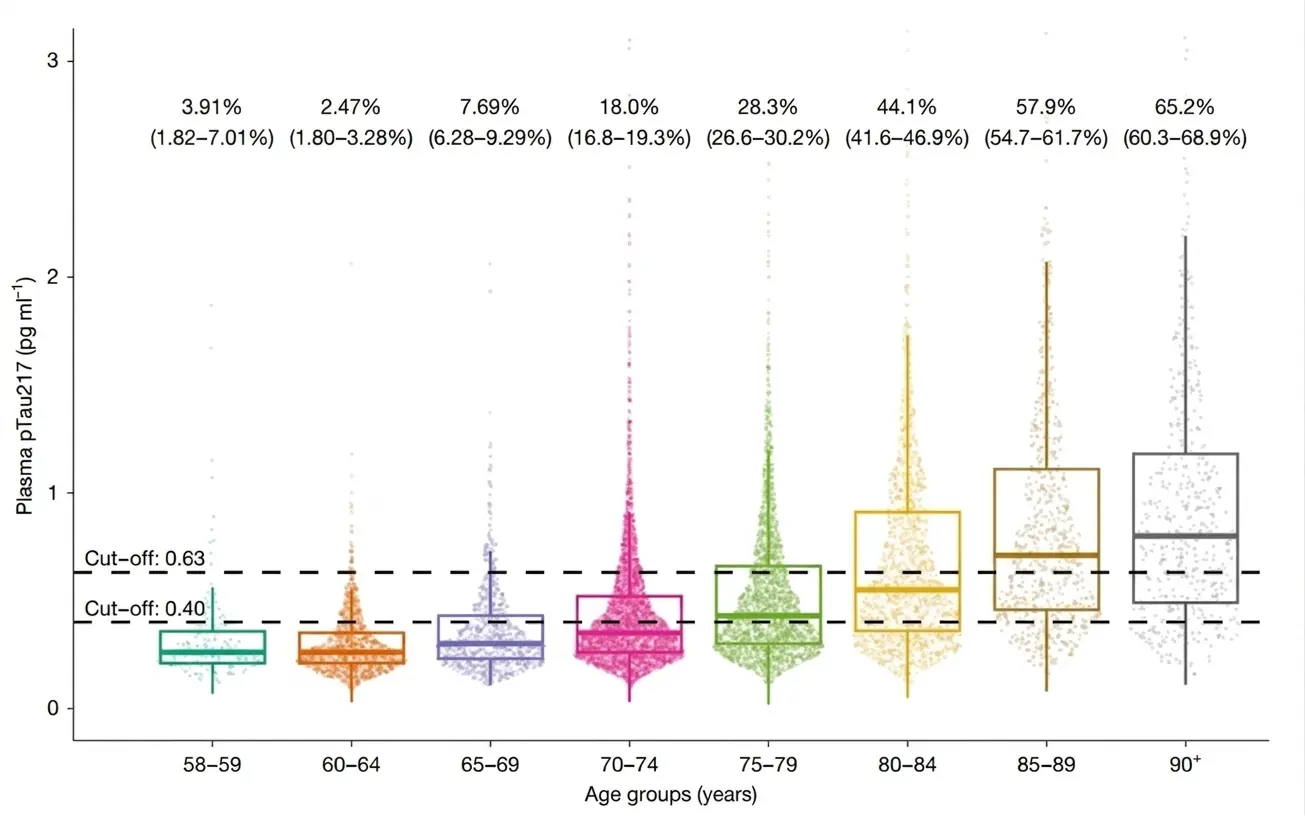
This pattern reinforces the idea that age is the primary risk factor for the development of Alzheimer’s pathology.
Alzheimer’s disease begins before clinical symptoms appear.
When the data from people over 70 are analyzed, the study identifies three clinical stages with remarkably similar prevalence:
- 10% → preclinical AD (no symptoms),
- 10.4% → prodromal phase (mild cognitive impairment),
- 9.8% → Alzheimer’s disease dementia.
This means that a very significant proportion of the population is in the early stages of the disease, and that there is as much active pathology in asymptomatic people as in people with established dementia.
Even cognitively healthy people may have pathology
One of the most striking findings is that 23.5% of cognitively healthy people have changes consistent with Alzheimer’s disease that can be detected using plasma p-tau217.
This reinforces the idea that Alzheimer’s disease is a biological process that begins years—or even decades—before clinical symptoms appear.
In addition, when biomarker levels are analyzed according to cognitive status, Alzheimer’s pathology is found not only in people with dementia, but also in individuals with mild cognitive impairment and even in those without clinical symptoms.
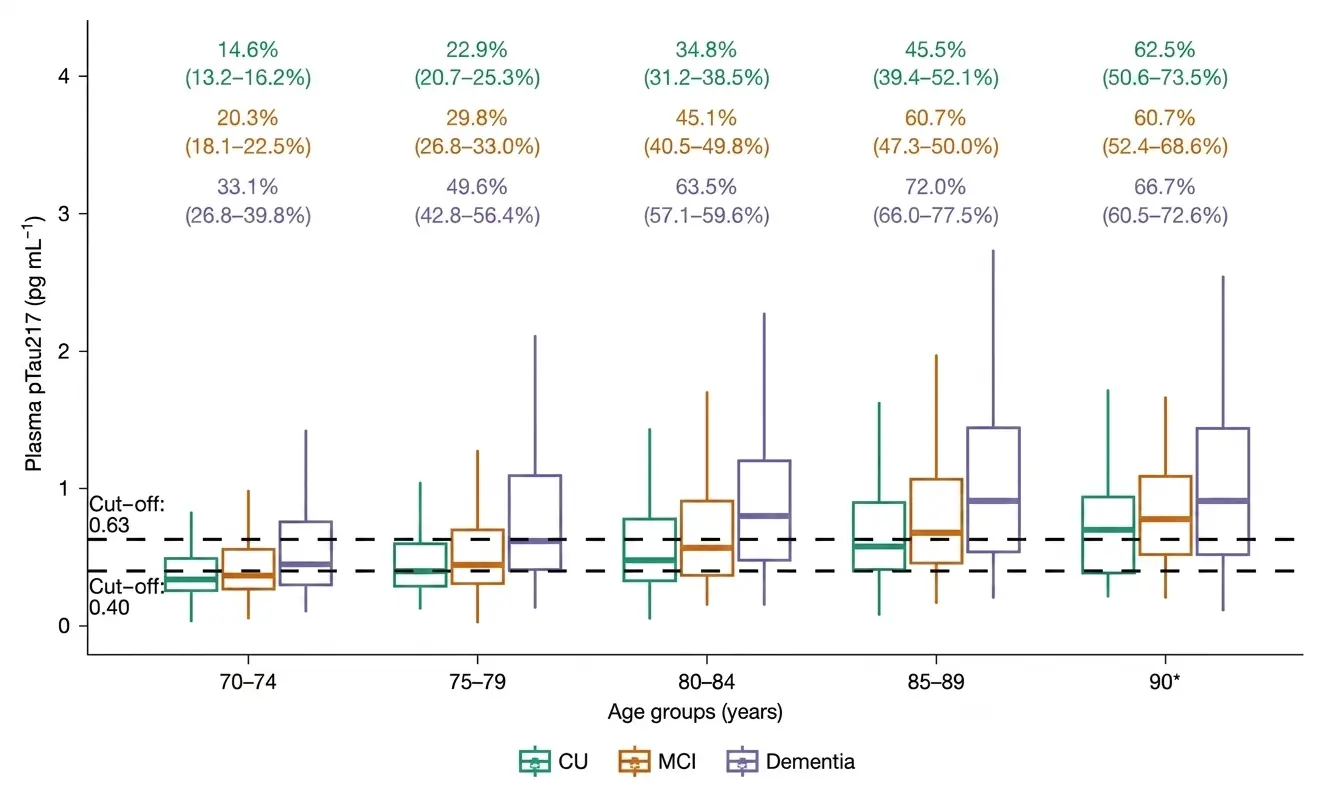
This finding supports the concept that Alzheimer’s disease begins as a silent biological process before becoming clinically apparent, with a window of years or even decades between the activation of the pathology and the first symptoms.
Not all dementia is caused by Alzheimer’s disease
Among people over 70 with a diagnosis of dementia:
- 60% of people with dementia → have Alzheimer’s pathology,
- 40% → have other causes.
This underscores the importance of biomarkers for a more accurate diagnosis.
Associated factors
The study identifies several factors associated with a higher prevalence of Alzheimer’s pathology in the population:
- Age (the most influential factor),
- APOE ε4 genotype,
- lower educational attainment.
By contrast, no clear associations with multiple chronic diseases were found after adjusting for relevant variables.
Summary of the main results
| Metric | Result |
|---|---|
| Prevalence >90 years | 65% |
| Prevalence ≥70 years | 33.4% |
| Preclinical AD | 10% |
| Prodromal AD | 10.4% |
| Alzheimer’s disease dementia | 9.8% |
| Pathology in cognitively healthy people | 23.5% |
| Potentially eligible for treatment | ~11% |
What are the implications for clinical practice?
Population screening and early detection
Using blood biomarkers can help identify people with biological changes consistent with early stages of the disease, always in combination with clinical, cognitive, and diagnostic assessment.
Patient selection for new treatments
Approximately 11% of adults over 70 could be candidates for disease-modifying therapies, which has a major impact on healthcare planning. Biomarkers may help identify people who could potentially be candidates for these therapies, together with clinical assessment and complementary diagnostic tests.
Redefining Alzheimer’s disease
This study reinforces a paradigm shift that the scientific community has been developing for years:
Alzheimer’s disease is not merely a clinical disease that appears with symptoms, but rather a biological continuum present in the population long before any detectable manifestation.
How does this advance relate to NeuronUP?
At NeuronUP, the goal is to improve cognitive intervention and rehabilitation based on scientific evidence.
Incorporating biomarkers such as p-tau217 makes it possible to:
- Identify biological changes at earlier stages,
- integrate biological findings with neuropsychological and functional assessment,
- design cognitive stimulation programs tailored to each person’s profile, needs, and progression;
- promote a multidisciplinary approach combining diagnosis, monitoring, and cognitive intervention.
This approach supports the development of more comprehensive care models in which early detection is accompanied by rigorous cognitive assessment and personalized intervention.
Conclusion
This study represents one of the most comprehensive analyses to date of the prevalence of Alzheimer’s pathology in the general population.
Its results show that:
- The pathology is much more common than expected in advanced age,
- a large proportion of the population has changes without symptoms,
- blood biomarkers make it possible to study Alzheimer’s disease on a large scale.
Taken together, these findings reinforce the need to advance toward early-detection models and comprehensive approaches in which tools such as NeuronUP play a key role in improving patients’ quality of life.
References
- Aarsland, D., Sunde, A. L., Tovar-Rios, D. A., Leuzy, A., Fladby, T., Zetterberg, H., et al. (2026). Prevalence of Alzheimer’s disease pathology in the community. Nature, 650, 182–186.
Frequently asked questions about p-tau217, blood biomarkers, and Alzheimer’s disease
1. What is p-tau217, and how is it related to Alzheimer’s disease?
p-tau217 is a phosphorylated form of the tau protein that can be measured in blood. Elevated levels are associated with neuropathological changes characteristic of Alzheimer’s disease, making it a promising biomarker for early detection.
2. Can blood biomarkers diagnose Alzheimer’s disease?
Blood biomarkers can help identify biological changes consistent with Alzheimer’s disease, but they should not be interpreted in isolation. Their results should be complemented by the patient’s clinical, cognitive, and functional assessment.
3. Can a person have Alzheimer’s pathology without symptoms?
Yes. The study shows that some cognitively healthy people have p-tau217 levels consistent with neuropathological changes associated with Alzheimer’s disease. This supports the idea that the disease may begin years before the first symptoms appear.
4. How does the prevalence of Alzheimer’s pathology increase with age?
Prevalence increases progressively with aging. The study found values below 8% among people aged 58 to 69, approximately 33% among people over 70, and above 60% among people over 90.
5. What role does cognitive assessment play in detecting Alzheimer’s disease?
Cognitive assessment makes it possible to identify impairments in memory, attention, executive functions, and other abilities. Although biomarkers provide biological information, neuropsychological assessment remains essential for understanding the functional impact of the disease and designing personalized interventions.







 Burnout Syndrome and Executive Functions: Evidence and Intervention in Clinical Neuropsychology
Leave a Reply