
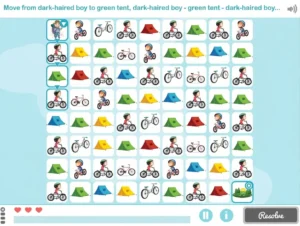
Discover the best NeuronUP activities for training alternating attention in adults.
Why train alternating attention in adults
Alternating attention is one of the most complex and essential executive functions in everyday life: it allows us to shift our focus of concentration between different tasks, stimuli, or rules quickly and smoothly. In the field of neuropsychological rehabilitation and cognitive stimulation for adults, training this ability is key to restoring mental flexibility, optimizing processing speed, and improving impulse control in changing situations.
In this article, we compile a selection of the best NeuronUP activities for training alternating attention in adults. Discover adaptable and customizable activities that will allow you to structure efficient, engaging intervention sessions focused on specific clinical goals.
Activities for training alternating attention in adults
- Waiter in Action
- Find Your Luggage
- Jump the Squares
- Maze with Alternating Instructions
- The Animated Maze
- Card Pyramid
- Actions According to Numbers
1. Waiter in Action
What does it involve?
This NeuronUP game places the adult user in the role of a waiter who must manage and serve multiple orders in a busy restaurant. The key to the task is accurately serving the dishes requested by each customer while the sequence and menus change dynamically.
It requires maintaining active concentration on the overall task, continuously alternating the attentional focus and quickly adapting to unexpected changes in the order.
Intervention areas
Waiter in Action allows you to work on:
- Alternating attention: Requires shifting the cognitive focus between different customers and orders as requests change.
- Selective and sustained attention: Helps maintain continuous concentration while filtering out irrelevant or outdated information.
- Inhibition (impulse control): Stops automatic responses before delivering an order when a last-minute change is detected.
Clinical customization
This activity allows the difficulty level to be adapted and specific parameters to be modified according to each user’s individual needs or degree of impairment.
The Waiter in Action game is ideal for working with adults with acquired brain injury (ABI), neurodegenerative diseases, or neurodevelopmental disorders in adulthood.
Available languages
Spanish, English, French, and Portuguese.
Version for children
For work with children, the platform offers the adapted version Animals Restaurant.
2. Find Your Luggage
What does it involve?
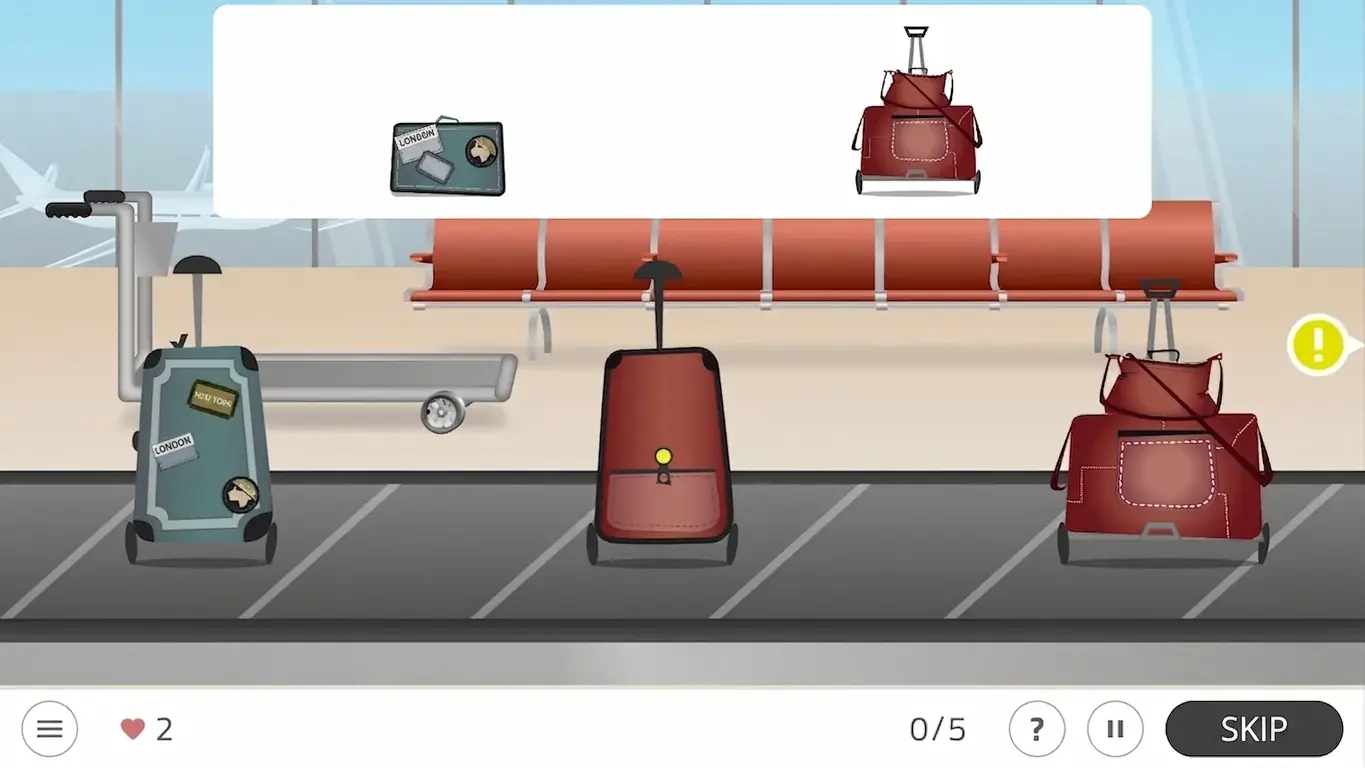
This NeuronUP game simulates collecting luggage from an airport conveyor belt. Users must visually discriminate between moving suitcases and accurately identify those that match the reference models in pattern, color, and details.
As users progress through the stages, complexity increases as the number of suitcases to track and the similarity among distractors increase, requiring careful analysis before the available lives run out.
Intervention areas
Find Your Luggage allows you to work on:
- Alternating attention: The alarm activation throughout the exercise requires continuously alternating between visual stimuli.
- Selective and sustained attention: Requires focusing on specific features and continuously ignoring irrelevant stimuli.
- Working memory: Keeps the characteristics of the visual model active in mind while scanning the belt.
- Processing speed: Requires identifying and selecting the correct object in time while the luggage moves along the belt.
Clinical customization
The exercise has three difficulty levels (easy, medium, and hard), each consisting of four stages, allowing for gradual progression adapted to the user’s needs.
Available languages
Spanish, English, French, Portuguese, Catalan, German, and Italian.
3. Jump the Squares
What does it involve?
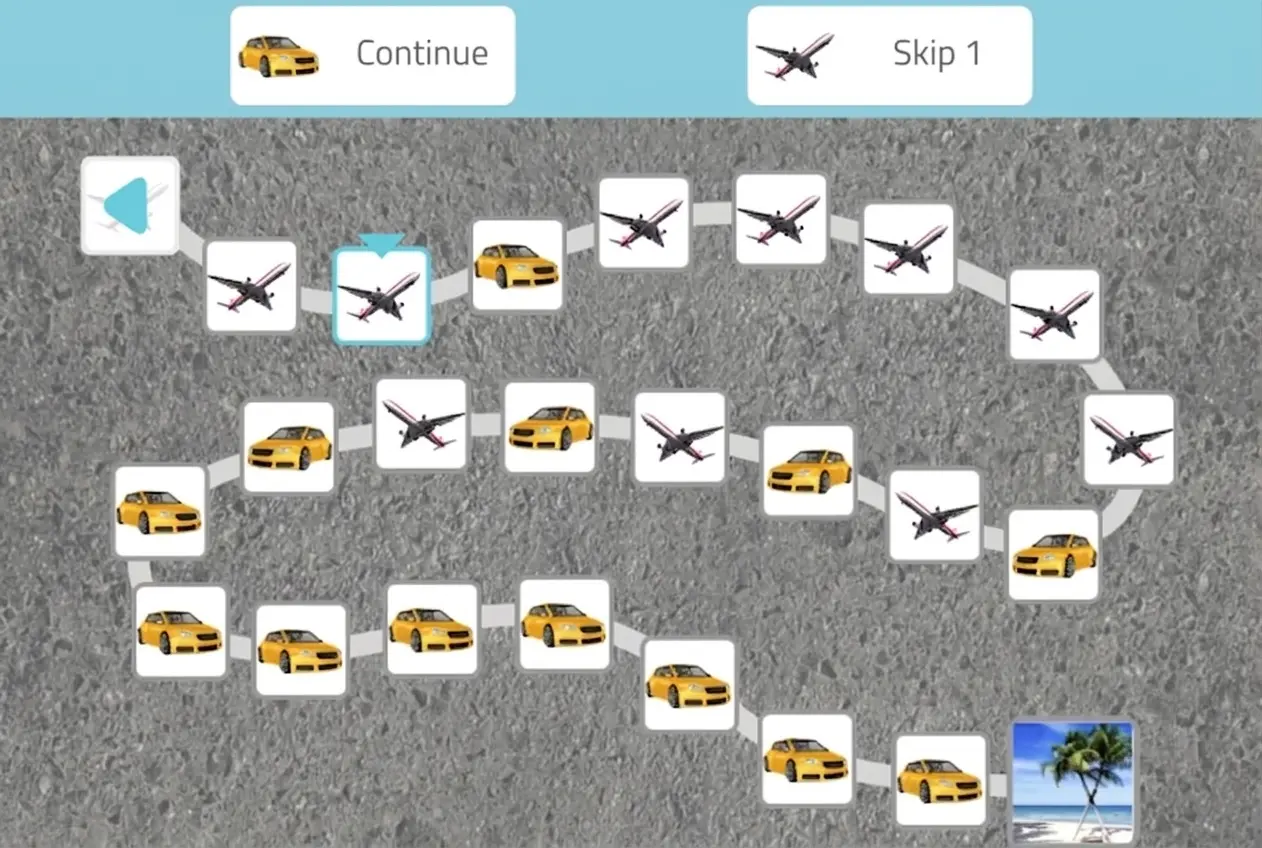
These NeuronUP worksheets present a route along a path of squares and icons where the user must reach the final goal by moving forward, jumping, or moving backward according to changing instructions. The activity requires the adult to adjust their behavior on the go, restructuring their response pattern each time a new rule is introduced along the route.
It is an exercise widely used in the neuropsychological rehabilitation of conditions such as multiple sclerosis.
Intervention areas
Jump the Squares allows you to work on:
- Alternating attention: Requires smoothly alternating the cognitive focus between interpreting the current rules and navigating the squares accurately.
- Inhibition (impulse control): Suppresses the automatic tendency to move forward linearly, requiring the user to pause before making conditional jumps or backward moves.
- Mental flexibility: Exercises the ability to adapt to unexpected changes in the exercise conditions.
Clinical customization
The difficulty increases from short routes with simple instructions at the initial levels to complex paths with multiple simultaneous variables at the advanced levels.
It also offers maximum flexibility in application, as it is available both as an interactive digital activity and as printable paper worksheets.
4. Maze with Alternating Instructions
What does it involve?
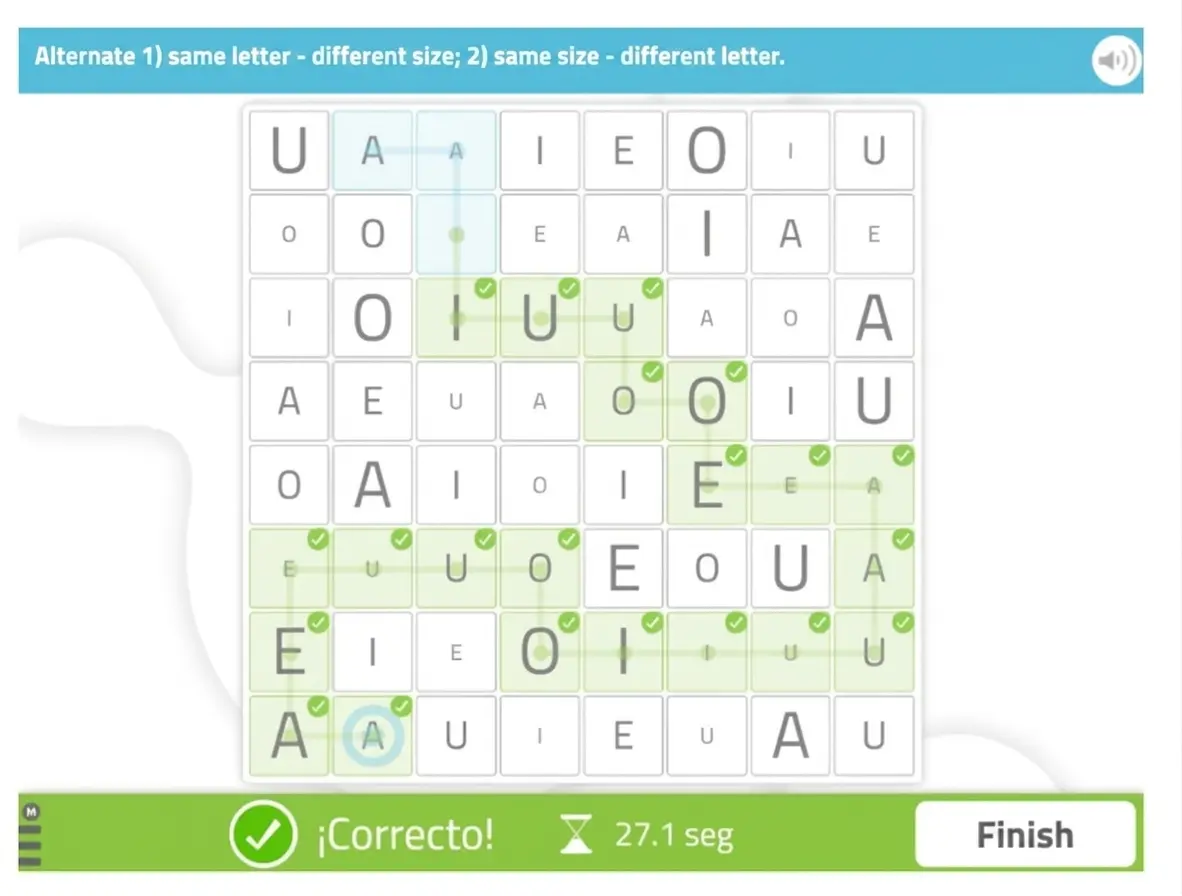
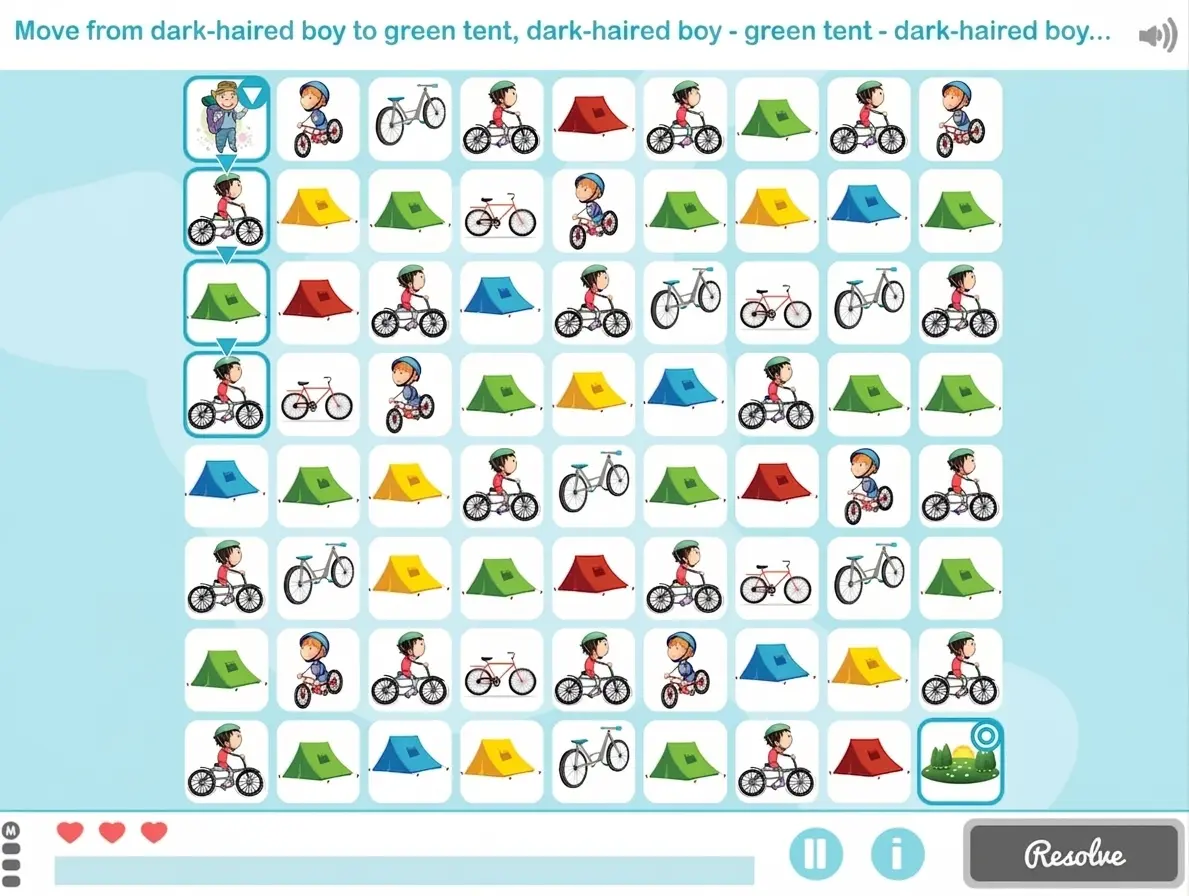
These NeuronUP worksheets propose navigating a visual maze to reach the goal by constantly switching movement rules. The user must move from square to square, systematically alternating between two logical criteria (for example, selecting the same character while varying its size and then, on the next move, keeping the size while changing the character). The route also requires respecting strict spatial restrictions, such as not repeating squares or making diagonal moves.
Because of its structure based on attentional control and following complex instructions, it is a key tool in the rehabilitation of adults with acquired brain injury.
Intervention areas
Maze with Alternating Instructions allows you to work on:
- Alternating attention: This is the core of the activity, requiring the user to smoothly change the selection criterion and logical rule at each step.
- Selective attention: Requires analyzing and isolating specific visual features (size or letter type) among multiple concurrent alternatives.
- Flexibility and planning: Requires monitoring the sequence of movements to plot the correct route without violating the rules or running out of valid options.
Clinical customization
These worksheets are available in both interactive digital and printable paper formats, facilitating their integration into clinical practice or remote interventions.
5. The Animated Maze
What does it involve?
This NeuronUP activity proposes navigating a visual maze to reach the goal by constantly switching movement rules. The user must move from square to square, systematically alternating between two logical criteria (for example, selecting the same character while varying its size and then, on the next move, keeping the size while changing the character). The route also requires respecting strict spatial restrictions, such as not repeating squares or making diagonal moves.
Intervention areas
The Animated Maze allows you to work on:
- Alternating attention: This is the core of the activity, requiring the user to smoothly change the selection criterion and logical rule at each step.
- Selective attention: Requires analyzing and isolating specific visual features (size or letter type) among multiple concurrent alternatives.
- Flexibility and planning: Requires monitoring the sequence of movements to plot the correct route without violating the rules or running out of valid options.
Clinical customization
These worksheets are available in digital and paper formats, allowing them to be integrated into clinical practice or remote rehabilitation sessions.
In addition to these five activities for training alternating attention in adults, we propose two others that, although they do not train alternating attention as their primary function, include it as a secondary function:
6. Card Pyramid
What does it involve?
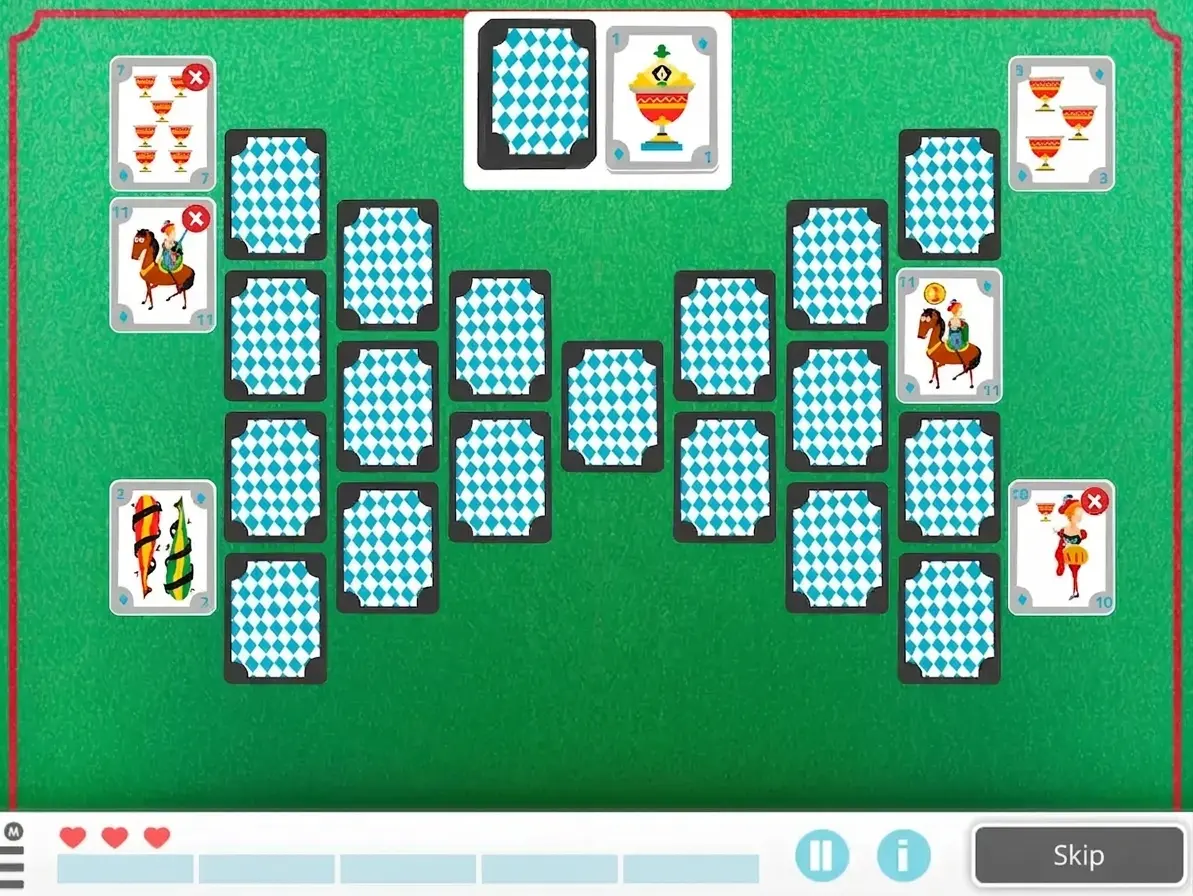
This NeuronUP game challenges adult users to arrange playing cards in consecutive order, either ascending or descending, regardless of suit. Based on the Spanish deck—where the logical sequence progresses from the seven to the jack, and the king links back to the ace—the task requires clearing the layout in a maximum of five screens. To facilitate independent task management, the interface includes a visible timer and issues alerts when it detects inactivity, keeping the user engaged with the exercise.
Intervention areas
Card Pyramid allows you to work on:
- Flexibility: Allows the user to continuously adjust their reasoning, as they must switch from ascending to descending order according to the options available on the table.
- Planning: Requires anticipating moves and developing a tactical strategy to determine which cards should be removed first and which will be unlocked.
- Alternating and selective attention: Requires visually tracking the target card while ignoring irrelevant features (such as suit), continuously alternating the focus between the pyramid and the deck.
Clinical customization
The activity stands out for its clinical adaptability. As the user progresses, the therapist can increase complexity by modifying key parameters. By default, it has three preset levels (easy, medium, and hard), with two stages at each level.
Available languages
Spanish, English, French, Portuguese, Catalan, and Italian.
7. Actions According to Numbers
What does it involve?
In this NeuronUP activity, the user must perform a specific task or action in response to the numerical code presented at each moment. The activity demands high mental agility, as it requires quickly associating each digit with its corresponding rule and reacting immediately but accurately, alternating the type of response as the numerical stimuli change on the screen.
Intervention areas
Actions According to Numbers allows you to work on:
- Processing speed: This is the core of the exercise, challenging the adult to interpret the stimulus and perform the correct action as quickly as possible.
- Alternating attention: Requires continuously switching the attentional focus between the different instructions associated with each digit.
- Inhibition (impulse control): Suppresses the tendency to respond hastily or automatically, ensuring that the user checks the rule before acting.
- Working memory: Retains and keeps active in mind the rules and instructions linked to each number throughout the task.
Clinical customization
The activity offers a methodological progression organized into 5 difficulty levels (basic, easy, medium, hard, and advanced), with 5 stages per level. To facilitate its use in different clinical settings, it is available both in digital format and as paper worksheets.
Available languages
Spanish, English, French, Portuguese, Catalan, and German.
Summary of NeuronUP activities for training alternating attention in adults
| Activity name | Who it is for | Activity type | Intervention areas |
|---|---|---|---|
| Waiter in Action | Adults | Game | Alternating attention, inhibition, selective attention, and sustained attention |
| Find Your Luggage | Adults | Game | Alternating attention, selective attention, and sustained attention |
| Jump the Squares | Adults | Worksheets | Alternating attention and inhibition |
| Maze with Alternating Instructions | Adults | Worksheets | Alternating attention and selective attention |
| The Animated Maze | Adults | Worksheets | Alternating attention and selective attention |
| Card Pyramid | Adults | Game | Flexibility, planning, selective attention, and alternating attention |
| Actions According to Numbers | Adults | Worksheets | Processing speed, alternating attention, inhibition, and working memory |
Frequently asked questions about alternating attention in adults
1. What is alternating attention, and why is it important in adults?
Alternating attention is the cognitive ability that allows us to flexibly shift our attention between different tasks, rules, or stimuli without losing track of what we are doing. In adults, it is essential for daily independence, as it is involved in everyday activities such as following a recipe while responding to interruptions, switching between different work windows on a computer, or managing unexpected events while driving.
2. What is the difference between alternating attention and divided attention?
Although they are often confused, the difference lies in simultaneity:
- Alternating attention: The brain shifts its focus of concentration from one task to another sequentially (first task A, then B, and then A again), adapting to different rules at each step.
- Divided attention: Requires processing two or more sources of information or performing multiple tasks simultaneously (for example, talking on the phone while walking).
3. Which profiles or conditions are these exercises recommended for?
Alternating attention activities are key components of neuropsychological rehabilitation and cognitive stimulation for:
- People with acquired brain injury (ABI) resulting from a stroke or traumatic brain injury.
- People with neurodegenerative or demyelinating diseases, such as multiple sclerosis, Parkinson’s disease, or mild cognitive impairment (MCI).
- Adults with ADHD to improve impulse control and mental flexibility.
- Active aging to prevent attentional decline and strengthen cognitive reserve.
4. How often is it recommended to train alternating attention?
To promote neuroplasticity and transfer to everyday life, sessions 2 to 4 times per week, lasting approximately 20 to 40 minutes, are recommended. It is essential to adjust the difficulty through personalized levels and parameters to maintain motivation and prevent cognitive fatigue or frustration.
5. Is it preferable to do these exercises on a screen or on paper?
Both formats are complementary. The NeuronUP digital platform offers advantages such as precise time measurement, automatic level progression, and instant feedback. Paper worksheets, in turn, are ideal for working on visuomotor integration and physical tracking across the table, and for facilitating intervention at home or without an internet connection.


 Sleep Duration and Biological Brain Aging: Clinical and Neurobiological Implications
Leave a Reply