

Today we are presenting two new activity packs designed with high ecological value, created to train cognitive functions within everyday and meaningful situations for users.
These activities recreate familiar contexts, making it easier for people to transfer what is practiced in session to their daily lives.
At a clinical level, they make it possible to work on different components of attention, integrated into advanced activities of daily living, such as education in the case of children or leisure in the case of adults.
Below, we present the two new activity packs.
Ready for school: cognitive training in school contexts
This pack is designed to work on cognitive functions in situations typical of the school environment, a highly relevant context in children’s daily lives.
These activities feature very eye-catching visual designs intended to increase motivation during the task.
In the following video, our colleague and neuropsychologist Valeria Medina explains how each activity works.
![[EN]Arango_Cover_Kids.png (1)](https://neuronup.us/wp-content/uploads/2026/04/ENPortada-Arango_Kids.png_-1024x576.webp)
📚 Prepare for school
The activity takes place in a room where the child is packing their backpack before going to school.
The goal is to select only the objects they would take to school, ignoring other stimuli that appear on the screen.
🚌 Let’s go to school
In this activity, the child is on their way to school using public transportation.
The child must listen to different announcements and respond only when the indicated stop is mentioned.
The task includes two versions: bus and train, making it possible to adapt it to the child’s usual means of transportation and thus increase its realism and ecological validity.
🌲Going on a field trip
This activity recreates a school field trip, a very familiar experience for children.
The child must maintain attention to visual and auditory stimuli, responding when a specific image appears or when they hear a certain stimulus.
It includes two versions:
Version with sounds, especially useful for younger children or those with greater language difficulties.
Voice version, where the auditory stimulus is a word.
The activities follow a narrative sequence that reproduces the step-by-step flow of a school morning: Prepare to school → Let’s go to school → Going on a Field Trip.
This structure allows the professional to present the tasks as a short story, which can make the session more dynamic and understandable for the child, in addition to promoting the transfer to real situations in the educational environment.
Off we go: Cognitive training in everyday contexts
This pack recreates common situations that occur during a trip.
These activities use images based on real-life elements, which makes the task easier to understand and increases the ecological validity of the training.
In the following video, our colleague and neuropsychologist Valeria Medina explains how each activity works.
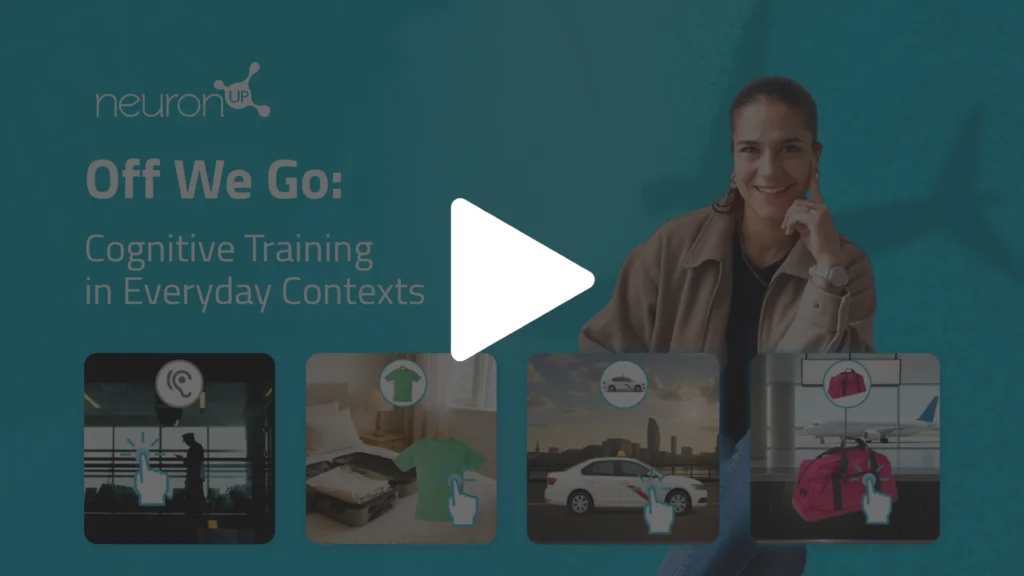
🧳Prepare your suitcase
In this activity, the user is simulated to be packing their suitcase before starting a trip.
At the beginning, a specific item of clothing is shown that they must locate.
From that moment on, different garments will appear on the screen and the goal will be to select only the indicated item of clothing, ignoring the rest.
🚕 Order a taxi
This activity simulates the moment of looking for a taxi to get around during the trip.
The user must stay attentive to visual and auditory stimuli, responding when they see a taxi or hear the word “taxi,” and ignoring other vehicles or sounds.
📢 Don’t miss your flight
The activity takes place at the airport, listening to announcements over the loudspeaker.
The user must respond only when they hear the indicated instruction, ignoring the rest of the announcements related to flights or boarding gates.
🛄Find your luggage
This task recreates baggage claim at the airport.
Different suitcases will appear on the conveyor belt, and the user must select a specific type of luggage.
At certain moments, a signal will sound indicating that they must change the instruction and start selecting another type of suitcase, thereby working on cognitive flexibility.
The activities also follow a logical sequence that reproduces the different stages of a trip: Pack the suitcase → Hail a taxi to the airport → Wait for the flight announcement → Collect the luggage at the destination
This step-by-step journey allows the professional to frame the intervention as a complete story or experience, which can increase the user’s interest and promote the generalization of what is practiced in session to real-life situations.

Subscribe
to our
Newsletter
These activities become an especially useful tool for the professional, since they make it possible to work on cognitive processes within functional contexts, helping the training have a more direct impact on users’ daily lives.
By recreating situations close to real-life experience, they can be used by any profile.
If you enjoyed this blog post about high ecological value activities, you will probably be interested in these NeuronUP articles:


 BrainAge and Alzheimer’s: How to Distinguish Brain Aging from Cognitive Decline
Leave a Reply