

The technical team at the Patronat Municipal de L’Hospital de Ciutadella shares its six years of experience with NeuronUP cognitive stimulation sessions.
Patronat Municipal de L’Hospital de Ciutadella
The Patronat
The Patronat is a public entity that reports to the town council. Its team of professionals includes nurses, nursing assistants, a social worker, a psychologist, activity coordinators, custodians, laundry and kitchen staff, and administrative staff. We also have external physical therapy and laundry services, physical activity instructors, a music therapist, and a psychologist specializing in animal-assisted therapy.
With 40 years of experience caring for older adults in our town, we offer residential care, an adult day center, and a service to promote independence:
The Patronat’s residential service
The residential service is a permanent, comprehensive care service for people over 55 whose personal independence is reduced when it comes to basic activities of daily living (BADLs) and who need constant supervision.
It can also include people whose social and family situation requires an alternative to their home and/or who lack sufficient financial resources to support themselves.
The Patronat’s adult day center
The adult day center is a daytime care service that provides support with basic activities of daily living (BADLs) for people with a certain degree of dependence, which helps them stay in their usual family and social environment.
The Patronat’s service to promote independence
The service to promote personal independence is a community-based social resource that aims to provide specialized, comprehensive care to promote personal and social independence and achieve healthy aging.
Over the years, we have evolved to adapt to the characteristics of each resident. Today, our mission is to provide care for older adults, their families, and the community across the biological, psychological, and social dimensions, to promote well-being and quality of life.
Taking a person-centered approach, we aim to know and recognize each person’s individuality, supporting their self-determination, promoting their functional independence, safeguarding their privacy, and helping them lead a meaningful life.

Subscribe
to our
Newsletter
What therapies at the Patronat are like
At our residence, for more than a decade we have focused our efforts on strengthening non-drug interventions, especially for residents affected by degenerative diseases such as dementia. Examples of these interventions include gardening, music therapy, cognitive stimulation, and animal-assisted therapy, which have gradually been added to what our center offers.
Cognitive stimulation has been promoted since a psychologist joined the center almost 20 years ago. As part of this work, and to give as many patients as possible access to cognitive stimulation, we introduced new technologies at the center in 2019.
Cognitive rehabilitation with NeuronUP at the Patronat Municipal de L’Hospital de Ciutadella
The need to improve our residents’ cognitive functioning and our goal of strengthening the cognitive abilities and skills they still have in order to delay decline led us to choose a digital platform.
Choosing NeuronUP has given us more flexibility to adjust training to each resident’s needs, while also offering more engaging and fun activities. We have also been able to extend it to more residents than with the traditional paper-and-pencil method.
At first, the people who took part were those already familiar with traditional cognitive stimulation. The move to the digital method was very well received and has been very successful.
The novelty and ease of use are remarkable. We have noticed a big difference between working with a tablet and working with a computer. Lack of practice, especially with the mouse, slows down task completion somewhat, so the tablet is the method we use most.
What these NeuronUP cognitive rehabilitation sessions are like
We currently use both digital and paper activities/sessions. The digital ones are usually done weekly under supervision. They include a variety of activities depending on the cognitive function being worked on and are short. The paper sessions are handed out as reinforcement activities for residents to do whenever they choose.
For weekly individual sessions, we use digital sessions, and we use paper-and-pencil group activities with some residents and with adult day center participants.
The sessions usually include three different activities that work on different cognitive abilities and last about 15 minutes. We use the weekly scheduled sessions with all residents who have similar abilities, or we adapt the difficulty or timing depending on the person.
Learn more about
NeuronUP


Regular users who benefit from NeuronUP
Mrs. M., age 95 and with no cognitive impairment, has used the program since it was introduced and loves using it every week. We do varied sessions working on different cognitive functions. Over the years, she has become more confident doing the activities, and it has helped her preserve her cognitive abilities. It’s worth noting that she usually ends her sessions by saying it’s “very nice” to work with the program and the tablet. Because she gets results right away, the interaction is very satisfying.
Mr. M., age 70 and with a history of stroke, has also used the program from the start. Weekly cognitive exercise has helped him preserve his cognitive abilities and improve those affected by his underlying condition. He takes part in the sessions with great motivation and feels very satisfied when he finishes.
Examples of NeuronUP sessions
Example of a NeuronUP session for mild cognitive impairment (MCI)
Here is an example of a digital session for a person with mild cognitive impairment, working on attention, processing speed, reasoning, and planning.
NeuronUP activities used in this MCI session:
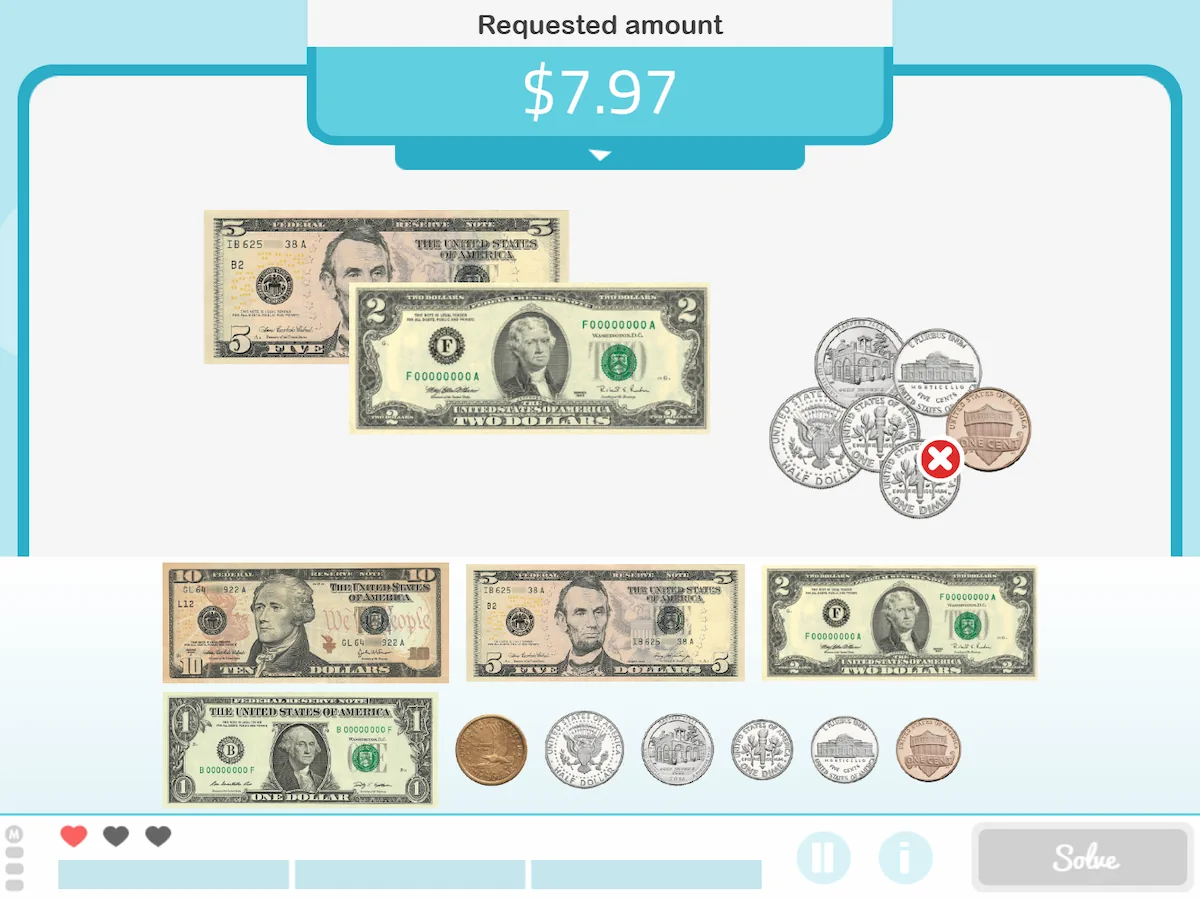
- Pocket Money, an activity aimed at working memory, planning, and shopping, in which users have to select the exact amount of money requested in the image.
- Count the stimuli, worksheets for working on processing, sustained attention, working memory, and planning. They involve counting the number of stimuli shown.
- Actions According to Numbers, worksheets for training processing speed, alternating attention, inhibition, and working memory. In this activity, users have to carry out different actions that change depending on the number.
Example of a NeuronUP session for moderate cognitive impairment
Below is an example of a simpler session that mainly works on attention and short-term memory, for people with moderate cognitive impairment.
NeuronUP activities used in this session for moderate cognitive impairment:
- Mark the different image, worksheets for training processing speed and selective attention, in which users have to point to the image that is different in a series.
- Racing with Partners, an activity for working on processing speed, selective attention, and sustained attention. It involves matching the items shown on screen as quickly as possible.
- Remember the Names (audio), an auditory activity aimed at episodic memory. It involves memorizing the names heard and matching them with the right person.
Conclusion
In conclusion, most residents love using the NeuronUP cognitive rehabilitation and stimulation platform. What’s more, they always look forward to using it. The wide variety of exercises and ways to combine them, the quick interaction, and how easy it is to use make NeuronUP a great tool that all of us at the Patronat Municipal de L’Hospital de Ciutadella, both staff and residents, are delighted with.
If you enjoyed this blog post on the use of NeuronUP as a working tool at the Patronat Municipal de L’Hospital de Ciutadella, you may also be interested in these NeuronUP articles:
“This article has been translated. Link to the original article in Spanish:”
Uso de NeuronUP como herramienta de trabajo en el Patronat Municipal de L’Hospital de Ciutadella

 PsicoNED and NeuronUP in Zanzibar: Neuropsychology, Cooperation and Hope

Leave a Reply