
People with mental illness experience impairments in cognitive function, as well as difficulties with concentration, decision-making, or planning. Therefore, at NeuronUP we offer rehabilitation to work on the cognitive decline associated with mental health disorders with activities that train sustained attention, spatial relations, working memory, reasoning and episodic memory, among others.
1. Organize the Bookcase
The first activity for people with mental illness is Organize the Bookcase.
What does it involve?
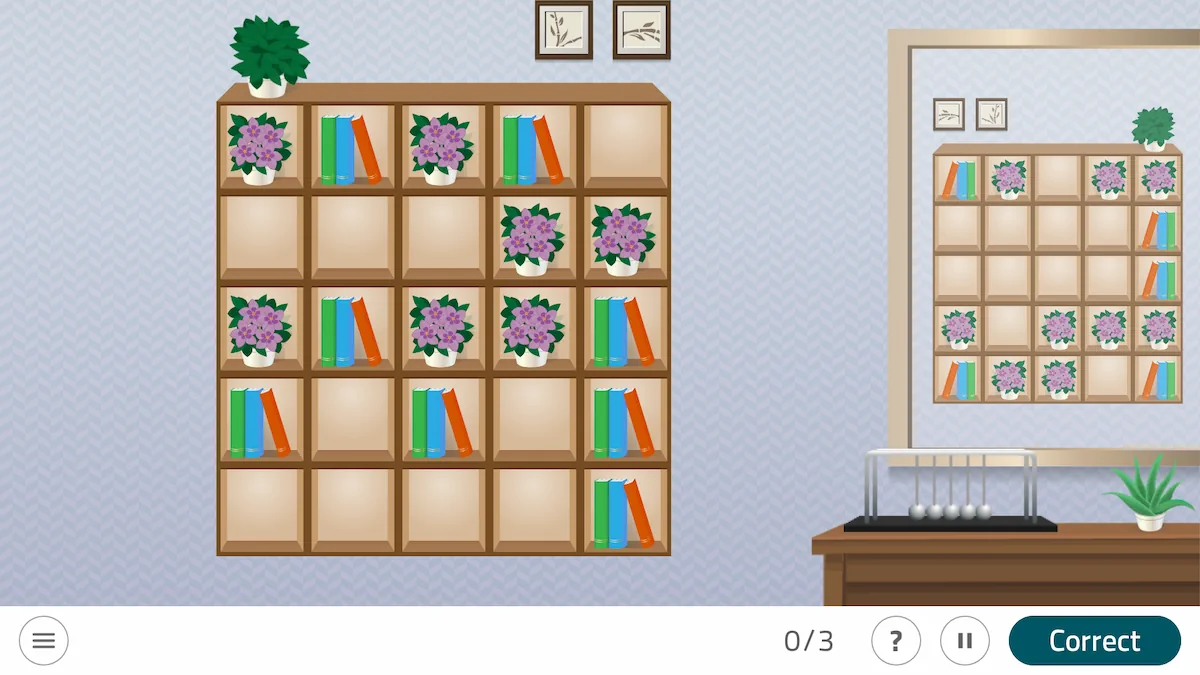
This activity consists of copying the position of the model’s objects, bearing in mind that the model to follow is shown as a mirror image, so the user will have to copy it in reverse.
For example, in the following image there may be different types of objects on the shelf, so the user will have to select and reposition them until they find the correct option.
What does this activity train?
This NeuronUP activity trains sustained attention, spatial relations, selective attention and hemineglect.
Play by levels
Remember that you can choose the level of difficulty you want to adapt the activity to the needs and abilities of each user. The higher the level, the more difficult it will be to copy the positions of the objects.
Activity customization
General aspects
You will be able to customize: the number of exercises (total, passed, acceptable and failed), the maximum time, the inactivity warning and the timer.
Parameters
As a professional you will be able to customize the game according to each user’s age and personal abilities . In this regard, you can choose:
- The size of the matrix,
- the number of options.
2. Form words by combining letters
Another activity for people with mental illness is Form words by combining letters.
What does it involve?
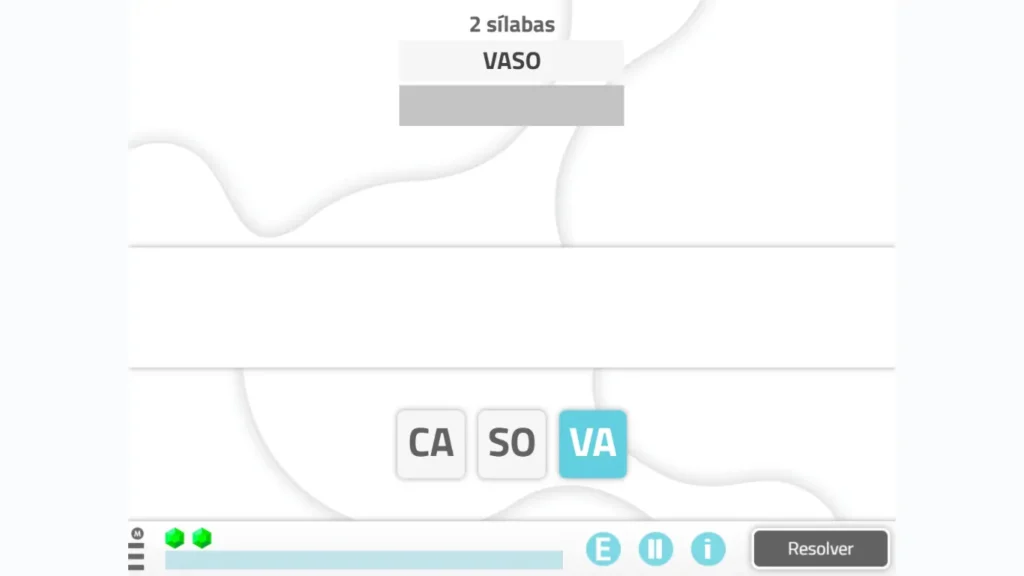
The user will have to form words by combining different letters and syllables.
For example, in the following image the word “glass” has been formed using the 3 syllables below. In this particular worksheet the user must form two words in total.
What does this activity train?
This worksheet trains working memory, flexibility and vocabulary.
Play by levels
This working memory activity has five levels of difficulty: basic, easy, medium, difficult and advanced. As the level advances, complexity will increase.
Format
This worksheet is also available on paper.

Subscribe
to our
Newsletter
3. Organizing a timetable
What does it involve?
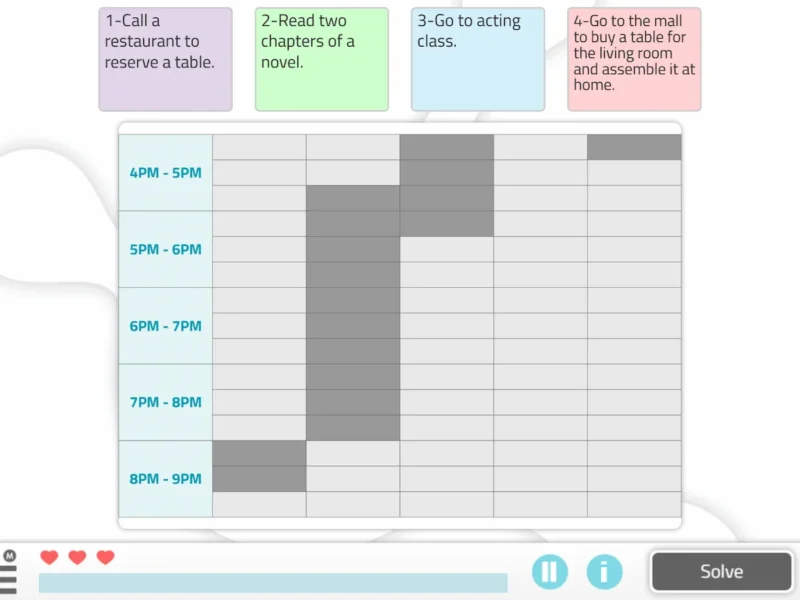
In this worksheet for people with mental illness, the user must organize various tasks in a planner based on the available time.
For example, in the following worksheet, the user must place the 4 tasks from the top into the slots that appear in the schedule in a darker tone.
What does this activity train?
This worksheet trains time estimation and planning.
Play by levels
This time estimation activity has four levels of difficulty: basic, easy, medium and difficult. As the level advances, complexity will increase.
Format
This worksheet is also available on paper.
5. Pick Up your Baggage
What does it involve?
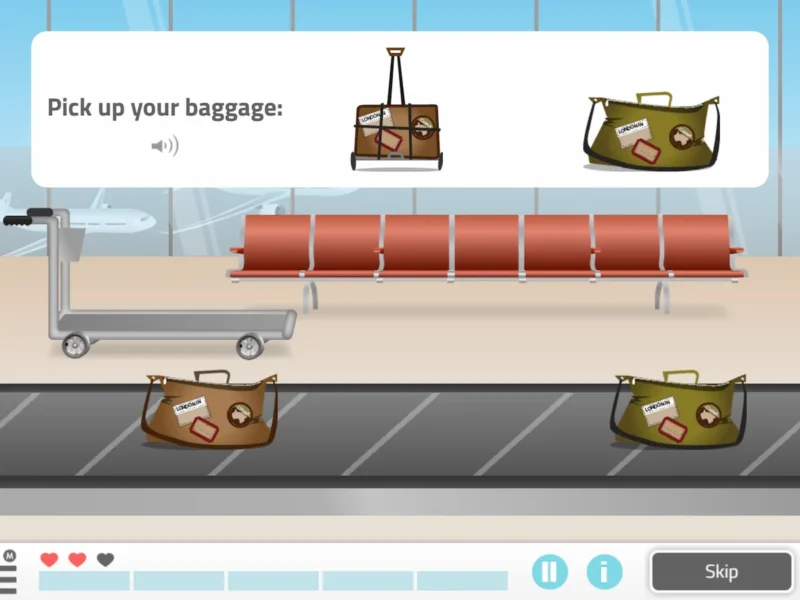
The user, in this activity for people with mental illness, has to select only the suitcases matching the model from a set of moving luggage.
For example, in the following image the user must wait for the correct suitcase to pass along the conveyor belt.
What does this activity train?
This activity for cognitive rehabilitation in mental health trains selective attention, sustained attention, processing speed, working memory and leisure.
Play by levels
Remember that you can choose the level of difficulty you want to adapt the activity to the needs and abilities of each user. The more difficult the level, the harder it will be to select the suitcases.
Activity customization
General aspects
You will be able to customize: the number of exercises (total, passed, acceptable and failed), the maximum time, the inactivity warning and the timer.
Parameters
- Similarity between stimuli,
- the exposure time,
- the number of target stimuli,
- the frequency of the stimuli,
- the quantity of stimuli,
- the correction criterion,
- the total duration,
- the maximum errors.
If you liked this post about cognitive rehabilitation in mental health and activities for people with mental illness, you may also be interested in these NeuronUP articles:




“This article has been translated. Link to the original article in Spanish:”
Rehabilitación cognitiva en salud mental: actividades para personas con enfermedad mental

 Improve cognitive development in children: Motivating activities for NeuronUP children



Leave a Reply