

Doctoral student Marta Arbizu Gómez analyzes the scientific evidence on prescribing physical exercise to protect brain health during aging.
Introduction
Physical exercise and cognitive decline are closely related. Scientific evidence shows that regular physical activity is an effective nonpharmacological intervention for slowing cognitive decline in aging and reducing the risk of dementia. Its effect is associated with increased brain-derived neurotrophic factor (BDNF), improved cerebral blood flow, and reduced vascular risk factors.
Why is physical exercise key to brain health during aging?
Alzheimer’s disease and other dementias represent one of the greatest health challenges of the 21st century. As the population ages, the number of people affected continues to increase, and to date there is no cure capable of stopping the course of the disease. In this context, identifying effective, accessible strategies based on scientific evidence is a priority.
Among modifiable risk factors for Alzheimer’s disease, physical inactivity stands out as one of the most relevant. Several studies have shown that a low level of physical activity in midlife is associated with a greater risk of developing dementia later in life. However, despite this evidence, exercise is rarely prescribed systematically with the explicit goal of improving or preserving cognitive function.
The article published in Exercise, Sport, and Movement by Heisz and Waddington (2023) addresses precisely this gap, proposing clear principles for prescribing exercise focused on brain health during aging.
What happens in the brain during aging?
Normal aging is associated with a progressive decline in memory and structural changes in the brain, especially in the hippocampus, a region essential for learning and memory. In people with Alzheimer’s disease, this process accelerates markedly, with a hippocampal atrophy rate approximately 2.5 times higher than that observed in healthy aging.
The good news is that the brain retains a remarkable capacity for adaptation. Evidence shows that physical exercise can increase hippocampal volume, improve cerebral blood flow, and promote neural plasticity, even when it is initiated at an advanced age. In other words, it is never too late to start.
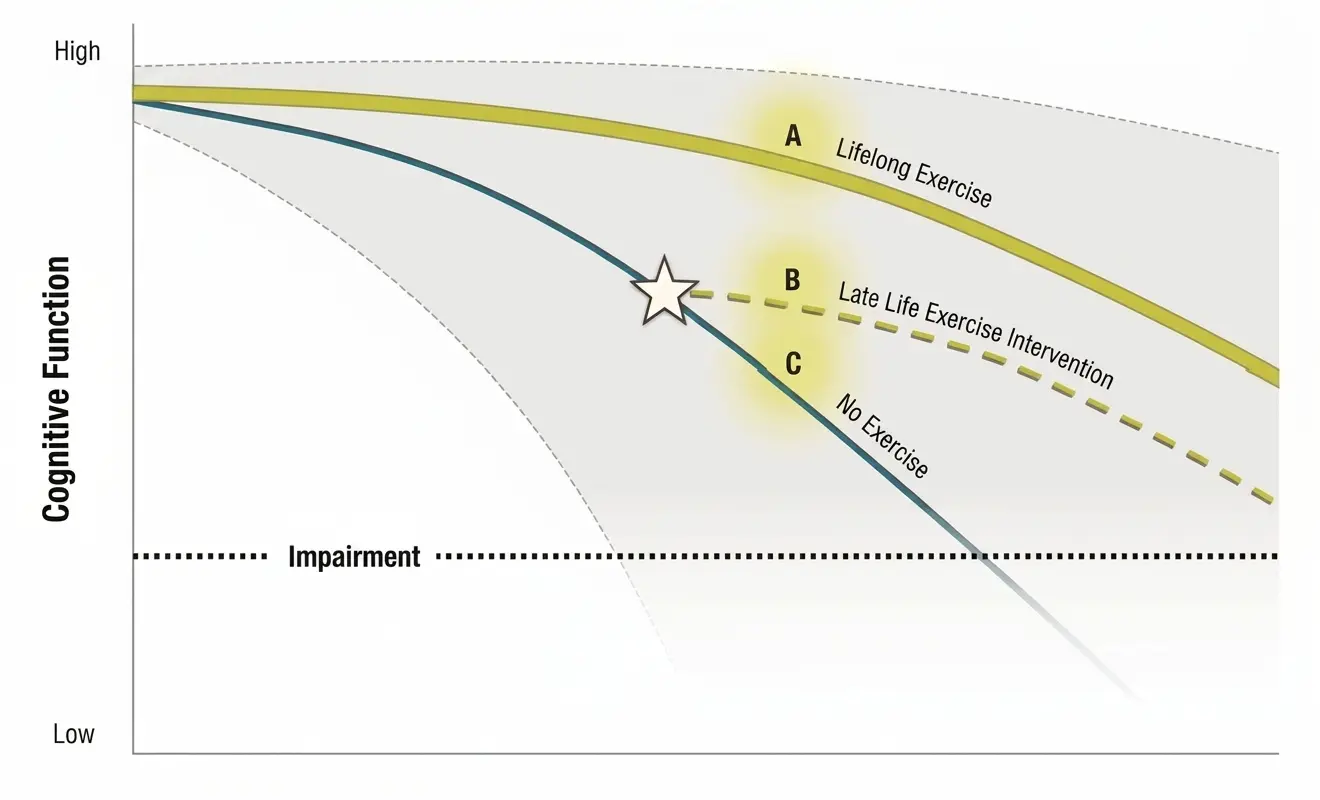
Source: Heisz JJ, Waddington EE. The Principles of Exercise Prescription for Brain Health in Aging. Exercise, Sport, and Movement, 2023.
Neurobiological mechanisms: how does exercise affect the brain?
One of the article’s most interesting aspects is its explanation of the biological mechanisms connecting exercise with cognitive function. During moderate or vigorous exercise, muscles release signaling molecules—known as myokines—among which lactate stands out.
This lactate crosses the blood–brain barrier and activates production of brain-derived neurotrophic factor (BDNF) in the hippocampus. BDNF plays a fundamental role in neuroplasticity, neurogenesis, and memory and learning processes. Thus, exercise not only improves vascular or metabolic health, but also acts directly on the brain mechanisms that support cognition.

Subscribe
to our
Newsletter
Principles for prescribing physical exercise to improve cognition
Based on the available evidence, the authors propose an adaptation of the FITT model (Frequency, Intensity, Time, and Type) specifically focused on brain health:
- Frequency: exercise should be performed as often as possible. There is no minimum threshold: any amount of activity is better than none.
- Intensity: moderate-to-vigorous exercise is recommended because this level most consistently promotes activation of the muscle–brain mechanisms. The familiar talk test can be used as a practical guide for adjusting intensity.
- Time (weekly dose): to obtain clinically relevant cognitive benefits, the following doses are proposed:
- Minimum:
- 70 minutes per week of moderate exercise,
- or 35 minutes per week of vigorous exercise.
- Optimal:
- 140 minutes per week of moderate exercise,
- or 75 minutes per week of vigorous exercise.
- Minimum:
- Type of exercise: evidence supports a combination of modalities:
- Aerobic exercise (walking, swimming, cycling).
- Strength or resistance training.
- Multicomponent programs that include balance.
- Activities such as Tai Chi or yoga.
In addition, the added value of integrating cognitive challenges during physical activity is highlighted (for example, moving through new environments or performing orientation tasks), as is promoting exercise in socially stimulating contexts, which improves adherence and reduces risk factors such as loneliness.
What are the implications of physical exercise for clinical and preventive practice?
These principles reinforce a key idea: physical exercise can and should be considered a first-line preventive intervention for brain health, comparable in importance to other lifestyle recommendations.
The flexibility of the guidelines allows them to be adapted to different levels of functional ability, facilitating implementation in both community programs and clinical settings. Long-term consistency, rather than momentary intensity, emerges as the decisive factor in preventing cognitive decline.
How does this approach to physical exercise and cognitive decline relate to NeuronUP?
At NeuronUP, work is based on an evidence-based perspective to improve and preserve cognitive function. The principles described in this article naturally align with an integrated approach to brain care, in which physical activity, cognitive stimulation, and longitudinal monitoring reinforce one another.
Combining well-prescribed exercise programs with digital rehabilitation and cognitive training tools makes it possible to:
- Enhance neuroplasticity through multiple pathways.
- Personalize interventions according to the user’s profile.
- Continuously monitor cognitive progress.
Conclusion
Physical exercise is not merely a general health recommendation, but a specific and powerful tool for protecting cognitive function during aging. The proposal of clear principles for its prescription represents an important step toward its systematic integration into dementia prevention strategies.
In a context where population aging is unstoppable, moving toward accessible, customizable, and sustainable interventions is essential. Properly prescribed exercise is becoming one of the fundamental pillars of healthy brain aging.
References
- Heisz JJ, Waddington EE. The Principles of Exercise Prescription for Brain Health in Aging. Exercise, Sport, and Movement. 2023;2(1):e00019. doi:10.1249/ESM.0000000000000019.
Frequently asked questions about physical exercise and brain health
1. How many minutes of exercise are needed to improve cognitive function?
To obtain clinically relevant cognitive benefits, at least 70 minutes per week of moderate exercise or 35 minutes per week of vigorous exercise are recommended. The optimal range is 140 minutes of moderate or 75 minutes of vigorous exercise per week.
2. Can physical exercise prevent cognitive decline?
Yes. Scientific evidence shows that regular physical exercise is an effective nonpharmacological intervention for reducing the risk of cognitive decline and dementia. Its effect is related to improved cerebral blood flow, increased brain-derived neurotrophic factor (BDNF), and stimulation of neuroplasticity, especially in the hippocampus.
3. Does physical exercise increase brain-derived neurotrophic factor (BDNF)?
Yes. Moderate- to vigorous-intensity exercise increases the release of lactate and other myokines that stimulate BDNF production. BDNF is key to neuroplasticity, neurogenesis, and memory and learning processes.
4. Can physical exercise and cognitive stimulation be combined?
Yes. Combining physical exercise and cognitive stimulation enhances neuroplasticity through multiple pathways. While exercise promotes biological mechanisms (BDNF, cerebral perfusion), cognitive stimulation activates specific neural networks, producing a complementary effect.
5. Does physical exercise replace cognitive stimulation?
No. Physical exercise and cognitive stimulation act through complementary mechanisms. While exercise promotes neurobiological processes such as increased BDNF, cognitive stimulation strengthens specific neural networks. Combining both interventions offers greater benefits.
6. At what intensity should exercise be prescribed to obtain cognitive benefits?
Moderate to vigorous intensity is recommended. A practical guide is the “talk test”: during moderate exercise, a person can talk but not sing; during vigorous exercise, maintaining a conversation is difficult. This intensity most effectively activates the muscle–brain mechanisms.
7. What type of exercise is most effective for brain health?
Aerobic exercise has the strongest evidence for improving memory and hippocampal volume. However, the best results are obtained by combining aerobic exercise, strength training, and multicomponent programs that include balance and coordination.
8. Can physical exercise delay the onset of Alzheimer’s disease?
Exercise does not completely prevent Alzheimer’s disease, but it can delay its onset and reduce risk by acting on modifiable factors such as physical inactivity, vascular risk, and chronic inflammation.
9. Is physical exercise helpful for people with mild cognitive impairment (MCI)?
Yes. In people with mild cognitive impairment, regular physical exercise can slow the progression of decline, improve executive function, and support cognitive reserve. In addition, it is a safe intervention that can be adapted to different functional levels.











 Cognitive Reserve and Neuroplasticity in Aging: Clinical Implications for Assessment and Cognitive Stimulation
Leave a Reply