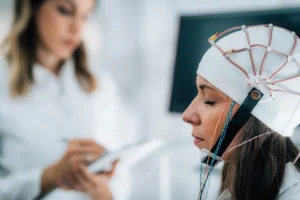
Doctoral researcher Marta Arbizu Gómez analyzes how noninvasive neuromodulation can modify brain activity during sleep and enhance neurorehabilitation.
Can we “hack” sleep to improve memory and brain health?
Sleep neuromodulation makes it possible to actively intervene in brain architecture to enhance memory and neurocognitive health. Through noninvasive techniques such as tDCS and synchronized auditory stimulation, it is possible to amplify slow waves and optimize the clearance of brain toxins. Integrating these advances with platforms such as NeuronUP maximizes the effectiveness of neuropsychological rehabilitation, enabling a multidisciplinary and personalized approach to cognitive impairment.
Sleep physiology and its impact on neurological and psychiatric disorders
We spend approximately one-third of our lives asleep, but sleep is far from a passive state. During the night, biological processes essential for brain and whole-body functioning take place.
Its most important functions include:
- memory and learning consolidation,
- emotional regulation,
- synaptic plasticity,
- the removal of metabolites and toxic proteins from the brain,
- and metabolic and immune regulation.
In fact, alterations in sleep architecture have been associated with multiple neurological and psychiatric disorders, including depression, insomnia, schizophrenia, mild cognitive impairment, and Alzheimer’s disease.
Given this context, a key question for current research is: can we actively intervene in sleep to improve its cognitive and therapeutic functions?
A comprehensive review article published in Physiological Reviews in 2026 explores precisely this question, analyzing how different noninvasive neuromodulation techniques can modify brain activity during sleep.
How was this research on noninvasive stimulation techniques conducted?
The paper reviews several decades of experimental studies that have developed methods to stimulate or modulate neural activity during sleep.
These techniques can be divided into two broad groups:
Transcranial brain stimulation
This includes methods that act directly on brain activity through electrical currents or magnetic fields applied to the scalp. The most extensively studied include:
- Transcranial magnetic stimulation (TMS).
- Transcranial electrical stimulation (tDCS or tACS).
These techniques make it possible to modify neural activity in specific brain regions and alter certain brain rhythms associated with sleep.
Sensory or peripheral stimulation
Rather than acting directly on the brain, these methods use sensory stimuli to influence neural activity during sleep. Examples include:
- sounds,
- tactile stimuli,
- olfactory stimuli,
- vagus nerve or vestibular system stimulation.
This type of intervention takes advantage of the fact that the brain continues to process sensory information during sleep, although differently than when we are awake.

Subscribe
to our
Newsletter
Auditory stimulation: a particularly promising technique
One of the most extensively studied approaches in recent years is auditory stimulation synchronized with sleep waves, known as phase-targeted auditory stimulation.
The procedure works as follows:
- Brain activity is recorded by electroencephalography (EEG) during deep sleep.
- When the system detects a slow wave characteristic of deep sleep,
- a brief, gentle auditory stimulus is played (for example, pink noise).
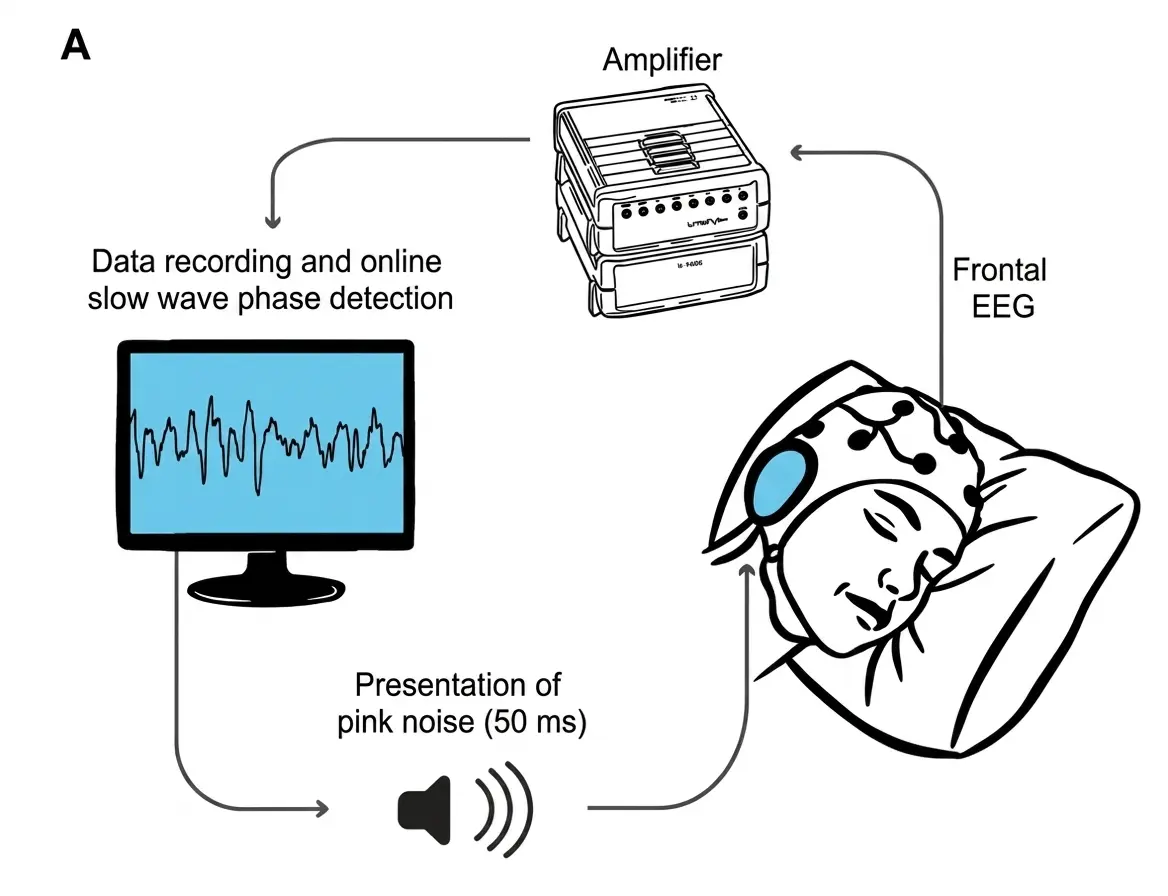
This stimulus is delivered at the exact point in the brain wave cycle, making it possible to amplify the wave.
Various studies have shown that this technique can:
- increase the intensity of slow-wave sleep,
- improve memory consolidation,
- and potentially strengthen processes of brain plasticity.
In addition, some experiments have used sounds previously associated with specific learning to reactivate memories during sleep, a phenomenon known as targeted memory reactivation.
What do the research findings reveal about neuromodulation during sleep?
Overall, the scientific literature suggests that modifying certain brain rhythms during sleep can influence various cognitive functions.
The most notable findings include:
- Slow-wave stimulation may support declarative memory consolidation;
- REM sleep modulation could influence emotional processing;
- and improving the quality of deep sleep could contribute to the brain’s metabolic clearance processes, which are relevant to neurodegenerative diseases.
However, the results still show substantial variability between individuals. Factors such as age, genetics, and sleep history can significantly influence the effectiveness of these interventions.
In addition, many studies have been conducted in small samples or in healthy individuals, so larger clinical trials are still needed to confirm their therapeutic utility.
Clinical applications of these neuromodulation findings
Although these technologies are still in the research phase, their potential applications are highly promising.
In the future, they could be used to:
1. Improve sleep disorders
Neuromodulation could become an alternative or complement to pharmacological treatments for insomnia, reducing dependence-related problems or side effects associated with some medications.
2. Enhance cognitive processes
Targeted stimulation during sleep could help strengthen learning and memory, with potential applications in education, neurological rehabilitation, and cognitive aging.
3. Address neurological diseases
Given sleep’s role in clearing toxic proteins from the brain, improving the quality of deep sleep could have implications for diseases such as Alzheimer’s disease or Parkinson’s disease.
How is this advance related to NeuronUP?
NeuronUP develops digital tools for rehabilitation and cognitive stimulation based on scientific evidence.
Advances in sleep research open up new possibilities for integrating different therapeutic strategies.
For example:
- Improving sleep quality could enhance the effects of cognitive rehabilitation programs.
- A better understanding of memory consolidation processes could help optimize the planning of cognitive training sessions.
- Combining sleep biomarkers with digital platforms would make it possible to further personalize interventions.
In this regard, research on sleep neuromodulation reinforces the idea that treatment of cognitive impairment should be addressed from a multidisciplinary perspective, combining advances in neuroscience, technology, and rehabilitation.
Conclusion
Sleep plays a fundamental role in brain health and in multiple cognitive functions. New noninvasive neuromodulation techniques are beginning to demonstrate that it is possible to modify certain neural processes during sleep to enhance its benefits.
Although many questions remain unanswered, this field of research opens a promising path toward improving learning, treating sleep disorders, and addressing neurological diseases.
In the future, combining these advances with digital cognitive rehabilitation tools—such as those developed by NeuronUP—could contribute to more personalized, preventive, and effective care.
References
- Krugliakova, E., Breuer, F., Adelhofer, N., Alonso, A., Besedovsky, L., Murphy, K., Peters, E., Raczek, K., Rasch, B., Salvesen, L., Snipes, S., Schoch, S., Schreiner, T., Wassing, R., Bergmann, T. O., & Dresler, M. (2026). Hacking the functions of sleep: Noninvasive approaches to stimulate sleep neurophysiology. Physiological Reviews, 106, 675–749. https://doi.org/10.1152/physrev.00007.2025
Frequently asked questions about sleep neuromodulation
1. Why is sleep quality essential for brain health?
Sleep is an active biological process that is essential for memory consolidation, learning, and emotional regulation. During sleep, critical mechanisms take place, including synaptic plasticity and the removal of metabolites and toxic proteins from the brain—processes that are vital for preventing cognitive decline and neurodegenerative diseases.
2. Is it possible to intervene in sleep to enhance therapeutic functions?
Yes. Current research in 2026 confirms that noninvasive neuromodulation techniques can be applied to modify neural activity during sleep. These interventions make it possible to amplify specific brain rhythms, which may improve declarative memory and support neurological rehabilitation in patients with various conditions.
3. Which noninvasive techniques can “hack” or modulate sleep?
The main tools fall into two groups:
- Transcranial brain stimulation: This includes electrical stimulation (tDCS/tACS) and magnetic stimulation (TMS) to act on specific brain regions.
- Sensory stimulation: Synchronized auditory stimulation (phase-targeted auditory stimulation) is particularly notable; it uses brief sounds to enhance slow waves during deep sleep.
4. What benefits does synchronized auditory stimulation offer?
This technique records brain activity by EEG in real time to deliver an auditory stimulus, such as pink noise, during specific phases of the slow-wave cycle. This method has been shown to increase the intensity of these waves, improve memory consolidation, and strengthen brain plasticity.
5. How is improved sleep related to digital cognitive rehabilitation?
Optimizing sleep architecture can significantly enhance the outcomes of training programs such as NeuronUP. Understanding consolidation processes enables professionals to plan therapeutic sessions more effectively, combining sleep biomarkers with digital tools for a more personalized and effective intervention.




 The Transformation of the DSM in Clinical Practice
Leave a Reply