

Doctoral researcher Marta Arbizu Gómez reveals how the exposome and habits such as smoking and diet predict brain aging.
This article examines how the exposome—the set of habits and medical conditions accumulated throughout life—determines brain health and predicts cognitive aging. Drawing on recent scientific evidence and the Brain Age Gap indicator, we break down why the timeline of factors such as hypertension, diabetes, and smoking accelerates neurological damage. Understanding this cumulative impact is essential in current clinical practice to optimize neuropsychological assessment and design much more effective cognitive stimulation programs using neurorehabilitation tools such as NeuronUP.
Why is it important to understand what influences brain health?
Brain aging is a complex process that does not depend on a single factor. Although we know that diseases such as Alzheimer’s disease are associated with multiple risks—hypertension, diabetes, and smoking—most studies have analyzed these factors in isolation.
In real life, however, people are exposed to a combination of factors over time: lifestyle habits, medical conditions, social environment, and early-life experiences.
In this context, the concept of the exposome is particularly relevant. It refers to the set of exposures we accumulate throughout our lives that, taken together, influence our health.
A recent study published in Nature Communications takes precisely this approach: jointly analyzing these factors to better understand brain health in aging.
Study methodology: neuroimaging, the exposome, and machine learning
The researchers used data from the UK Biobank and combined information from three major sources:
- Brain neuroimaging data;
- 261 exposome variables (biomedical, lifestyle, social, and environmental);
- and machine learning models.
The objective was to predict brain health using the Brain Age Gap (BAG) indicator, which measures the difference between chronological age and estimated brain age.
A positive value indicates that the brain displays older characteristics than expected, whereas a negative value suggests better brain preservation.
Key findings: how the exposome predicts brain aging
The models were able to predict brain health from the exposome, although their predictive capacity was moderate. Nevertheless, the study’s main value lies in identifying which factors carry the greatest weight in this prediction.
Factors with the greatest negative impact on brain aging
The results consistently show that the main factors associated with poorer brain health are:
- Hypertension,
- smoking,
- alcohol consumption,
- and diabetes.
One particularly relevant point is that it is not only the presence of these factors that matters, but also:
- The duration of exposure,
- the age at onset,
- and the timing of diagnosis or cessation.
In other words, the timeline of each factor is key to understanding its impact on the brain.
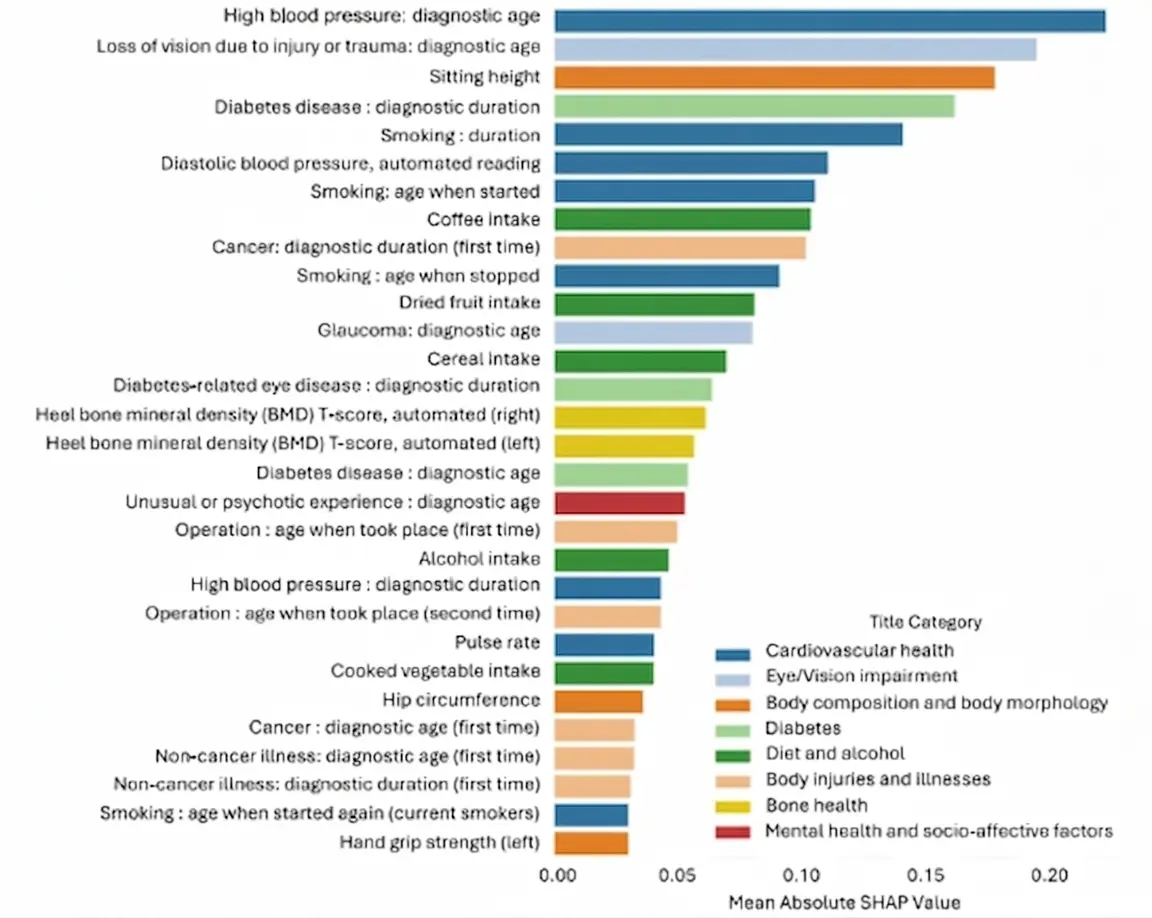
The following figure shows the exposome variables that contribute most to predicting brain health. Factors related to cardiovascular health, smoking, alcohol consumption, and diabetes stand out, along with certain dietary and bone health factors.
The impact of diet and lifestyle on the brain
In terms of diet, the results suggest interesting patterns:
- High coffee consumption is associated with poorer brain health;
- higher cereal intake (especially whole grains) is associated with better brain health;
- and nut consumption shows a protective effect.
These factors probably do not act in isolation, but rather interact with other elements, especially those related to cardiovascular health.
Other relevant factors in brain health
In addition to the classic factors, the study identifies other elements that contribute to prediction:
Low bone mineral density;
hip circumference (as a complex indicator of metabolic health);
and a history of diseases and surgeries.
These findings reinforce the idea that brain health is closely linked to the overall condition of the body.
Factors with less weight in the model
The analysis shows that some traditionally studied factors make a smaller contribution to the overall prediction:
- Social and affective variables,
- mental health factors,
- early-life experiences,
- and specific environmental exposures.
This does not mean that they lack clinical relevance, but rather that their impact is smaller than that of physical and metabolic factors when analyzed together.

Subscribe
to our
Newsletter
Brain health as a cumulative outcome across the life course
One of the study’s main contributions is to demonstrate that brain health depends on the interaction of multiple factors over time.
There is no single determinant of brain aging, but rather a cumulative combination of exposures.
In this regard, cardiovascular and metabolic factors stand out as the main determinants, especially when exposure is prolonged.
Implications of the study for clinical practice
The study’s findings have clear implications for prevention and clinical care:
Early prevention
Early management of factors such as hypertension, diabetes, and smoking can reduce long-term brain deterioration and aging.
The importance of the life course
Intervention should not focus solely on later stages. The earlier risk factors are modified, the greater the benefit.
A comprehensive approach
Brain health requires a global perspective that integrates medical, behavioral, and lifestyle factors.
How does this study relate to NeuronUP?
At NeuronUP , we develop evidence-based rehabilitation and cognitive stimulation tools. This study reinforces the importance of considering the patient’s overall context.
The combination of clinical data, lifestyle habits, and cognitive performance makes it possible to:
- Personalize intervention programs;
- better interpret the patient’s progress;
- and integrate rehabilitation with prevention strategies.
In this way, we move toward a more comprehensive approach to brain health.
Conclusion
The study demonstrates that brain aging does not depend on a single factor, but on the accumulation and interaction of multiple exposures throughout life.
Cardiovascular and metabolic factors—especially when they act over long periods—emerge as the main determinants of brain health.
Understanding this complexity is essential for designing more effective prevention strategies and moving toward more personalized care.
References
- Mahdipour M, Maleki Balajoo S, Raimondo F, et al. (2026). Exposome-wide patterns predict brain health in aging. Nature Communications, 17, 3409. https://doi.org/10.1038/s41467-026-71271-9
Frequently asked questions about the exposome and brain health
1. What is the exposome, and how does it affect brain aging?
The exposome refers to the set of exposures a person accumulates throughout life, including medical conditions, lifestyle habits, social environment, and early-life experiences. Analyzing the exposome as a whole makes it possible to predict brain health and demonstrates that brain aging does not depend on a single isolated factor, but rather on a cumulative combination.
2. What does the Brain Age Gap (BAG) indicator measure in neuroimaging?
The Brain Age Gap (BAG) is an indicator that measures the exact difference between an individual’s chronological age and their estimated brain age. A positive BAG value indicates that the brain displays older characteristics than expected, whereas a negative value suggests better brain preservation.
3. Which risk factors most accelerate brain aging?
Scientific evidence shows that the main factors associated with greater brain aging and poorer cognitive health are hypertension, smoking, diabetes, and alcohol consumption. Their impact on the brain depends largely on their timeline, that is, the age at onset and duration of exposure.
4. What role does diet play in predicting brain health?
Diet is a fundamental component of the exposome. Patterns such as higher whole-grain intake and nut consumption show a clear protective effect on the brain. In contrast, high coffee consumption has been associated in these predictive models with poorer brain health.
5. Why is the exposome key to neurorehabilitation programs?
Considering the patient’s exposome as a whole allows clinical professionals to gain a global view of their health. Combining these biomedical data and lifestyle habits with cognitive performance is essential for personalizing intervention programs using rehabilitation tools such as NeuronUP and improving prevention strategies.





 Working Memory in Children: What It Is, How It Affects Learning, and Signs of Difficulty
Leave a Reply