

Doctoral researcher Marta Arbizu Gómez shows how BrainAge modulates the relationship between Alzheimer’s biomarkers and cognitive decline and highlights its applications in clinical practice.
Executive summary:
BrainAge is a neuroimaging-based biomarker that estimates brain age and makes it possible to predict the risk of cognitive decline in Alzheimer’s disease. Combining it with biomarkers such as p-tau217 and beta-amyloid improves diagnostic accuracy and early detection. In Spain, its use in neuropsychological assessment and neurorehabilitation facilitates more personalized interventions, supported by tools such as NeuronUP.
Why does the brain’s biological age matter?
Alzheimer’s disease (AD) is characterized by the progressive accumulation of pathological proteins such as β-amyloid and tau protein, which ultimately cause cognitive decline and loss of independence. However, one of the major questions in current research is why two people with similar levels of brain pathology can experience very different disease courses.
While some individuals remain cognitively stable for years, others experience much more rapid decline. Understanding which factors explain these differences is essential for improving disease prognosis and developing more precise intervention strategies.
In this context, the concept of brain age (BrainAge) has emerged: a measure that estimates the brain’s biological age from magnetic resonance imaging scans. Unlike chronological age, BrainAge attempts to reflect a person’s actual brain health.
A study published in Alzheimer’s & Dementia analyzed whether this measure can help explain how Alzheimer’s biomarkers are associated with cognitive decline over time.
What is BrainAge and how is it calculated?
BrainAge is obtained using machine learning models that analyze structural features of the brain, such as:
- the volume of different brain regions,
- and cortical thickness measured with neuroimaging tools such as FreeSurfer.
Based on these variables, the model predicts a person’s estimated brain age.
The difference between this estimated age and actual age is called BrainAge delta:
- Positive BrainAge delta → the brain appears more aged than expected.
- Negative BrainAge delta → the brain appears younger.
This measure can be interpreted as a global indicator of brain health.

Subscribe
to our
Newsletter
How was this Alzheimer’s biomarker study conducted?
To analyze the role of BrainAge in the progression of Alzheimer’s disease, the researchers used data from two large international cohorts:
- A4/LEARN, with 1,690 participants,
- and the Harvard Aging Brain Study (HABS), with 349 participants.
In both groups, three key biomarkers associated with Alzheimer’s pathology were analyzed:
- β-amyloid (Aβ) using brain PET,
- tau using PET,
- and p-tau217 in blood.
In addition, participants’ cognitive trajectories were assessed using the PACC (Preclinical Alzheimer Cognitive Composite), a measure used in research to detect early cognitive changes.
The researchers used longitudinal statistical models to analyze how estimated brain age influenced the relationship between biomarkers and cognitive decline.
Key findings and clinical significance
The study results provide three main findings.
1. BrainAge is associated with Alzheimer’s pathology
First, the researchers observed that people with a higher BrainAge—that is, whose brains appear biologically older—have higher levels of amyloid, tau, and p-tau217.
Relationship between BrainAge and Alzheimer’s biomarkers:
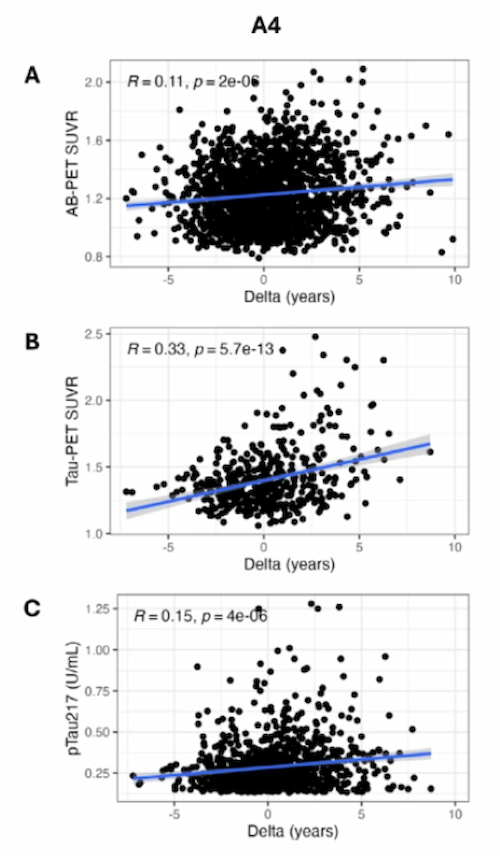
This suggests that the brain’s biological age may reflect the degree of neurodegeneration associated with the disease.
2. BrainAge predicts cognitive trajectories
The second finding is that BrainAge is also directly associated with cognitive performance over time.
Participants with a higher BrainAge showed steeper cognitive decline trajectories, indicating that this measure may function as a marker of brain vulnerability.
3. BrainAge amplifies the effect of biomarkers
The most relevant finding is that BrainAge moderates the relationship between Alzheimer’s biomarkers and cognitive decline.
In other words, the impact of brain pathology on cognition is not the same for everyone.
When BrainAge delta is elevated, the effect of biomarkers such as amyloid or tau on cognitive decline becomes stronger, accelerating disease progression.
This suggests that the brain’s biological age may act as a factor that amplifies or attenuates the impact of Alzheimer’s pathology.
| Finding | Interpretation |
|---|---|
| Higher BrainAge is associated with more amyloid and tau. | Reflects greater neurodegeneration. |
| Higher BrainAge predicts worse cognitive trajectories. | Indicates greater brain vulnerability. |
| BrainAge moderates the effect of biomarkers. | Pathology has a greater impact when the brain is biologically older. |
Implications for research and clinical assessment and intervention
These findings have several important implications.
1. Improved participant selection for clinical trials
BrainAge could be used to identify people at greater risk of cognitive decline, making it possible to design more efficient clinical trials and reduce the number of participants who do not develop symptoms during the study.
2. Accessible biomarker of brain health
Unlike more expensive techniques such as PET, BrainAge can be calculated from a single structural magnetic resonance imaging scan, facilitating its integration into clinical studies and monitoring programs.
3. More comprehensive understanding of Alzheimer’s progression
The findings suggest that disease progression depends not only on the presence of pathological biomarkers, but also on the brain’s overall condition.
How does this advance relate to NeuronUP?
Research on biomarkers and brain health metrics such as BrainAge may help improve the personalization of cognitive interventions.
In cognitive rehabilitation platforms such as NeuronUP, this type of information could help:
- identify patients at greater risk of accelerated decline,
- adjust the intensity and type of cognitive stimulation,
- and evaluate cognitive trajectories in combination with biological indicators.
In this way, the future of Alzheimer’s care is taking shape as an integrated model, in which biomarkers, neuroimaging, and digital rehabilitation tools work together.
Conclusions for professionals
The concept of BrainAge offers a new perspective for understanding the progression of Alzheimer’s disease. Beyond the presence of pathological biomarkers, the brain’s biological age appears to play a key role in the rate at which cognitive decline occurs.
Understanding this difference between chronological age and brain age could eventually help identify people at greater risk of decline earlier and design more personalized interventions.
References
- Condado JG, Klinger HM, Birkenbihl C, et al. BrainAge moderates associations between AD biomarkers and cognitive decline: findings from A4/LEARN and the Harvard Aging Brain Study. Alzheimer’s & Dementia. 2025. doi:10.1002/alz70856_106989.
Frequently asked questions about BrainAge and Alzheimer’s disease
1. What is BrainAge and how is it used in Alzheimer’s disease?
BrainAge is an estimate of the brain’s biological age obtained using neuroimaging techniques such as magnetic resonance imaging. In Alzheimer’s disease, it is used to identify accelerated brain aging and predict the risk of cognitive decline before evident clinical symptoms appear.
2. What is the difference between chronological age and brain age?
Chronological age corresponds to the years a person has lived, whereas brain age (BrainAge) reflects the brain’s actual condition. A brain age greater than chronological age may indicate a higher risk of neurodegenerative diseases such as Alzheimer’s disease.
3. How do biomarkers help predict cognitive decline?
Biomarkers such as p-tau217 protein and beta-amyloid make it possible to detect biological changes associated with Alzheimer’s disease. Combined with BrainAge, they improve the ability to predict the progression of cognitive decline more accurately.
4. What is the clinical utility of BrainAge in daily practice?
BrainAge makes it possible to stratify the risk of cognitive decline, personalize neuropsychological assessment, and adjust cognitive stimulation interventions according to the patient’s brain health.
5. How can BrainAge help personalize cognitive stimulation?
By knowing the patient’s brain age, professionals can design intervention programs better matched to the level of decline, thereby optimizing the effectiveness of cognitive rehabilitation with tools such as NeuronUP.
6. Does BrainAge replace traditional Alzheimer’s biomarkers?
No. BrainAge does not replace biomarkers; it complements them. Combining them provides a more complete view of brain health and the risk of disease progression.
7. Is it possible to prevent cognitive decline if an elevated BrainAge is detected?
Detecting an elevated BrainAge does not necessarily mean that decline can be prevented entirely, but it does allow for early intervention through cognitive stimulation, lifestyle changes, and clinical monitoring, which may slow the progression of decline.
8. Which professionals can apply these advances in Alzheimer’s disease?
Primarily neuropsychologists, neurologists, geriatricians, and occupational therapists who work in cognitive assessment and rehabilitation, both in clinical settings and in neurorehabilitation centers.




 Recommended Reading on Forensic Neuropsychology
Leave a Reply