Did you enjoy our press conference with Óscar Pino on NeuronUP Talks? In this article we share the bibliography recommended by this clinical and forensic neuropsychologist to continue exploring forensic neuropsychology.
Executive summary:
1. What forensic neuropsychology is and its role in the courts.
2. How human behavior is evaluated based on scientific evidence.
3. The importance of forensic cognitive assessment in legal proceedings.
4. Ethical dilemmas and limitations of forensic neuroscience.
5. The role and limitations of artificial intelligence (AI) in forensic neuropsychological assessment.
6. Challenges and the future of neuropsychology applied to justice.
Who is neuropsychologist Óscar Pino?
Óscar Pino is a clinical and forensic neuropsychologist with an extensive background in mental health, research, and teaching. He is currently coordinator of the Center for Care and Monitoring of Drug Dependence (CAS) in L’Hospitalet de Llobregat and head of research at Benito Menni Hospital, where he evaluates and provides interventions for complex clinical populations.
In academia, he is an associate professor at the University of Barcelona, combining clinical practice with the training of future professionals in psychology and neuropsychology. He also plays a significant institutional role as coordinator of the Clinical Neuropsychology Division of the General Council of Psychology.
Specializing in forensic neuropsychology, neuropsychologist Óscar Pino’s work focuses on cognitive assessment in legal settings, the preparation of expert reports, and the analysis of behavior based on scientific evidence. His profile combines clinical experience, research rigor, and practical application in legal contexts.
Recognized for his teaching ability, he regularly participates in courses, conferences, and scientific meetings, contributing to the dissemination and updating of knowledge in clinical and forensic neuropsychology.
Press Conference with Óscar Pino on NeuronUP Talks
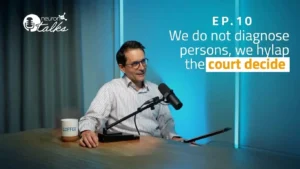
We close the second season of NeuronUP Talks, NeuronUP’s podcast, with an episode focused on forensic neuropsychology, where neuroscience intersects with justice to provide scientific evidence in the courts.
In this new episode, Marcos Ríos-Lago talks with Óscar Pino, a clinical and forensic neuropsychologist, about how knowledge of neuroscience and forensic cognitive assessment helps courts better understand human behavior in legal contexts.
The conversation reveals how the neuropsychologist’s work changes completely when the goal is not to treat a patient, but to provide objective information to a court for judicial decision-making.
Óscar explains how cognitive abilities are assessed, the validity of results, attempts at malingering, and the effects of brain injury, and how all this data is transformed into a forensic neuropsychological report that may be decisive in a trial.
Going beyond technical procedures, this episode of NeuronUP Talks invites listeners to reflect on the ethical dilemmas of forensic neuropsychology, the role of artificial intelligence (AI), and the limits of scientific knowledge in the search for truth.
Could a brain image ever determine whether someone is lying?; How far can neuroscience intervene in the courts without replacing human judgment?
This conversation highlights the future challenges of forensic neuropsychology: maintaining objectivity, integrating technology thoughtfully, and remembering that, even in the legal sphere, the brain is not judged—it is understood.
Listen to this full episode of NeuronUP Talks, NeuronUP’s podcast, and discover how forensic neuropsychology is transforming justice. A season finale that invites us to reflect, debate, and look toward the future of neuropsychology applied to society.

Subscribe
to our
Newsletter
Recommended Reading on Forensic Neuropsychology
Recommended Books on Forensic Neuropsychology
- Casas, A. N. (2019). Neuropsicología forense: Una disciplina emergente. Editorial Síntesis.
- Jarne Esparcia, A., & Aliaga Moore, Á. (Eds.). (2012). Manual de neuropsicología forense: De la clínica a los tribunales. Herder.
Recommended Scientific Articles on Forensic Neuropsychology
- Chafetz, M. D., Sweet, J. J., Boone, K. B., Cox, D., Hall, V., Kirkwood, M. W., Lafosse, J. M., Merten, T., & Oldenburg, C. (2025). Neuropsychological review of records in forensic cases: An AACN best practices paper with international perspectives. The Clinical Neuropsychologist, 39(4), 839–869. https://doi.org/10.1080/13854046.2025.2461750
- Marcopulos, B. A., Kaufmann, P., & Patel, A. C. (2024). Forensic neuropsychological assessment. Behavioral Sciences & the Law, 42(4), 265–277. https://doi.org/10.1002/bsl.2656
- Sweet, J. J., Boone, K. B., Denney, R. L., Hebben, N., Marcopulos, B. A., Morgan, J. E., Nelson, N. W., & Westerveld, M. (2023). Forensic neuropsychology: History and current status. The Clinical Neuropsychologist, 37(3), 459–474. https://doi.org/10.1080/13854046.2022.2078740
- Sweet, J. J. (2025). Forensic neuropsychology goes from nowhere to almost everywhere: Lessons learned during decades of practice. Archives of Clinical Neuropsychology, 40(2), 162–173. https://doi.org/10.1093/arclin/acae105
Frequently Asked Questions About Forensic Neuropsychology
1. Who is neuropsychologist Óscar Pino, and what is his specialty?
Óscar Pino is a clinical and forensic neuropsychologist in Spain who specializes in forensic cognitive assessment and neuropsychological reports in legal settings. He works in mental health, research, and teaching, combining clinical practice with the application of neuropsychology in the courts.
2. Where does neuropsychologist Óscar Pino currently work?
Óscar Pino is coordinator of the Center for Care and Monitoring of Drug Dependence (CAS) in L’Hospitalet de Llobregat and head of research at Benito Menni Hospital. He is also an associate professor at the University of Barcelona and coordinator of the Clinical Neuropsychology Division of the General Council of Psychology.
3. What does the forensic neuropsychology episode of NeuronUP Talks cover?
This episode of NeuronUP Talks examines how neuroscience and forensic cognitive assessment help courts understand human behavior. It also addresses topics such as malingering, brain injury, expert reports, and ethical dilemmas in legal settings.
4. What is forensic neuropsychology?
Forensic neuropsychology is the discipline that applies knowledge of neuroscience and cognitive assessment to legal settings. Its goal is to provide scientific evidence to help judges and courts understand human behavior in legal proceedings.
5. What is the difference between clinical and forensic neuropsychology?
Clinical neuropsychology focuses on diagnosing and treating the patient, whereas forensic neuropsychology serves the court, with the goal of providing objective information for judicial decision-making.
6. What is the role of a forensic neuropsychologist in a trial?
A forensic neuropsychologist conducts forensic cognitive assessments, analyzes functions such as memory and executive functioning, and prepares forensic neuropsychological reports that may influence judicial decisions concerning responsibility, capacity, or brain injury.
7. How is a forensic cognitive assessment conducted in forensic neuropsychology?
The assessment includes standardized tests to analyze functions such as memory, attention, and executive functioning, as well as the detection of malingering or symptom exaggeration. The results are integrated into a technical report used in legal proceedings.
8. How important is a forensic neuropsychological report in a trial?
A forensic neuropsychological report may be decisive in a trial because it provides scientific evidence about a person’s cognitive status, helping establish their capacity, responsibility, or possible impairments following a brain injury.
9. What are the ethical dilemmas in forensic neuropsychology?
One of the main dilemmas is the difference between explaining behavior and justifying it. In addition, professionals must remain objective, avoid bias, and ensure that scientific evidence does not replace legal judgment.
10. What role does artificial intelligence play in forensic neuropsychology?
Artificial intelligence can support data analysis in cognitive assessments, but its use in courts in Spain is still limited. Its application must be ethical and supervised, as it cannot replace clinical interpretation or human judgment.
11. Can neuroscience determine whether a person is lying?
Currently, neuroscience cannot determine with certainty whether a person is lying. Although advances in neuroimaging exist, these methods have limitations and are insufficient as conclusive evidence in legal settings.
12. What books and scientific articles are recommended for training in forensic neuropsychology?
To explore forensic neuropsychology in greater depth, recommended works include Neuropsicología forense: Una disciplina emergente and Manual de neuropsicología forense: De la clínica a los tribunales, along with recent articles in scientific journals such as The Clinical Neuropsychologist and Behavioral Sciences & the Law, which address forensic assessment, ethics, and advances in the field.
NeuronUP Talks — the podcast where professionals in neuropsychology, neurorehabilitation, and cognitive health share knowledge, practice, and the future.







 Impact of Spasticity on ADLs and Motor Learning: A Guide for Occupational Therapists
Leave a Reply