
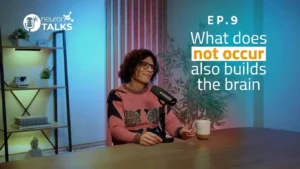
Were you interested in our Press Conference with Emilia Redolar on NeuronUP Talks? In this article we share the bibliography recommended by this neuroscientist to continue exploring brain development.
Executive summary with the key points of this article:
1. How the brain is built through experience.
2. Development, perception, and plasticity throughout life.
3. Prefrontal cortex development during adolescence and its practical implications.
4. Factors that promote good brain health.
Who is Emilia Redolar?
Dr. Emilia Redolar holds a PhD in Neuroscience and is a leading expert in the study of cognitive functions and noninvasive brain stimulation. She received international training at prestigious institutions such as McGill University (Canada) and Harvard Medical School (United States), which has shaped her career in neuroscience research.
She currently combines clinical work with her work as an academic and scientist. She oversees university management as director of the Psychology degree program at the Universitat Oberta de Catalunya (UOC) and head of the UOC Cognitive Neurolab, where she leads projects focused on studying cognitive processes and their modulation using noninvasive brain stimulation techniques.
Her research focuses on analyzing memory, attention, executive functions, and other cognitive processes, contributing to the development of evidence-based interventions applicable in neurorehabilitation and cognitive stimulation.
Dr. Redolar’s profile is particularly relevant to professionals interested in integrating advances in applied neuroscience, neuromodulation, and cognitive rehabilitation, both in clinical settings and in research and university training environments.
Press Conference with Emilia Redolar on NeuronUP Talks
In this new episode of NeuronUP Talks, the NeuronUP podcast, our neuropsychologist Carolina Sastre speaks with neuroscientist Emilia Redolar about brain development. Specifically, they discuss how the brain is built through experience and how this determines our perception of the world.
The episode addresses key issues for neuropsychology and cognitive health professionals:
- Brain development and the importance of critical periods.
- The real limits of neuroplasticity.
- Perception as an active construction.
- Cross-modal plasticity and brain reorganization in the absence of a sense.
- Prefrontal cortex development during adolescence and its practical implications.
- The impact of circadian rhythms and digital habits on brain health.
Finally, this conversation with neuroscientist Emilia Redolar also raises a crucial point for clinical practice: understanding how the brain interprets reality allows us to design better interventions, adapt expectations, and gain a deeper understanding of human behavior.
This new episode of NeuronUP Talks offers a rigorous, educational, and necessary conversation about development, perception, and the capacity for change. Don’t miss it!

Subscribe
to our
Newsletter
Recommended Reading on Brain Development
Recommended Scientific Articles
- Redolar Ripoll, D. (2011a). Brain and Addiction. Editorial UOC.
- Redolar Ripoll, D. (2011b). The Stressed Brain. Editorial UOC.
- Redolar Ripoll, D. (2012). The Changing Brain: Synaptic Plasticity and Memory Systems. Editorial UOC.
- Redolar Ripoll, D. (2016). Pleasure, Decision-Making, and the Brain. Editorial UOC.
- Redolar Ripoll, D. (2018). Psychobiology. Editorial Médica Panamericana.
- Redolar Ripoll, D. (Ed.). (2023). Cognitive Neuroscience (2nd ed.). Editorial Médica Panamericana.
- Redolar Ripoll, D. (2024). The Blind Woman Who Could See with Her Tongue: And Other Mysteries of Neuroscience. Grijalbo.
- Redolar Ripoll, D., Blázquez Alisente, J. L., González Rodríguez, B., Muñoz Marrón, E., Periañez Morales, J. A. and Viejo Sobera, R. (2013). Neuropsychology. Editorial UOC.
Frequently Asked Questions About Brain Development
1. Who is Emilia Redolar in applied neuroscience?
Emilia holds a PhD in Neuroscience and has extensive training from prestigious universities, such as McGill University (Canada) and Harvard Medical School (United States). She combines clinical work with teaching and directs the Psychology degree program at the Universitat Oberta de Catalunya (UOC) and the UOC Cognitive Neurolab. In addition, she has extensive research experience in the field of neuroscience, specifically in studying cognitive functions using noninvasive stimulation techniques.
2. How is the brain built through experience?
The episode discusses how experience helps build the brain and how this influences our perception of the world. It also highlights the importance of understanding this interpretation in order to design interventions and adjust expectations in clinical practice.
3. What neuroplasticity topics are covered in the Press Conference?
The Press Conference covers the real limits of neuroplasticity, critical periods of development, and cross-modal plasticity. It also describes brain reorganization when a sense is absent, as part of how the brain adapts to different conditions.
4. Why is the prefrontal cortex relevant during adolescence?
The Press Conference includes discussion of prefrontal cortex development during adolescence and its practical implications. It is presented as a key point for professionals seeking to better understand behavior and apply knowledge of brain development in clinical settings.
5. How do circadian rhythms and digital habits affect the brain?
The episode mentions the impact of circadian rhythms and digital habits on brain health. It presents this as a relevant topic for professionals interested in cognitive health and in understanding factors that may modulate brain functioning.
6. What recommended reading is available on brain development?
Emilia Redolar’s recommended reading is shared to promote deeper exploration of brain development, including works on addiction, stress, synaptic plasticity, memory, decision-making, psychobiology, cognitive neuroscience, and neuropsychology. These are educational and training resources and do not replace professional guidance.







 Brain Fog in Fibromyalgia: Assessment, Differential Diagnosis, and a Neuropsychological Approach
Leave a Reply