

Dr. Marta Arbizu Gómez examines the relationship between flu vaccination and Alzheimer’s disease risk in older adults; recent evidence on high-dose vaccination opens new perspectives in prevention, brain health, and professional cognitive rehabilitation.
Marta Arbizu Gómez analyzes a study published in Neurology on the relationship between high-dose flu vaccination and Alzheimer’s disease risk in older adults. The research found an association between high-dose influenza vaccination and a lower risk of developing Alzheimer’s disease compared with the standard dose. The article reviews the possible role of the immune system, inflammation, and medical prevention in brain health, as well as their implications for professional cognitive assessment and rehabilitation.
Can vaccination also influence brain health?
Alzheimer’s disease (AD) is a complex neurodegenerative condition involving multiple factors, including inflammation, immune system aging, and exposure to infections. In recent years, several studies have suggested that vaccines—beyond preventing infectious diseases—may have a protective effect against cognitive decline.
Specifically, influenza vaccination has been associated with a reduced risk of Alzheimer’s disease in older adults. However, it was previously unclear whether the type or intensity of the immune response induced by the vaccine could influence this protective effect.
A study published in Neurology in 2026 addresses this question by comparing the risk of developing Alzheimer’s disease in people over age 65 after receiving a high-dose flu vaccine versus a standard-dose vaccine.
How was the research on vaccines and Alzheimer’s disease conducted?
To answer this question, the researchers analyzed data from a large United States healthcare database, including more than 160,000 adults over age 65 with no prior diagnosis of cognitive impairment.
The study has several relevant methodological features:
- Comparison between:
- High-dose influenza vaccine (H-IIV)
- Standard-dose influenza vaccine (S-IIV)
- Follow-up of up to 3 years after vaccination
- Use of advanced analytical techniques (such as target trial emulation) to reduce biases inherent in observational studies
This approach approximates the evidence that would be provided by a clinical trial while using real-world data.

Subscribe
to our
Newsletter
What do the key results reveal about flu vaccination and Alzheimer’s disease?
The results show a meaningful difference between the two types of vaccine:
- The high-dose vaccine is associated with a lower risk of Alzheimer’s disease compared with the standard dose.
- This effect is significant during approximately the first 25 months after vaccination.
- The clinical impact is relevant:
- An NNT ≈ 185 is estimated, suggesting that vaccinating 185 people with the high-dose vaccine could be associated with one fewer case of AD if these results are confirmed in future research.
In addition, the effect is not uniform across the population:
- Stronger and longer-lasting in women;
- more limited and delayed in men.
These findings suggest that the immune response—and its relationship with the brain—could differ by sex.
To better visualize this difference, the following figure shows how Alzheimer’s disease risk changed over time according to the type of vaccine received. A summary table with the study’s main results is also included to facilitate interpretation.
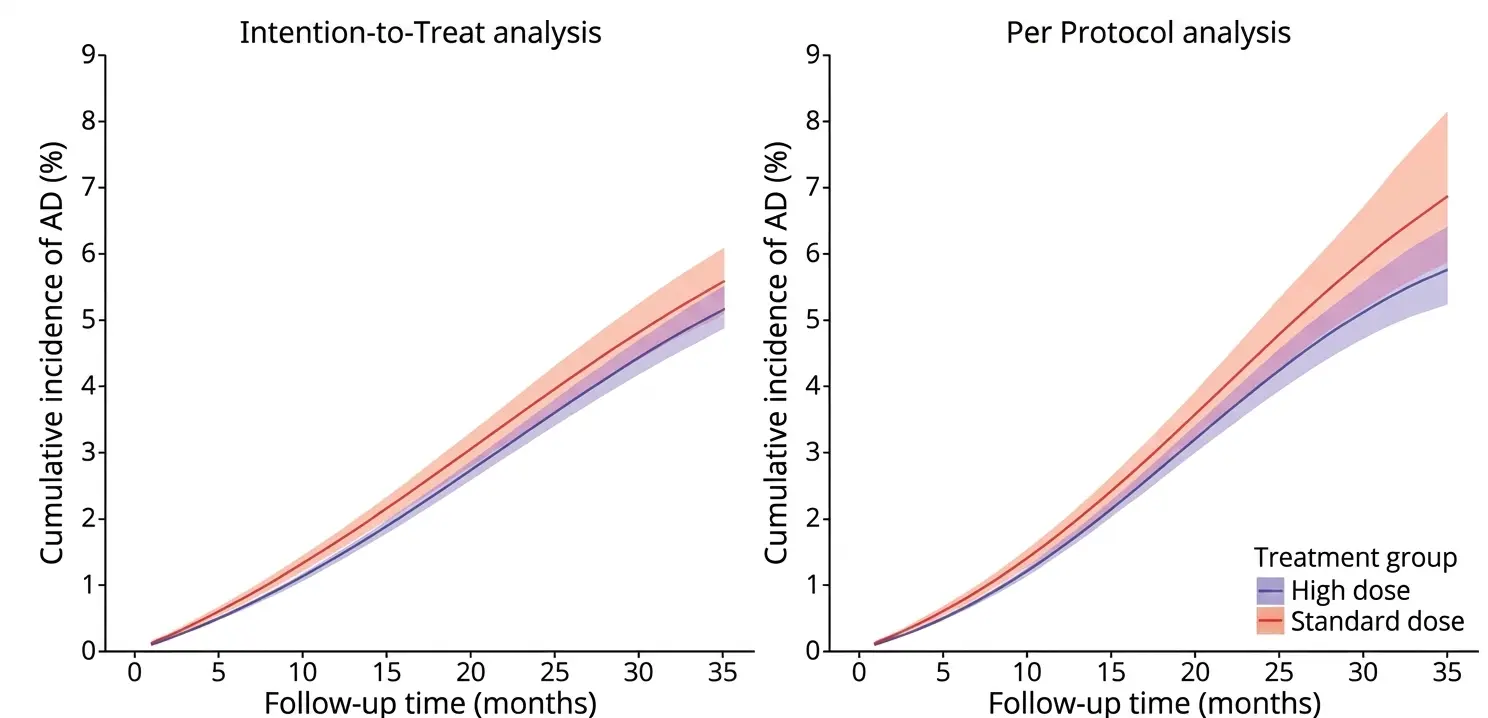
| Measure | Result |
|---|---|
| Reduction in Alzheimer’s risk | Yes (vs standard dose) |
| Period with significant effect | 1–25 months |
| Number needed to treat (NNT) | ≈ 185 |
| Sex differences | Greater effect in women |
| Follow-up duration | Up to 3 years |
Why might this effect occur?
The study proposes several mechanisms that could explain this association:
How might the high-dose vaccine be protective?
1. Fewer infections: greater protection against influenza, reducing infections and complications.
2. Less systemic inflammation: fewer infections mean less generalized inflammation, a key factor in neurodegeneration.
3. Immune system modulation: vaccination may activate mechanisms such as “trained immunity” and regulate the inflammatory response.
4. Neuroprotective effect: these processes could help reduce neuronal damage and the progression of Alzheimer’s disease.
What are the implications for clinical practice?
Although this is an observational study, the results open up new perspectives:
Accessible prevention
Influenza vaccination is a simple, affordable, and widely available intervention. If its protective effect is confirmed, it could become a relevant tool for preventing cognitive decline.
The importance of immune response intensity
It is not only vaccination that matters, but also how powerful the resulting immune response is. This introduces the concept of optimizing vaccination strategies for older adults.
A comprehensive approach to Alzheimer’s disease
These findings reinforce the idea that Alzheimer’s prevention depends not only on neurological factors. It may also be influenced by systemic health, infection prevention, inflammation, and immune system function.
How does this development relate to NeuronUP?
At NeuronUP, cognitive decline is addressed from a comprehensive perspective, combining assessment, intervention, and monitoring.
This type of study provides key information for:
- Identifying modifiable risk factors for Alzheimer’s disease
- Complementing cognitive intervention with preventive strategies
- Integrating clinical and biological data into the design of personalized programs
Combining medical prevention and cognitive rehabilitation is essential to improve the quality of life of older adults.
Study limitations
It is important to interpret the results with caution:
- The follow-up period is relatively short (up to 3 years).
- It is based on administrative data (with possible diagnostic inaccuracies).
- It does not include variables such as lifestyle or socioeconomic status.
Therefore, although the results are promising, additional studies—ideally longitudinal studies including biomarkers—are needed to confirm these findings.
Conclusion
High-dose influenza vaccination is associated with a reduced risk of Alzheimer’s disease in older adults compared with the standard dose. This effect, more pronounced in women, suggests that the intensity of the immune response could play a key role in neuroprotection.
These results reinforce an emerging idea in research: immune system health is closely linked to brain health. Integrating preventive strategies such as vaccination with cognitive interventions may be fundamental to addressing Alzheimer’s disease more effectively.
References
- Bukhbinder AS, Ling Y, Jhin L, et al. Risk of Alzheimer Dementia After High-Dose vs Standard-Dose Influenza Vaccination. Neurology. 2026.
Frequently asked questions about flu vaccination and Alzheimer’s disease.
1. Does the flu vaccine reduce the risk of Alzheimer’s disease?
Some studies have found an association between influenza vaccination and a lower risk of Alzheimer’s disease in older adults. However, this relationship alone does not prove that the vaccine prevents the disease, so more research is needed.
2. What is the difference between the high-dose and standard-dose flu vaccines?
The high-dose influenza vaccine is designed to generate a more intense immune response in older adults than the standard-dose vaccine.
3. Why might the immune system influence Alzheimer’s risk?
The immune system may influence brain health through processes involving infections, systemic inflammation, and neurodegeneration. For this reason, its role in neurodegenerative diseases such as Alzheimer’s disease is increasingly being studied.
4. Can the flu vaccine prevent Alzheimer’s disease?
It cannot be stated that the flu vaccine prevents Alzheimer’s disease. The available evidence suggests a promising association between high-dose influenza vaccination and a lower risk of AD, but more studies are needed to confirm whether a direct protective effect exists.
5. How does this development relate to cognitive rehabilitation?
These findings reinforce the importance of addressing cognitive decline from a comprehensive perspective by combining medical prevention, cognitive assessment, cognitive stimulation, and personalized rehabilitation programs.







 Hyperfocus in Children with ADHD: Neuropsychological Assessment and Cognitive Flexibility Strategies
Leave a Reply