

Marta Arbizu Gómez analyzes a study published in Nature Communications that explores how breathing modulates visual perception, cortical excitability, and brain activation. The research provides new evidence on the role of breathing in cognition and its potential application in cognitive rehabilitation and cognitive stimulation strategies.
Marta Arbizu Gómez analyzes a study published in Nature Communications that demonstrates how breathing modulates visual perception and brain activity. The results show that perceptual sensitivity increases during inhalation, when the brain exhibits greater activation and cortical excitability. In addition, participants adjusted their breathing to optimize performance, reinforcing the idea that cognition emerges from the dynamic interaction between body and brain.
Can breathing influence how we perceive the world?
Breathing is an automatic process that we carry out thousands of times a day without paying attention. However, there is growing evidence that it not only maintains vital functions but also directly influences brain activity and behavior.
In particular, recent studies suggest that breathing could act as a “synchronization” mechanism between the body and the brain, modulating processes such as attention, perception, and decision-making.
The study published in Nature Communications in 2026 explores this idea in greater depth and raises a key question:
Can breathing actively improve our ability to perceive stimuli?
How was the research conducted?
To answer this question, the researchers simultaneously analyzed three types of signals in 30 healthy participants:
- Brain activity (measured using magnetoencephalography, MEG)
- Respiratory rate
- Pupil dilation (an indicator of activation or arousal)
During the experiment, participants performed a simple visual task:
they had to detect very weak (almost imperceptible) stimuli that appeared on the screen.
In addition, stimulus predictability was manipulated using:
- Spatial cues (where it would appear)
- Temporal cues (when it would appear)
This design made it possible to analyze how breathing, the brain, and behavior interact under controlled conditions.

Subscribe
to our
Newsletter
What do the key results reveal?
1. We perceive better during inhalation
One of the most important findings is that visual perception is not constant throughout the respiratory cycle.
- Sensitivity is greater during the inspiratory phase (inhalation)
- At that moment, participants detect weak stimuli more effectively
This means that the brain is in a more “receptive” state during inhalation.
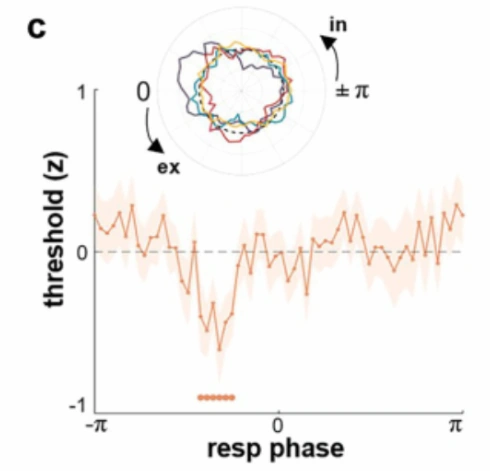
Sensitivity for detecting visual stimuli is greater during the inspiratory phase (in), when the perceptual threshold decreases. This indicates that the brain is in a state more favorable for processing sensory information during inhalation.
2. We adjust our breathing to improve performance
The study demonstrates something even more interesting:
Participants adapted their breathing when they could predict the stimulus.
- They synchronized inhalation with the moment when it was going to appear
- The better this synchronization was → the better the performance
This suggests that breathing is part of an active process for optimizing perception.
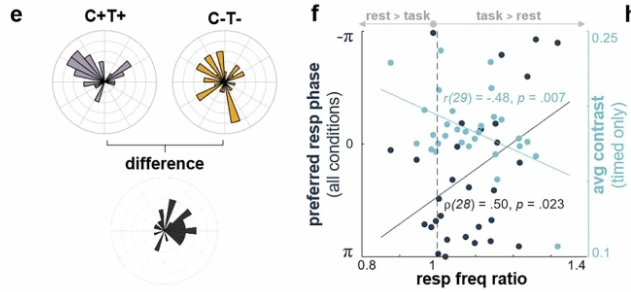
Participants adjusted their respiratory rate to align the inspiratory phase with the appearance of predictable stimuli. The greater this adaptation was, the better their performance on the perceptual task.
3. Breathing modulates the brain state
Changes in perception are related to two key mechanisms:
Activation (arousal)
- Measured through the pupil
- Greater dilation during inhalation
- Associated with better perceptual performance
Cortical excitability
- Changes in brain oscillations:
- Alpha (7–13 Hz) ↓ → greater sensory excitability
- Beta (15–40 Hz) ↓ → motor preparation
Together, these changes indicate that during inhalation the brain is in an optimal state for processing information.
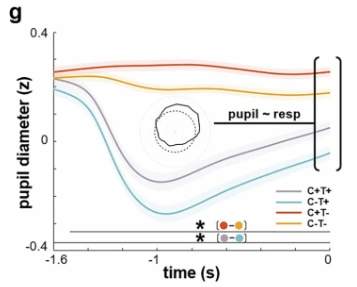
Pupil dilation, an indicator of the level of brain activation, varies according to the respiratory phase and increases during inhalation, coinciding with better perceptual performance.
4. Breathing organizes communication between brain regions
The effect is not limited to specific areas but involves a broad network that includes:
- Visual cortex
- Insula
- Cingulate cortex
- Motor areas
Breathing modulates the flow of information between these regions, facilitating perception, especially when stimuli are predictable.
What are the implications of this finding?
This study provides strong evidence that breathing is part of an “active sensing” mechanism:
- The brain does not simply react to the environment
- It also uses internal signals, such as breathing, to optimize perception
In practice, this means that:
- Perception depends both on the stimulus and on the body’s state
- The body and brain function as an integrated system
How does this advance relate to NeuronUP?
NeuronUP develops evidence-based cognitive rehabilitation tools. Findings of this kind open up new areas of interest:
Body–brain integration
Breathing could be incorporated as a relevant variable in cognitive intervention, especially in tasks involving attention or perception.
Performance optimization
Training synchronization between physiological states and cognitive tasks could improve the effectiveness of interventions.
New therapeutic strategies
Modulating breathing, for example through guided breathing techniques, could complement cognitive stimulation programs.
Conclusion
This study demonstrates that breathing is not a passive process but an active mechanism that influences how we perceive the world.
The ability to synchronize breathing with the environment enables the brain to optimize states of activation and excitability, thereby improving perception.
Together, these results reinforce a key idea: cognition depends not only on the brain but also on the continuous interaction between body and mind.
References
Chalas, N., Saltafossi, M., Berther, T., Balestrieri, E., Abbasi, O., & Kluger, D. S. (s. f.). Respiration as a dynamic modulator of sensory sampling.
Frequently asked questions about breathing as a modulator of visual perception and brain activity
1. How does breathing influence visual perception?
Research shows that the ability to detect weak visual stimuli fluctuates throughout the respiratory cycle. During inhalation, the brain exhibits greater activation and cortical excitability, which facilitates sensory information processing.
2. What is the relationship between breathing and brain activity?
Breathing modulates the activity of different brain networks involved in perception, attention, and motor preparation. It also influences neural oscillations related to cortical excitability and sensory processing.
3. What is active sensing?
Active sensing is a mechanism through which the brain uses internal bodily signals, such as breathing, to optimize perception of the environment. This process makes it possible to anticipate and improve the processing of relevant stimuli.
4. How does breathing affect attention and sensory processing?
Breathing can modify the brain’s functional state, facilitating attention and increasing the ability to process sensory information. Studies suggest that certain respiratory phases support superior perceptual performance.
5. Can breathing be applied in cognitive rehabilitation programs?
Although the evidence is still emerging, the findings suggest that guided breathing techniques could complement cognitive rehabilitation and cognitive stimulation programs by supporting brain states that are more optimal for learning and attention.






 New Cognitive Stimulation Activities for Children in 2026
Leave a Reply