

Cognitive stimulation is a fundamental neuropsychological technique for improving people’s mental abilities. Applied to children, cognitive stimulation aims to strengthen the basic learning processes, especially memory, attention, and reasoning. Today we’ll focus on explaining what exercises to work on reasoning in children involve.
What is reasoning?
Reasoning is a fundamental function in our daily lives, since it is the ability to compare results, draw inferences, and establish abstract relationships. In other words, it is the faculty that allows us to solve problems consciously, establishing causal relationships between them. And like all cognitive functions, it can be worked on to improve it.
How to work on reasoning in children
Cognitive stimulation is the ideal technique for working on reasoning. That’s why we present 4 NeuronUP activities to work on reasoning in children:
Exercises to work on logical reasoning in children
1. Converting Numbers into Words
What does it consist of?
First, we have this exercise to work on logical reasoning, in which children have to match numbers with their corresponding names. For example, 887 with “eight hundred eighty-seven”.
What does this activity do?
This activity also stimulates two other cognitive functions: semantic memory and reading.
2. Step by Step (Picture-Only)
If we want to work on reasoning in children with worksheets, Step by Step is ideal for this purpose.
What does this activity do?
It’s an exercise in which children have to put in order the different steps needed to carry out an activity.
Play by levels
It is organized into five difficulty levels: basic, easy, medium, hard, and advanced.
Below is an example of a basic-level reasoning worksheet for children:
Now here’s this advanced-level reasoning worksheet for children:
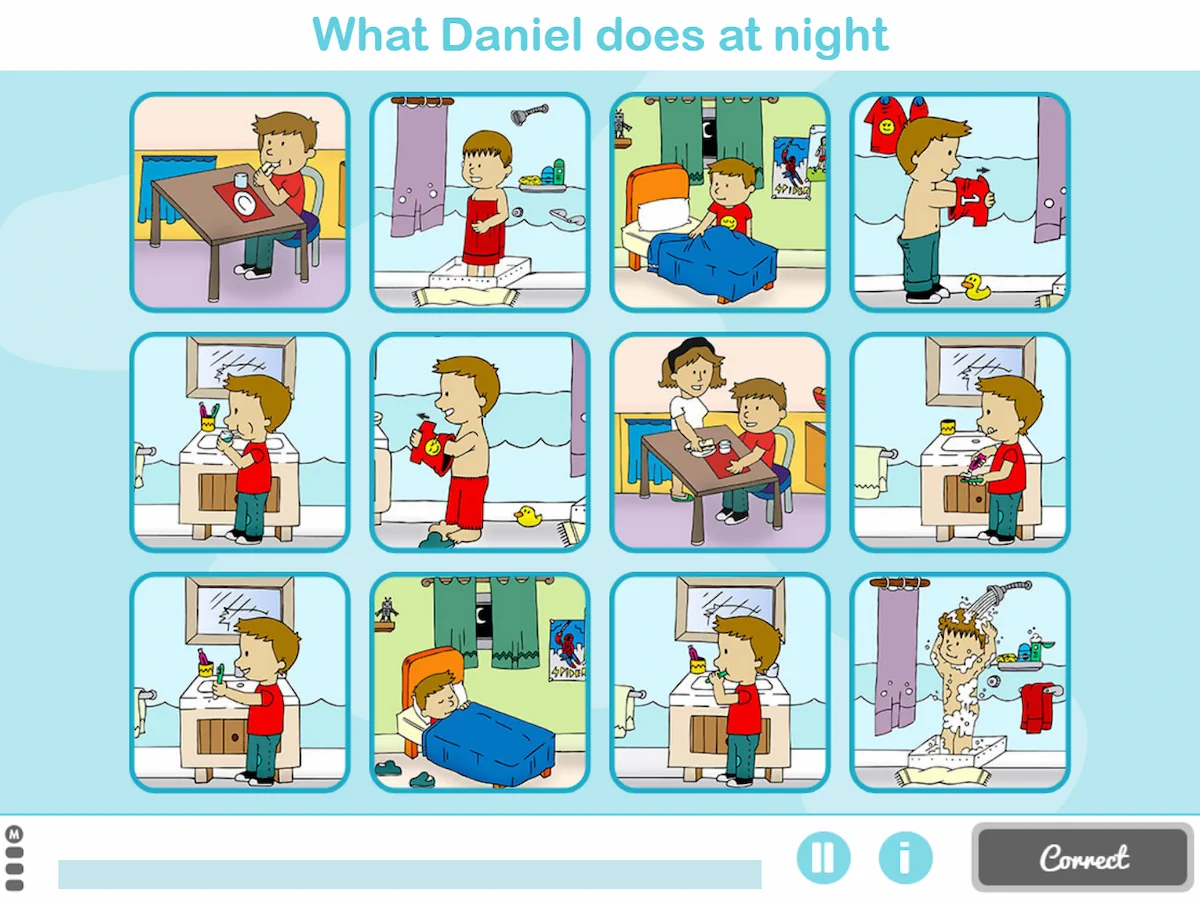
What does this activity do?
These two worksheets work on planning and reasoning.
3. Organize the Farm
What does it consist of?
Another activity to work on logical reasoning in children is Organize the Farm. Children have to complete a grid of pictures according to the instructions. On this farm, there is one animal of each type in each plot, in each row, and in each column.
The goal is for children to put the animals in their place so they don’t escape.

What does this activity do?
The activity is also designed to work on working memory, flexibility, planning, and reasoning.
4. Mixing Numbers
Finally, the last of the exercises to work on reasoning with children that we’ll show you today is Mixing Numbers.
What does it consist of?
It’s an activity in which children have to sort a series of numbers according to their value.
If you liked this post about exercises to work on reasoning in children, you may also be interested in:


“This article has been translated. Link to the original article in Spanish:”
Ejercicios para trabajar el razonamiento en niños: actividades prácticas

 Visual agnosia: types and how it is possible to see without understanding

Leave a Reply