
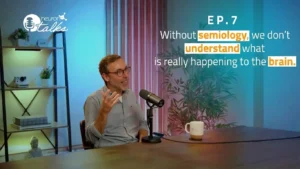
Were you interested in our press conference with Saül Martínez-Horta on NeuronUP Talks? In this article, we share the bibliography recommended by this clinical neuropsychologist to continue exploring neuropsychological semiology and clinical reasoning in the assessment of the human brain.
Who Is Saül Martínez-Horta?
Dr. Saül Martínez‑Horta is a clinical neuropsychologist and researcher based in Barcelona, where he works in the Movement Disorders Unit of the Neurology Department at Hospital de la Santa Creu i Sant Pau and at the Institut de Recerca Sant Pau.
His career combines more than 15 years of clinical experience in the assessment and cognitive rehabilitation of people with neurodegenerative disorders, acquired brain injury, and neuropsychological impairments, along with a strong commitment to applied research.
Martínez‑Horta is an expert in analyzing the cognitive and behavioral mechanisms associated with conditions such as Huntington’s disease, Parkinson’s disease, and other movement disorders. He is also a member of the Parkinson’s Disease and Movement Disorders Research Group at IR Sant Pau, contributing to studies seeking early markers of cognitive decline and to the development of evidence-based intervention strategies for cognitive stimulation and neurorehabilitation.
In addition to his clinical and research work, he is director of the Neuropsychology Department at the Barcelona Center for Neurocognitive Diagnosis and Intervention (CDINC) and an associate professor at the Autonomous University of Barcelona, where he helps train new professionals in neuropsychology and neurorehabilitation.
His experience is complemented by more than 70 published scientific articles, participation in national and international conferences, and leadership of specialized working groups focused on cognition and neurodegenerative diseases.
Press Conference with Saül Martínez-Horta on NeuronUP Talks
We resume the second season of NeuronUP Talks with a new episode. This time, our neuropsychologist Carolina Sastre sits down with neuropsychologist Saül Martínez-Horta to discuss an essential topic for all professionals in the cognitive field: how semiology can change the way we assess.
Throughout this conversation, Saül emphasizes that observing, listening, and engaging in clinical reasoning remain the most powerful tools for understanding symptoms, differentiating disorders, and contextualizing each person’s unique experience.
Although we now have artificial intelligence, biomarkers, and advanced neuroimaging, the episode emphasizes that technology is valuable only when combined with clinical judgment and human understanding.
This episode is essential listening for professionals in neuropsychology, neurology, clinical psychology, or neurorehabilitation who believe that our work is not limited to measuring, but consists of understanding people.

Subscribe
to our
Newsletter
Recommended Reading on Neuropsychological Semiology
Recommended Scientific Articles
- Buckner, R. L., Andrews-Hanna, J. R., & Schacter, D. L. (2008). The brain’s default network: Anatomy, function, and relevance to disease. Annals of the New York Academy of Sciences, 1124(1), 1–38.
- Buckner, R. L., & Carroll, D. C. (2007). Self-projection and the brain. Trends in Cognitive Sciences, 11(2), 49–57.
- Corbetta, M., & Shulman, G. L. (2002). Control of goal-directed and stimulus-driven attention in the brain. Nature Reviews Neuroscience, 3, 201–215.
- Fox, M. D. (2018). Mapping symptoms to brain networks with the human connectome. New England Journal of Medicine, 379(23), 2237–2245.
- Friston, K., & Kiebel, S. (2009). Predictive coding under the free-energy principle. Philosophical Transactions of the Royal Society B: Biological Sciences, 364(1521), 1211–1221.
- Friston, K. (2010). The free-energy principle. London: Allen & Unwin.
- Geschwind, N. (1965). Disconnexion syndromes in animals and man. I. Brain, 88(2), 237–294.
- Geschwind, N. (1970). The organization of language and the brain. Science, 170(3961), 940–944.
- Menon, V. (2011). Large-scale brain networks and psychopathology: A unifying triple network model. Trends in Cognitive Sciences, 15(10), 483–506.
- Menon, B. (2019). Towards a new model of understanding: The triple network, psychopathology and the structure of the mind. Medical Hypotheses, 133, 109385.
- Mesulam, M. M. (1981). A cortical network for directed attention and unilateral neglect. Annals of Neurology, 10(4), 309–325.
- Mesulam, M. M. (1990). Large-scale neurocognitive networks and distributed processing for attention, language, and memory. Annals of Neurology, 28(5), 597–613.
- Miller, E. K., & Cohen, J. D. (2001). An integrative theory of prefrontal cortex function. Annual Review of Neuroscience, 24, 167–202.
- Miller, E. K. (2000). The prefrontal cortex and cognitive control. Nature Reviews Neuroscience, 1(1), 59–65.
- Miller, E. K. (2010). Dynamic coordination of neural ensembles. Cambridge, MA: MIT Press.
- Moscovitch, M., Nadel, L., Winocur, G., Gilboa, A., & Rosenbaum, R. S. (2006). The cognitive neuroscience of remote episodic, semantic and spatial memory. Current Opinion in Neurobiology, 16(2), 179–190.
- Nadel, L., Samsonovich, A., Ryan, L., & Moscovitch, M. (2000). Multiple trace theory of human memory: Computational, neuroimaging, and neuropsychological results. Hippocampus, 10(4), 352–368.
- Posner, M. I., & Petersen, S. E. (1990). The attention system of the human brain. Annual Review of Neuroscience, 13, 25–42.
- Raichle, M. E., MacLeod, A. M., Snyder, A. Z., Powers, W. J., Gusnard, D. A., & Shulman, G. L. (2001). A default mode of brain function. Proceedings of the National Academy of Sciences, 98(2), 676–682.
- Raichle, M. E. (2015). The brain’s default mode network. Annual Review of Neuroscience, 38, 433–447.
- Raichle, M. E. (2015). The restless brain: How intrinsic activity organizes brain function. Cambridge, MA: MIT Press.
Recommended Books
- Baddeley, A. (1986). Working memory. Oxford, UK: Clarendon Press.
- Baddeley, A. (2007). Working memory, thought, and action. Oxford, UK: Oxford University Press.
- Damasio, A. (1994). Descartes’ error: Emotion, reason, and the human brain. New York, NY: Putnam.
- Friston, K. (2010). The free-energy principle: A unified brain theory? Nature Reviews Neuroscience, 11(2), 127–138.
- Fuster, J. M. (1980). The prefrontal cortex. New York, NY: Raven Press.
- Fuster, J. M. (2003). Cortex and mind: Unifying cognition. Oxford, UK: Oxford University Press.
- Gazzaniga, M. S. (2000). The split brain revisited. Cambridge, MA: MIT Press.
- Hebb, D. O. (1949). The organization of behavior: A neuropsychological theory. New York, NY: Wiley.
- Luria, A. R. (1962). Higher cortical functions in man. London: Tavistock.
- Luria, A. R. (1973). The working brain: An introduction to neuropsychology. New York, NY: Basic Books.
- Luria, A. R. (1968). The mind of a mnemonist: A little book about a vast memory. New York, NY: Basic Books.
- Luria, A. R. (1972). The man with a shattered world: The history of a brain wound. Cambridge, MA: Harvard University Press.
- Mesulam, M. M. (2000). Principles of behavioral and cognitive neurology (2nd ed.). New York, NY: Oxford University Press.
- Milner, B. (1972). Memory and brain. New York, NY: Oxford University Press.
- Moscovitch, M., Nadel, L., et al. (Eds.). (2016). The Oxford handbook of memory. Oxford, UK: Oxford University Press.
- Sporns, O. (2010). Networks of the brain. Cambridge, MA: MIT Press.
- Sporns, O. (2011). The human connectome: A structural description of the human brain. Cambridge, MA: MIT Press.
- Shallice, T. (1988). From neuropsychology to mental structure. Cambridge, UK: Cambridge University Press.
- Tulving, E. (1983). Elements of episodic memory. Oxford, UK: Oxford University Press.
- Tulving, E. (1972). Organization of memory. New York, NY: Academic Press.
- Uddin, L. Q., Supekar, K. S., Ryali, S., & Menon, V. (2011). Dynamic reconfiguration of structural and functional connectivity across core neurocognitive brain networks with development. Journal of Neuroscience, 31(50), 18578–18589.
- Uddin, L. Q. (2015). Salience network of the human brain. London: Academic Press.







 Person-Centered Cognitive Stimulation: Keys to Personalizing Neuropsychological Intervention
Leave a Reply