
Pro plan
Tests included in the Pro plan
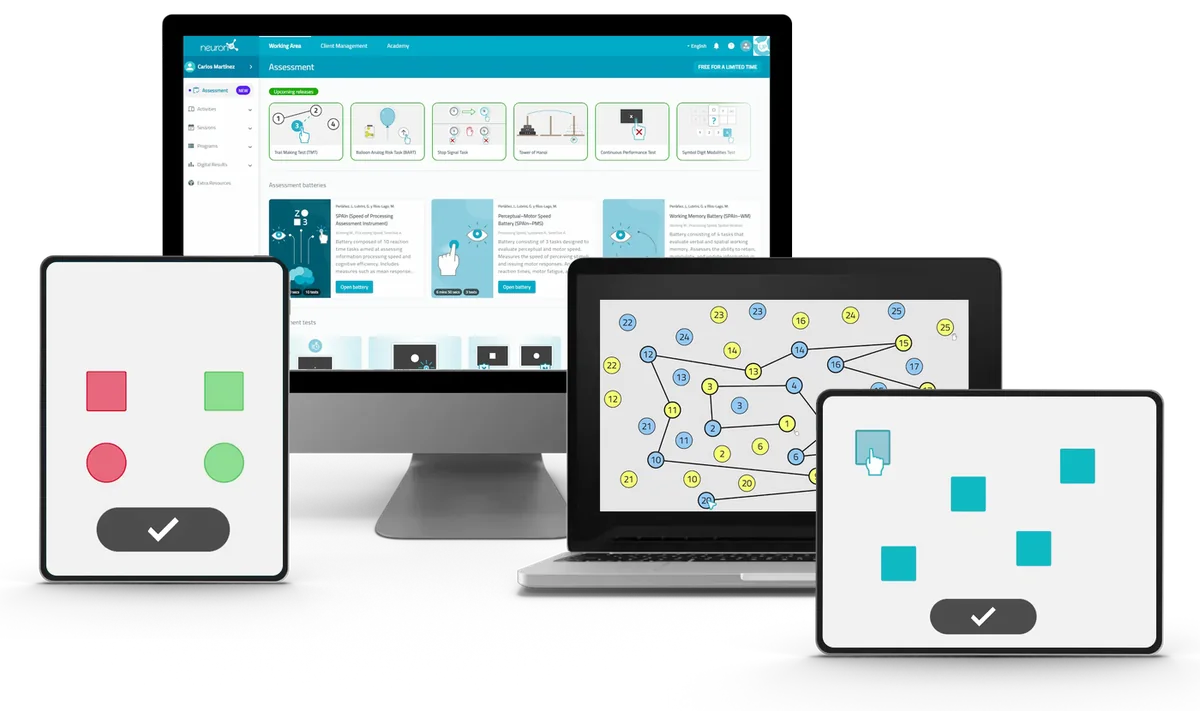
The complete NeuronUP Assessment battery: 23 digital tests to assess attention, memory, language, executive functions, processing speed and visuospatial skills. Filter by cognitive function to find the test you need.
Verbal comprehension
Token Test
36 verbal commands of increasing complexity involving tokens of different colors, shapes and sizes. Detects subtle auditory comprehension difficulties without requiring expressive language.
Duration: 10 minutes.
Working memory
Corsi Blocks Test
The reference paradigm for visuospatial memory, in digital form. Forward and backward sequences across nine blocks, with an exact record of the order tapped and the latencies between taps.
Duration: 5 minutes.
Working memory
Digit Span Test (Forward and Backward)
Repeat digit series in forward and backward order, with standardized audio. Compares the ability to hold verbal information with the cost of manipulating it, and includes Reliable Digit Span as a validity indicator.
Duration: 5 minutes.
Episodic verbal memory
Verbal Learning Test
Word-list learning across four trials, with interference, delayed recall at 30 minutes and recognition. It does not only measure how much is remembered: it measures how learning happens.
Duration: 15 + 7 minutes.
Selective attention
Brief Test of Auditory Attention
Digital version inspired by the Brief Test of Attention by Schretlen et al. (1996). In under 10 minutes, it assesses the ability to filter irrelevant information and maintain mental counting under interference, in a modality accessible to users with visual or motor difficulties.
Duration: 8 minutes.
Processing speed
Color Trails Test
Culturally fair analogue of the Trail Making Test (D’Elia et al., 1996). It replaces number-letter alternation with color-based alternation, preserving the executive demand while reducing dependence on the Latin alphabet and literacy.
Duration: 4 minutes.
Sustained attention
Continuous Performance Test (CPT)
Continuous Performance Test inspired by Rosvold (1956) and designed following the parameters of Conners, Epstein, Angold, and Klaric (2003). A 14-minute go/no-go task with variable intervals that makes it possible to objectively measure inattention, impulsivity, slowness, and attentional fatigue.
Duration: 15 minutes.
Processing speed
Stroop Test
Digital version with binary response of the classic Stroop paradigm. Quantifies with millisecond-by-millisecond precision the cognitive cost of inhibiting automatic reading to resolve the conflict between word and color.
Duration: 3 minutes.
Inhibition
Stop Signal Task
Stop-Signal Task with adaptive logic (Logan, 1994; Verbruggen et al., 2019). Estimates the SSRT, the internal latency of the inhibitory process: the cleanest metric available to quantify impulse control in milliseconds.
Duration: 10 minutes.
Processing speed
Trail Making Test (TMT)
Connect 25 numbers in order and then alternate between numbers and letters. The contrast between parts A and B separates visuomotor speed from the executive cost of set-shifting, with times, errors and latencies per stimulus.
Duration: 4 minutes.
Episodic memory
Symbol-Number Association Test
Match symbols to digits for 120 seconds using an always-visible key. It is the most sensitive measure of cognitive slowing in multiple sclerosis, and the digital version adds time per item, variability, fatigue and incidental memory.
Duration: 4 minutes.
Planning
Tower of Hanoi
Digital version of the classic subgoal-based problem-solving task. With four subtests (3 and 4 disks, two attempts each), it makes it possible to separate initial planning from procedural learning, a critical dissociation for dysexecutive profiles.
Duration: 9 minutes.
Decision-making
Balloon Analog Risk Task (BART)
Inflate balloons to accumulate earnings without popping them: 60 balloons in three colors with risks the patient learns implicitly. Measures risk propensity and punishment sensitivity, with ecological validity for real-world risk-taking behavior.
Duration: 5 minutes.
Motor speed
Motor Speed Test (Finger Tapping)
Measures the speed of voluntary movement: the patient presses the space bar for 10 seconds with each hand. Provides a baseline measure of the motor component and detects slowing, bradykinesia or asymmetries between hands.
Duration: 1 minute and 50 seconds.
Processing speed
Response Selection Speed Test
Measures speed in discriminating between stimuli and choosing the correct response. The most direct and basic measure of decision-making speed in the SPAIn battery, essential for driving or work.
Duration: 2 minutes.
Working memory
Spatial Working Memory Test 1-back
Ability to remember where things were a moment ago. Assesses visual and spatial memory, useful for orientation or remembering where objects were left.
Duration: 2 minutes and 30 seconds.
Working memory
Verbal Working Memory Test 1-back
Ability to retain brief information and compare it with the next item. Assesses whether short-term memory works well under conditions of low executive demand.
Duration: 2 minutes and 30 seconds.
Inhibition
Visual Search Test with Interference
Ability to locate what matters and ignore distractions. Explains complaints such as “I can’t find things” or “I get lost among papers,” common after brain injury or in multiple sclerosis.
Duration: 4 minutes.
Inhibition
Go-No Go Test (SART)
Press for any digit from 1 to 9 except when the 3 appears. Based on the SART paradigm, it quantifies impulsivity and sustained attention in milliseconds. Useful in ADHD, frontal damage or after a stroke.
Duration: 1 minute and 30 seconds.
Working memory
Spatial Working Memory Test 2-back
Ability to handle several locations in mind at once. Sensitive to impairments after traumatic brain injury or in pathological aging.
Duration: 2 minutes and 30 seconds.
Working memory
Verbal Working Memory Test 2-back
Ability to keep several items in mind at the same time and update them. Detects difficulties following conversations, multi-step instructions, or demanding intellectual work.
Duration: 2 minutes and 30 seconds.
Flexibility
Cognitive Flexibility Test (task switching)
Ability to switch mental criteria without making mistakes. Detects cognitive rigidity and difficulties adapting to changing situations, frequent after frontal damage.
Duration: 8 minutes.
Perceptual-motor speed
Perceptual-Motor Speed Test (Simple Reaction Time)
The most basic “see and react” test: press as soon as a circle appears on the screen. Measures perceptual-motor speed and sustained alertness with millisecond precision, and serves as a baseline for more complex processing tasks.
Duration: 3 minutes.