
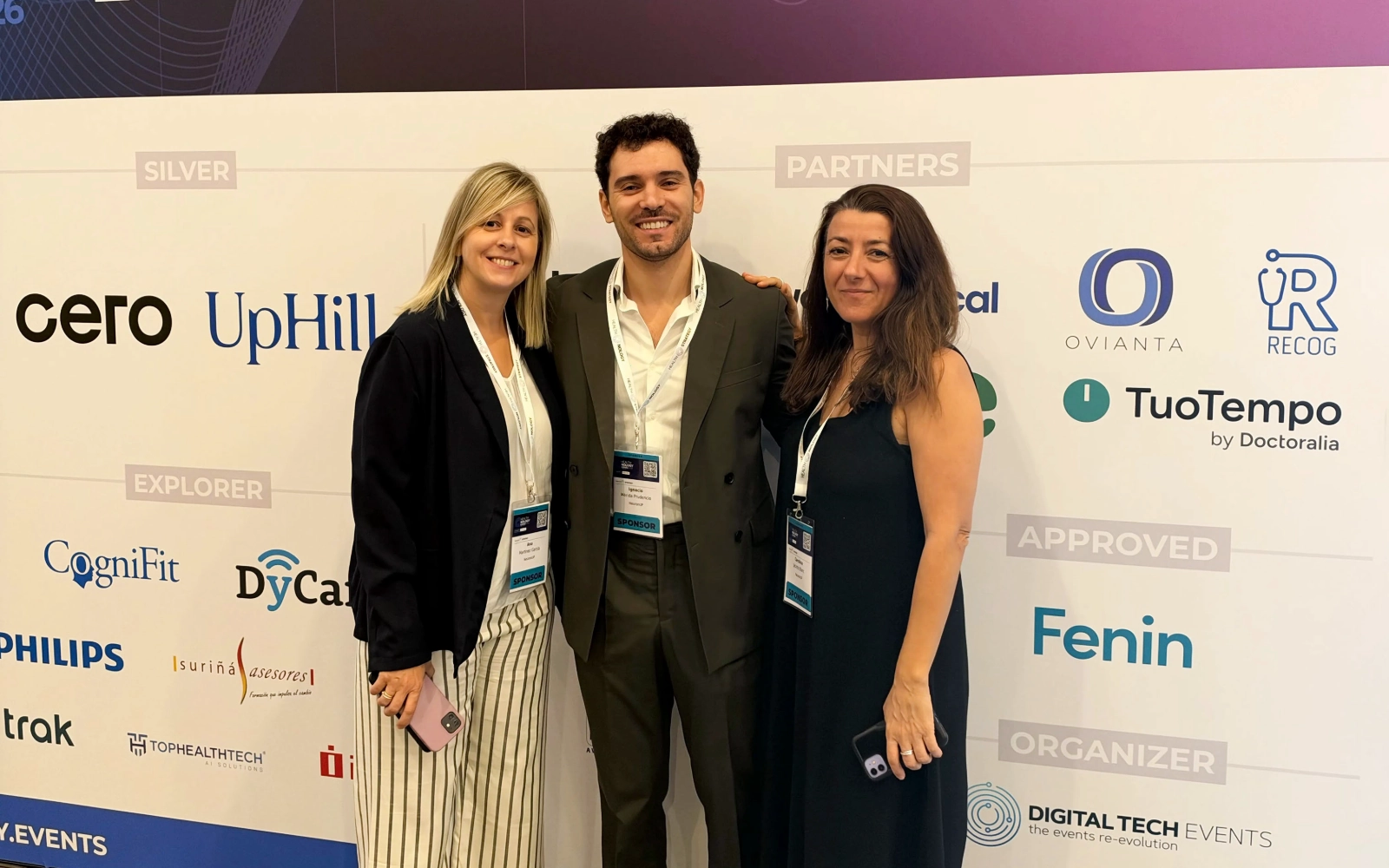
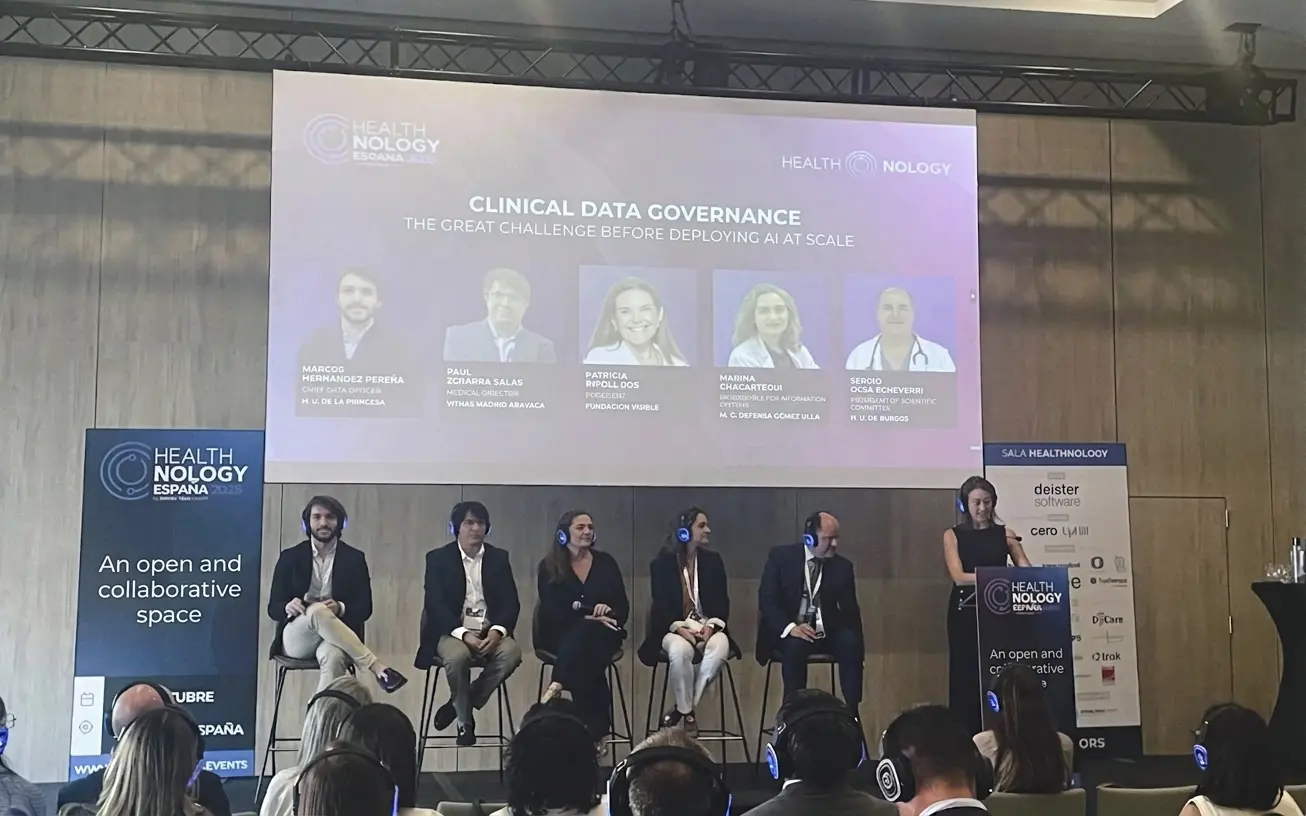
NeuronUP participated as a sponsor at Healthnology Spain 2026, an event held in Madrid that brought together healthcare leaders, professionals, and organizations to examine some of the key challenges of digital transformation in healthcare.
We had the opportunity to share our vision for the future of cognitive health, present our solutions, and, above all, talk with professionals leading digitalization initiatives in hospitals, healthcare groups, and other care settings.
How can we ensure digital transformation has a real impact on healthcare practice? How can we turn data into useful information that leads to better decisions? And how can we deploy technology across large organizations without losing the ability to tailor care to each patient?
These were some of the questions at the heart of Healthnology Spain 2026.
For NeuronUP, taking part in this event was also an opportunity to listen.
To listen to healthcare leaders shaping new digitalization strategies. To professionals who need to integrate new tools without adding complexity to their work. And to organizations seeking to grow and offer new services while maintaining the quality of care.
The conversations throughout the event led to a shared conclusion: digital transformation in healthcare only makes sense when it addresses the real needs of professionals, organizations, and users/patients.
Here are some of the key takeaways we came away with.
Digital transformation needs to solve concrete problems
Talking about digital transformation is relatively easy. Turning that transformation into real improvements for professionals, organizations, and patients is much more complex.
Adopting a new tool does not necessarily mean innovating.
Technology delivers real value when it addresses a specific need: reducing administrative tasks, streamlining processes, organizing information more effectively, supporting decision-making, or enabling an organization to expand certain services sustainably.
The same is true in cognitive health.
Digitizing processes related to assessment, rehabilitation, and follow-up can open up new possibilities, but technology must fit into the way professionals work—not force them to adapt their entire practice to a tool.
At NeuronUP, we start from this principle: technology should augment professional judgment, not replace it.
More data does not necessarily mean better decisions
Digitalization makes it possible to generate and store increasingly large amounts of information.
But accumulating data does not necessarily mean gaining a better understanding of the user/patient.
Real value emerges when that data can be turned into useful information for clinical practice.
In rehabilitation and cognitive health, having longitudinal data can help professionals better understand a person’s progress, identify changes, and draw on more information to decide how to proceed with the intervention.
So the goal should not simply be to digitize. It should be to turn data into information that supports decision-making.
Appropriate follow-up can help answer important questions:
- How is the user/patient progressing?
- Should the current intervention continue?
- Does the difficulty level need to be adjusted?
- Which cognitive functions are showing a different pattern of change?
- What information can help determine the next step?
When data starts answering clinical questions, it becomes more than a set of records—it begins to generate real value.
Assessment, intervention, and follow-up: toward more connected processes
Another opportunity offered by digitalization is reducing fragmentation.
In many healthcare settings, different stages of care may be carried out using different tools, formats, or systems.
Assessment in one setting. Intervention in another. Results recorded in a separate system. And then trying to reconstruct all that information to analyze progress.
In place of this fragmentation, there is a clear opportunity to build more connected models:
Assess. Interpret. Intervene. Monitor progress. Make the next decision.
In cognitive health, connecting these stages provides a more complete view of the patient’s journey.
This is also one of the areas in which NeuronUP is evolving as a platform: creating an ecosystem where professionals can address different stages of cognitive health through solutions that work together.
The challenge of scaling without losing personalization
Things become more complex when we move beyond an individual professional and consider organizations.
A hospital. A healthcare group. A network of clinics. Multiple sites. Dozens or hundreds of professionals.
In these settings, one question becomes especially important:
How can an organization-wide solution be deployed without losing the ability to tailor the intervention to each user/patient?
Scalability and personalization should not be opposing concepts.
An organization needs processes, traceability, and shared infrastructure. But every professional still needs the flexibility to tailor an intervention to each person’s characteristics, goals, and progress.
This combination of organizational structure and clinical personalization will be one of the major challenges in digital health in the coming years.
And it is precisely one of the needs that NeuronUP addresses.
NeuronUP is ideal for organizations that need to deploy NeuronUP across different professionals, teams, or sites and structure its implementation according to their specific needs.
The goal is not to standardize clinical intervention.
It is to provide shared infrastructure that enables teams to work in a coordinated way while retaining the ability to personalize every intervention.
From technological innovation to purposeful innovation
One of the key takeaways from Healthnology is that healthcare innovation should not be measured by the number of technologies adopted.
It should be measured by the problems we manage to solve.
By the time we can give back to professionals.
By our ability to turn information into better decisions.
By the opportunity to offer more personalized services.
And, ultimately, by the impact we can have on patients.
At NeuronUP, we will continue working in this direction: building a platform that can connect digital cognitive assessment, cognitive rehabilitation, telerehabilitation, and progress tracking, while always keeping professionals and their clinical judgment at the center.
We came away from Healthnology Spain 2026 with new conversations, questions, and insights that will help us keep building alongside healthcare organizations.
Thank you to everyone who stopped by our booth, shared their challenges with us, and took a few minutes to talk about how they envision the future of digital health.
Want to discover NeuronUP for groups?
NeuronUP is ideal for hospitals, healthcare groups, clinic networks, and organizations that need to implement cognitive assessment and rehabilitation solutions across multiple professionals, teams, or sites.
If you would like to explore how NeuronUP could be integrated into your organization, contact our team and tell us about your project.

 The Brain in the Digital Age: How Technology Is Transforming the Way We Think

Leave a Reply