
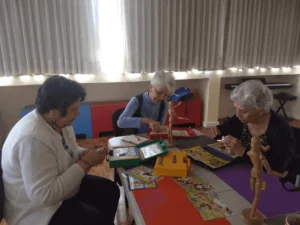
Marcela Vázquez-Mellado Cervantes, a careers adviser specializing in healthy and active ageing, argues in this article for the need to design meaningful activities for patients with dementia and for healthy ageing, combining the Montessori philosophy, constructivism and the Person-Centred Care (PCC) model.
A person whose universal basic needs (comfort, identity, attachment, inclusion and occupation) are met faces healthy ageing of better quality, even when illnesses appear with the passing years.
Older people in the early stages of ageing, fully independent and autonomous, often join activities designed for their new life as retirees. With surprise and sadness they report condescending treatment, constant infantilization and a complete absence of cognitive, physical, psychological and social challenges. For older people with dementia, the picture is even worse. With discipline, creativity and knowledge this can be reversed, meeting the ambitious challenge of getting participants genuinely excited by a good proposal. Montessori, constructivism and the Person-Centred Care (PCC) model are the perfect combination of care models and activity design.
Basic needs
Occupation is one of the universal basic needs of every older person. Unlike leisure and entertainment, occupation is characterized by the certainty of being useful, performing a task well and growing in a direction. This is achieved through the design and structured planning of activities that allow people to experience success in a task, handle surprises, take on new challenges and set routes, goals and specific short- and medium-term objectives — alert and ready each day to face obstacles and unforeseen variables as a team and a community.

Subscribe
to our
Newsletter
The success of the PCC model
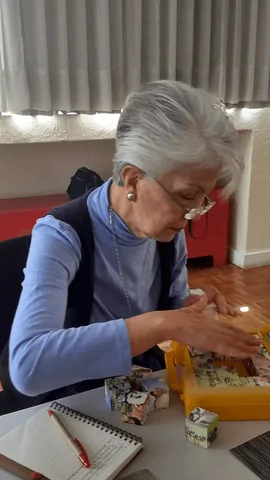
The Person-Centred Care (PCC) model is fundamental. It is a care model and an intervention approach in which people become the central axis of organizations, services and professional practice, recognizing the principles that guide the care each person receives. The PCC model, recommended and applied across the world, works both for people in full healthy ageing and for patients with dementia and other diagnoses.
Is there anyone who would not prefer a tailor-made suit?
The brain governs everything
Scientists approach the study of brain functions from two different perspectives: medicine and education. The former focus on the pathologies and conditions of the organ, the latter on the acquisition and retention of knowledge and experience. Non-Pharmacological Therapy (NPT) seeks to capitalize on both.
Cognitive functions (orientation, language, calculation, gnosias, praxias, memory, executive functioning, social cognition, intelligence, attention and alertness, perception, sensation, abstract thinking, motor responses, object recognition) are the compass in the design of meaningful activities. They are the banner of the constructivist approach and the core of the Montessori philosophy respectively, which is why they are the ideal complement to the PCC model.
NPTs are primary non-chemical agents that aim to improve the quality of life and cognition of both healthy and ill people through meaningful, flexible, comprehensive, coordinated and continuous activities with defined objectives. They can always be evaluated and make it possible to track their impact.
Meaningful activities
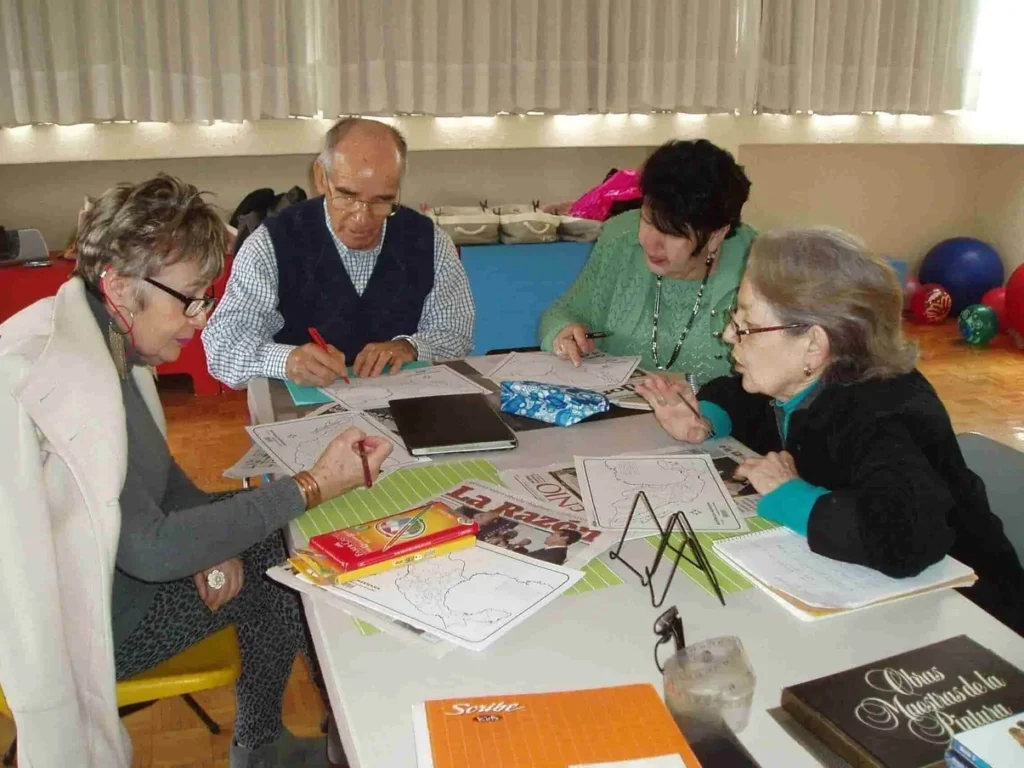
It is an open secret, a widespread problem and a constant complaint from families, patients and participants: the poor quality of the activities offered in many centres. With the best of intentions, they frequently disrespect the intelligence, life history, capabilities and skills of older people. Far removed from the concept of “meaningful activities”, they produce rejection and deep sadness among participants, who ask themselves: why am I being treated like this? Is this what awaits me for the rest of my life? Colouring sheets, making paper flowers, songs and games, yoga at 11:00, dominoes at 6:00, films on Saturdays and songs from your day on Wednesdays.
Designing meaningful activities requires investing time, effort, creativity and care at the outset, and it guarantees success and performance for periods of up to six months without having to repeat programmes or to coax, bribe, pressure, persuade or negotiate with participants on the grounds that “it is what it is”.
If we take care of aspects such as each person’s information and life history, choose the activities together, offer several options, involve them voluntarily in the design of those activities and invite them to add challenges and novelties that give them the chance to support one another, we will build teams and create community. Taking each person’s general interests into account in the design helps assign and rotate roles, cultivating a sense of community.
I remember staging a nativity play. Not everyone has the calling or the willingness to go on stage, but lighting enthusiasts, make-up artists and prompters emerged; the choreography was led by a participant in a wheelchair who danced through his companions. I vividly remember a participant who had lived with stage fright for 85 years and overcame it in the role of a tree. He was proud and happy, dressed as an oak, standing tall and full of dignity, playing his part: moving across the stage to give shelter to Joseph and Mary on their journey.
Every person, every individual matters; recognizing that we are different and unique gives us dignity. Non-pharmacological therapy or occupational therapy must be flexible and reinforce identity, strengthen social relationships and integrate NPT into everyday life as a form of work; doing so makes participants feel competent by highlighting their abilities. Preparing them for failed attempts and not letting them sink into failure is also our job. Creativity must be promoted and encouraged without giving in to personal whims: let us be creative as long as there is room for the participant’s personal development.
How do you create meaningful activities?
To begin with, you must be clear about the objectives, both specific and general. These depend on the person’s health status and the doctor’s recommendations — the GDS (Global Deterioration Scale) rating for a participant with dementia, or the temporary motor limitations caused by another person’s accident, for example.
Health status, life history, hobbies and preferences set the direction. But there is more:
- choosing the type of content (conceptual, procedural, attitudinal);
- determining the domain each activity will stimulate (psychomotor, cognitive, affective);
- the approach strategies, materials, group dynamics and settings;
- needs and resources, and the schedule of timings and movements;
- the roles;
- and, most importantly, the structure and instruments for evaluation.
Evaluation
Evaluation is the fulfilment of the objectives: if my objective says “observe”, all I can evaluate is whether the participant observed. The most important thing is not assessing the participant’s performance; what matters most is the evaluation of the activity itself and its impact.
We must be able to report which area of the brain was stimulated and the desirable outcomes we can record and project. It is far from simple, but supported by the Montessori and constructivist educational approaches and the solid scaffolding of the PCC model at the heart of the plan, the results are more than satisfactory.
Characteristics and requirements of Non-Pharmacological Therapies (NPT)
NPT must be voluntary, never forced, and joyfully undertaken: from the moment of the invitation the participant should show energy and enthusiasm for taking it on, or at the very least conviction and willingness.
It is not utilitarian in the sense of expecting a material or moral reward. Let us not overdo false praise, recognition and celebrations: if it merely helps break negative, repetitive thought patterns, that is already successful progress; it also restores energy, and we may achieve nothing more than a change in the kind of tiredness felt.
Older people may be tired of pain, boredom, loneliness, exhaustion, of missing people, tired of accumulating losses. One goal of NPT can be to achieve a sense of healthy tiredness, the kind that comes from healthy improvement in personal competence, in a skill, a domain or a challenge (doing what we are doing better than we did yesterday). Pursuing the continuous, repeated development of the team is a great achievement and extraordinary work. It becomes a way of life when it is approached with pleasure and a positive attitude. Work and occupation are not only a need but a human right that should hold true in every period of life.
Optimal work and lifelong learning are complemented by leisure and recreational activities, valuable opportunities for cognitive stimulation and a successful form of NPT. Our model holds that even spontaneous, improvised activities require planning and structure.
Work can be individual or collective, alternating between the two. The combination invites all of us to grow.
Our design succeeds when the work becomes the participant’s passion. Ideally, that work is repeated, guided and structured.
Let’s design together
Our work on activity design is guided by:
- María Montessori, with her defence of autonomy and independence and the importance of prepared environments. Each person’s context and qualities, and respect for their abilities and their own pace, as Montessori advocated, shape both the resulting path and the daily course of the work.
- Piaget, Vygotsky and Ausubel identify the participant as the dynamic, active and participatory centre, the builder and author of their own process, learning and development, responsible for the path towards the zone of proximal development and meaningful learning, through both reception and discovery. They hold that there is no direct transfer of content: it is varied experiences and individual lived experience that build the setting for work and stimulation.
- Scholars such as Dawn Brooker, Tom Kitwood, Howard Gardner, Carl Rogers, Joseph Villa Miravet, Nuria Carcavilla, Rosa María Farrés and Elena Fernández G. set the humanist framework for learning and collaborative work: activating prior knowledge, cognitive stimulation strategies and dignified, continuous work for older people and people with dementia, respecting the roles of facilitator or mediator, companion, observer, participant, medical professional, key worker and family member. Grounded in the PCC model, we keep the older person — healthy or living with dementia — as the central axis of the equation.
Choosing which type of NPT to apply
Once all of the above has been established, we choose the type of NPT to apply: physical, cognitive, social, affective, quality-of-life, recreational, behaviour-modifying, environmental, activities of daily living (ADL) and others.
Another classification proposes psychosocial, motor, balance, laterality, coordination, relaxation, orientation, abstract thinking, episodic memory, new technologies, sensory stimulation, animal-assisted, reminiscence, current affairs, reality orientation, body awareness and narrative variants.
The Montessori philosophy specifically adds sensory discrimination, fine motor skills, classification, seriation, personal care and care of the environment, to name a few.
Gardner’s theory of multiple intelligences helps in recognizing the patient and their strengths: logical-mathematical, linguistic, musical, spatial, bodily, naturalistic and emotional.
Other authors add financial, investigative, crystallized and fluid intelligence. The work of José Antonio Marina and Frida Díaz Barriga helps pinpoint the valuable relationship between the participant’s interest in the activity and its level of difficulty — which differs for every person. We call this relationship the “personal dimension of learning”.
It is essential to know each person’s preferred way of taking in content and their optimal condition: visual, auditory or kinaesthetic. Someone with a visual preference who currently has glaucoma or macular degeneration needs a different proposal.
Example: designing an activity that draws on all three approaches
Combing your hair after a shower
- In front of the mirror
- Alternating three partings
Stage: GDS 6
- basic need: identity;
- executive functioning;
- frontal lobe;
- movement interpretation;
- occipital lobe;
- general variant: laterality;
- content: procedural;
- kinaesthetic activity;
- personal care;
- grooming and appearance;
- body awareness;
- accompanied and guided.
Conclusions
Good design and a structured plan of meaningful activities recognizes and makes the most of every moment and occasion as an opportunity for stimulation and cognitive development — not only for patients with dementia, but also for older people experiencing healthy ageing. Personal hygiene, leisure time, outdoor activities, sporting events, cultural visits, walks, reading aloud, family visits, doing the shopping, preparing food, conversation, singing and dancing, even simply observing, are all opportunities for stimulation. Researchers of the brain and behaviour put valuable, versatile tools within our reach. A well-designed, well-structured NPT benefits the patient, their family, carers, peers and the institution or centre.
Bibliography
- Brooker, D. (2013). Atención centrada en la persona con demencia. Barcelona , Catalunya, España: Octaedro.
- Miravet, J. V. (1999). Guía práctica para entender los comportamientos de los enfermos de Azheimer. Barcelona, Catalunya, España: Octaedro.
If you liked this post about meaningful activities, you may also be interested in the following articles:


“This article has been translated. Link to the original article in Spanish:”
Diseño de actividades significativas para pacientes con demencia y envejecimiento saludable

 The multifactoriality of neuropsychological tests: What do we value when we evaluate?



Leave a Reply