
Basic plan
Tests included in the Basic plan
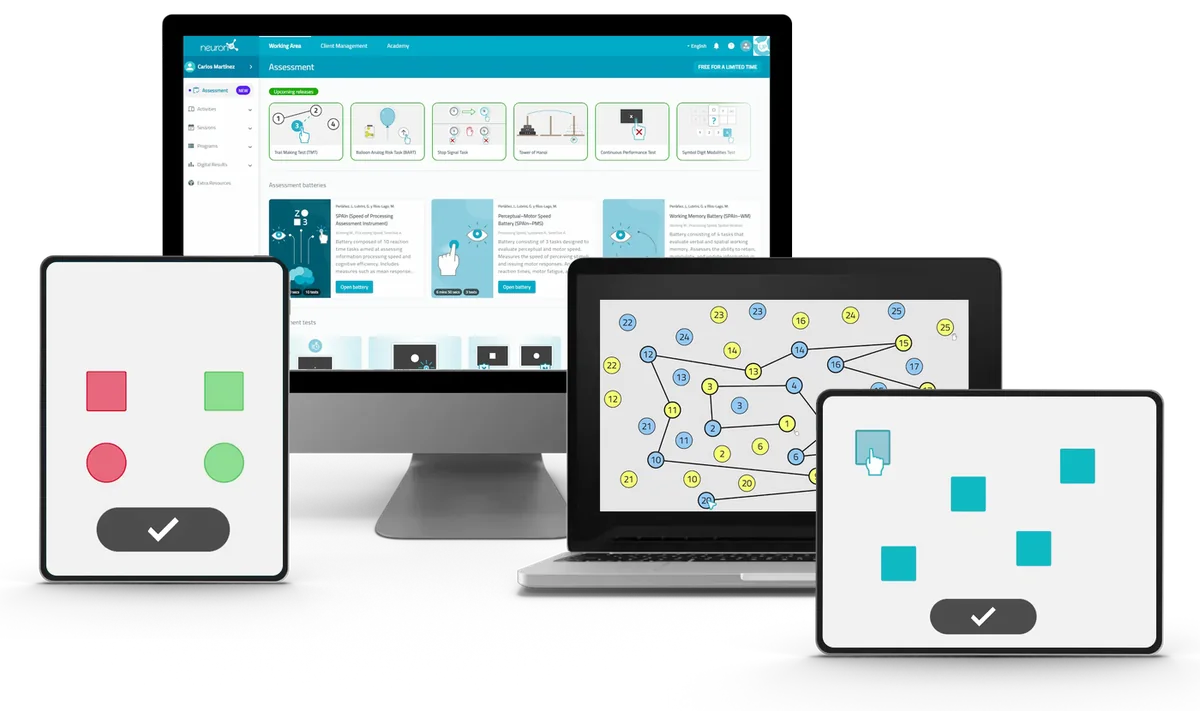
A basic protocol designed to assess as many cognitive processes as possible with as few tests as possible: 8 digital tests that measure motor and processing speed, attention, memory, language, executive functions and decision-making.
Motor speed
Motor Speed Test (Finger Tapping)
Measures the speed of voluntary movement: the patient presses the space bar for 10 seconds with each hand. Provides a baseline measure of the motor component and detects slowing, bradykinesia or asymmetries between hands.
Duration: 1 minute and 50 seconds.
Perceptual-motor speed
Perceptual-Motor Speed Test (Simple Reaction Time)
The most basic “see and react” test: press as soon as a circle appears on the screen. Measures perceptual-motor speed and sustained alertness with millisecond precision, and serves as a baseline for more complex processing tasks.
Duration: 3 minutes.
Verbal comprehension
Token Test
36 verbal commands of increasing complexity involving tokens of different colors, shapes and sizes. Detects subtle auditory comprehension difficulties without requiring expressive language.
Duration: 10 minutes.
Episodic memory
Symbol-Number Association Test
Match symbols to digits for 120 seconds using an always-visible key. It is the most sensitive measure of cognitive slowing in multiple sclerosis, and the digital version adds time per item, variability, fatigue and incidental memory.
Duration: 4 minutes.
Working memory
Digit Span Test (Forward and Backward)
Repeat digit series in forward and backward order, with standardized audio. Compares the ability to hold verbal information with the cost of manipulating it, and includes Reliable Digit Span as a validity indicator.
Duration: 5 minutes.
Processing speed
Trail Making Test (TMT)
Connect 25 numbers in order and then alternate between numbers and letters. The contrast between parts A and B separates visuomotor speed from the executive cost of set-shifting, with times, errors and latencies per stimulus.
Duration: 4 minutes.
Decision-making
Balloon Analog Risk Task (BART)
Inflate balloons to accumulate earnings without popping them: 60 balloons in three colors with risks the patient learns implicitly. Measures risk propensity and punishment sensitivity, with ecological validity for real-world risk-taking behavior.
Duration: 5 minutes.
Inhibition
Go-No Go Test (SART)
Press for any digit from 1 to 9 except when the 3 appears. Based on the SART paradigm, it quantifies impulsivity and sustained attention in milliseconds. Useful in ADHD, frontal damage or after a stroke.
Duration: 1 minute and 30 seconds.