Patricia Martín Gutiérrez, Head Speech and Language Therapy Supervisor at Lescer Center, presents in this article how they have optimized the center’s therapeutic approach with the help of NeuronUP and some examples of individual and group therapies.
Introduction
As a speech and language therapist at Lescer Center, I have had the privilege of supporting many patients in their recovery process and in improving their communication and cognitive abilities. Every day I see how cognitive rehabilitation can make a real difference in the lives of those who have experienced acquired brain injury (ABI) or other neurological conditions. From the first contact with the patient to the progress achieved through effort and dedication, each story is a testament to the positive impact of our work.
At our center, speech and language therapy plays an essential role within neurological rehabilitation, helping to restore functions related to communication, speech, voice, and swallowing.
The arrival of the NeuronUP platform in our sessions has been a revolution in the way we approach cognitive stimulation. Its implementation has allowed us to offer more dynamic, personalized, and motivating interventions for our patients.
About Lescer Center
What is Lescer Center?
Lescer Center was founded with the mission of offering comprehensive neurorehabilitation services to people affected by acquired brain injury, such as stroke, tumors, traumatic brain injuries, polyneuropathies, neurodegenerative diseases, etc. With three decades of experience, the center has established itself as an interdisciplinary space where specialized professionals come together to provide the care our patients need.
What is the professional team like at Lescer Center?
The center stands out for its holistic approach, combining evidence-based therapies with warm, compassionate care. Its team is made up of:
- Neurologists responsible for diagnostic assessments.
- Neuropsychologists specialized in recovering cognitive aspects.
- Physiotherapists specialized in motor recovery.
- Speech and language therapists who are experts in communication, speech, voice, and swallowing disorders.
- Occupational therapists focused on daily independence.
- Social worker.
- Nurse.
- Support staff.
What is Lescer Center’s specialty?
To guarantee comprehensive care, the center is organized into various specialized units that address the different needs of our patients:
Inpatient unit
Intended for patients who need intensive, continuous care due to the severity of their neurological condition. In this unit, professionals work in a coordinated way to address each patient’s medical, functional, and cognitive needs, ensuring comprehensive rehabilitation.
Home care unit
Designed for those patients who, for various reasons, cannot travel to the center. Our team of professionals goes to their homes to offer tailored rehabilitation, ensuring continuity of treatment and supporting recovery in a familiar environment.
Outpatient unit
Designed for patients who require periodic treatment without the need for hospitalization. Here, scheduled sessions of speech and language therapy, physiotherapy, occupational therapy, and neuropsychology are provided, allowing rehabilitation to continue without disrupting their daily routine.
Day center
Focused on daytime care for patients with neurological impairments who require ongoing therapeutic follow-up, but who can return home at the end of the day. Here, individualized rehabilitation programs are carried out, combining physical, occupational, speech and language, and neuropsychological therapy in a structured environment.
Telerehabilitation unit
For those patients who cannot come to the center due to where they live, because they do not have anyone who can bring them during holiday periods, or because medical issues prevent them from coming to our facilities. At Lescer Center we have expanded and improved our telerehabilitation unit.
At Lescer, we focus on the patient journey map, meaning the path the patient follows from admission to full rehabilitation. We begin with the initial assessment, where we establish an interdisciplinary treatment plan tailored to their needs, fully individualized based on the goals set by both the patient and their family. Throughout the process, we carry out periodic follow-ups to assess progress and adapt interventions as they evolve. This approach allows us to ensure more effective rehabilitation, centered on achievable goals and with a long-term perspective to improve the patient’s quality of life.
What is the profile of patients at Lescer Center?
At Lescer we work with people who have experienced:
- Acquired brain injury (ABI).
- Tumors.
- Neurodegenerative diseases.

Subscribe
to our
Newsletter
Lescer Center as a center for rehabilitation and cognitive stimulation
What is the approach to rehabilitation and cognitive stimulation therapies?
At Lescer we adopt a comprehensive approach based on the International Classification of Functioning (ICF), focused on the patient’s needs and their environment. Our goal is to design personalized rehabilitation plans that address both the physical and cognitive functions affected by brain injury.
Cognitive stimulation is a fundamental part of our therapies, as it aims to improve skills such as memory, attention, language, and executive functions, which are essential for our patients’ social and work reintegration. Specifically, cognitive stimulation is part of the therapies carried out in all units of the center.
In the day center unit, it is carried out in both individual and group sessions; whereas in the other units, it is provided through individual therapies. In speech and language therapy, priority is given to restoring communication and swallowing, which are key to achieving the patient’s reintegration.
Cognitive rehabilitation with NeuronUP at Lescer Center
What were the reasons for implementing NeuronUP at Lescer Center?
The decision to incorporate NeuronUP into our therapies arose from the need to have a versatile, up-to-date tool that would allow us to personalize interventions according to each patient’s individual characteristics. NeuronUP offers a wide variety of activities and resources that adapt to different difficulty levels and cognitive domains, which makes it easier to create specific and effective rehabilitation programs.
In addition, as it is a digital tool, it is very motivating for our patients.
What are the benefits of NeuronUP in interventions with Lescer Center patients?
- Personalized therapies: the wide range of available activities allows us to design specific programs for each patient, addressing their needs and individual goals.
- Motivation and engagement: NeuronUP’s interactive interface and dynamic activities increase patients’ motivation, encouraging their active participation in the rehabilitation process.
- Detailed tracking: the platform offers tracking tools that facilitate continuous progress assessment, enabling timely adjustments to therapies.
- Accessibility: it is a good option for working with patients in the telerehabilitation unit, ensuring continuity of therapies without interruptions.
What are the benefits of NeuronUP for Lescer Center professionals?
- Simplifies the planning and management of sessions.
- Access to detailed assessment and tracking tools.
- Ability to create personalized programs based on therapeutic goals.
How has NeuronUP been received by Lescer Center patients?
The response has been very positive:
- Older adults: they value the simplicity of the interface and the sense of achievement when they overcome levels. The feedback provided by the platform motivates patients to keep progressing and completing more complex exercises, with less frustration.
- Families: they appreciate being able to take part in activities from home through the caregiver version.
Success stories at Lescer Center thanks to working with NeuronUP
Home unit: individual therapy for motor aphasia
Below we present the case of a patient with motor aphasia. She is a 67-year-old woman who suffered an ischemic stroke in the left middle cerebral artery, and we began treatment with her in the inpatient unit. She spent two weeks there receiving one speech and language therapy session per day. Upon discharge from the hospital, we began providing treatment at her home.
Since one of the goals the patient requested was to do her daily shopping so she could start cooking, we worked on both recognition and use of money, vocabulary, and shopping lists. We addressed this major goal through occupational therapy and speech and language therapy by providing one hour of treatment in the morning with the occupational therapist and another hour in the afternoon with speech and language therapy.
Both the occupational therapist and the speech and language therapist used NeuronUP to work on the concept of money, its recognition, paying amounts, and small mental calculations. We did this work for one month, and then put it into practice: we went with her to the supermarket and little by little reduced our help so that she ultimately completed the task entirely on her own, with only our presence.
Finally, after two months of therapy, the patient with motor aphasia managed to do small shopping trips in stores near her home.
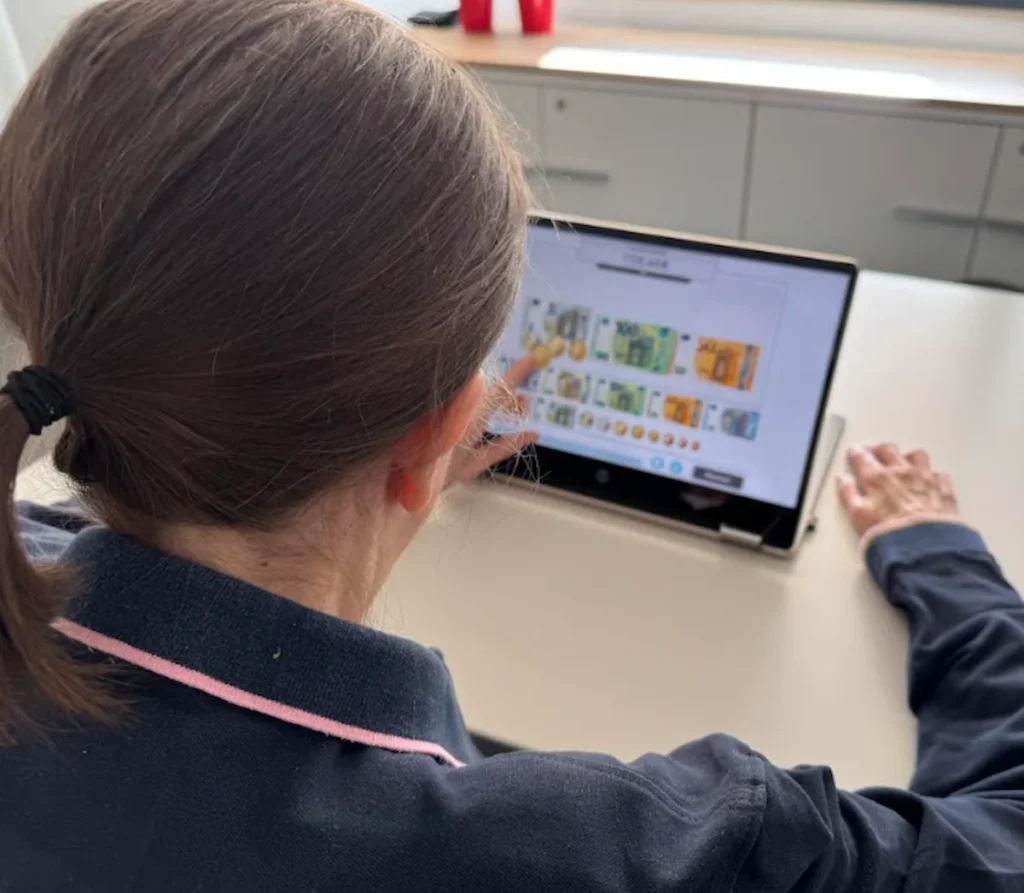
NeuronUP activities used in this individual therapy for motor aphasia
- Sort the money, an adult activity designed to work on visual gnosis and selective attention.
- Exact payments, an adult exercise focused on working memory, planning, and shopping.
- Objects, establishments, and professionals, worksheets for adults aimed at training spatial orientation and shopping.
Summary of this second individual therapy aimed at working on motor aphasia
- Goals: recognition and use of money; as well as the use of vocabulary adapted to the context.
- Observed results: in two months she was able to do small shopping trips in stores near her home.
Outpatient unit: individual therapy for motor aphasia
In this case, we also address a motor aphasia case, but this time from the outpatient unit. It is a male patient who suffered, like the previous patient, an ischemic stroke in the left middle cerebral artery.
When he arrived at our center, he already had a two-year evolution and had motor aphasia, with anomia and agrammatism, which led him to communicate with isolated words and made him unable to produce more elaborate messages that could better communicate his ideas.
The goal he requested was to be able to express his ideas better and for his family and friends to understand him better. To achieve this, we carried out one speech and language therapy session per day, five days a week.
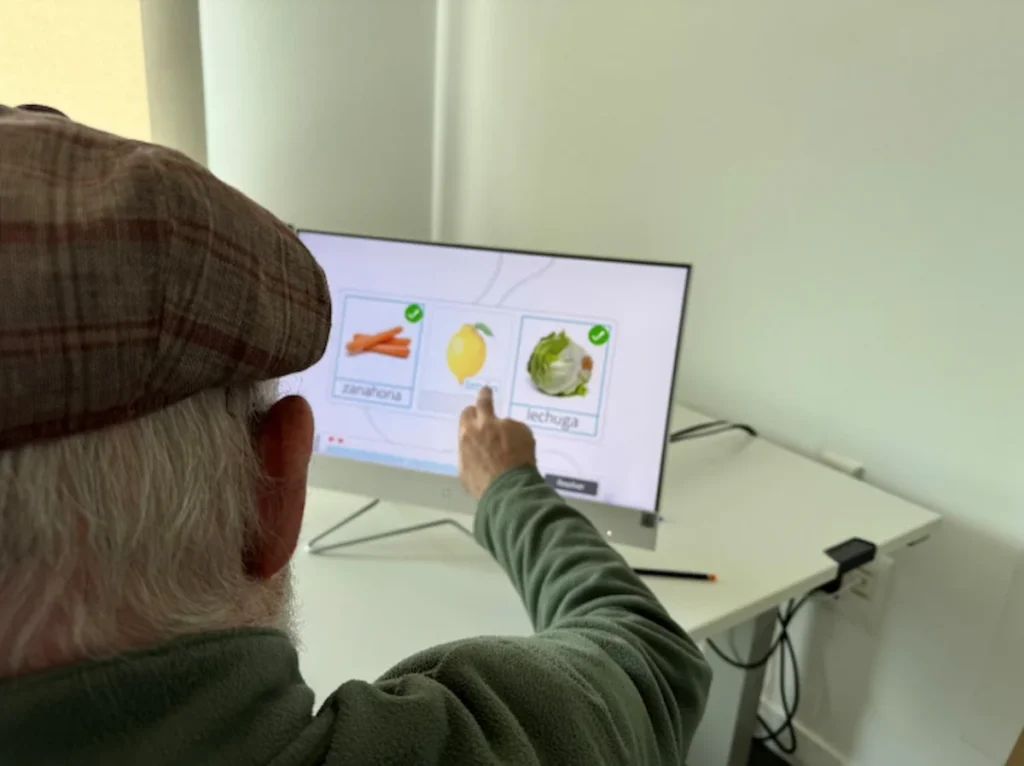
NeuronUP activities used in this individual therapy for motor aphasia
- Naming objects with phonological cues, worksheets for adults designed to work on naming.
- Finding words by their definition, matching a noun with an image, matching a verb with an image and matching an adjective with an image, worksheets for adults to improve vocabulary.
- Pairs by categories, an adult activity designed to work on reasoning.
- Put steps in order in activities, worksheets for adults in text and image format aimed at training planning, reasoning, and comprehension.
- Form sentences, an adult exercise focused on expression, working memory, flexibility, planning, and comprehension.
- Create stories from words, worksheets for adults designed to work on fluency, planning, and reasoning.
- Make up a story with drawings, worksheets for adults similar to the previous ones, aimed at working on reasoning and expression.
Summary of this second individual therapy aimed at working on motor aphasia
- Goals: improve naming and verbal fluency.
- Observed results: in three months, he went from articulating isolated words to forming 4–6-word sentences. In addition, his family noticed improvements in his self-esteem and participation in conversations.
Day center unit: oral expression and comprehension group
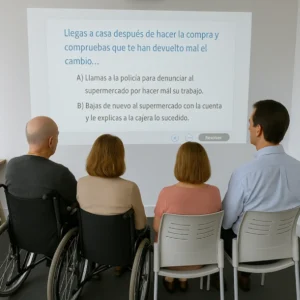
Next, we present one of the success stories from group therapies. On this occasion, it is a rehabilitation group made up of four women who have aphasia. Specifically, three of them have motor aphasia, and the fourth has mixed aphasia. Their ages range from 35 (the youngest) to 72 (the oldest).
They all get along very well, share hobbies, and love group therapy for several different reasons. One of them, and the one they all agree on, is that they are with people who have gone through similar things and have similar difficulties. On the other hand, they support each other a lot. When one of them gets stuck, another gives her a little push so she can continue.
This workshop is run by the center’s Speech and Language Therapy Department and is held twice a week, lasting an hour and a half per workshop. The goal for all of them is to improve their communication.
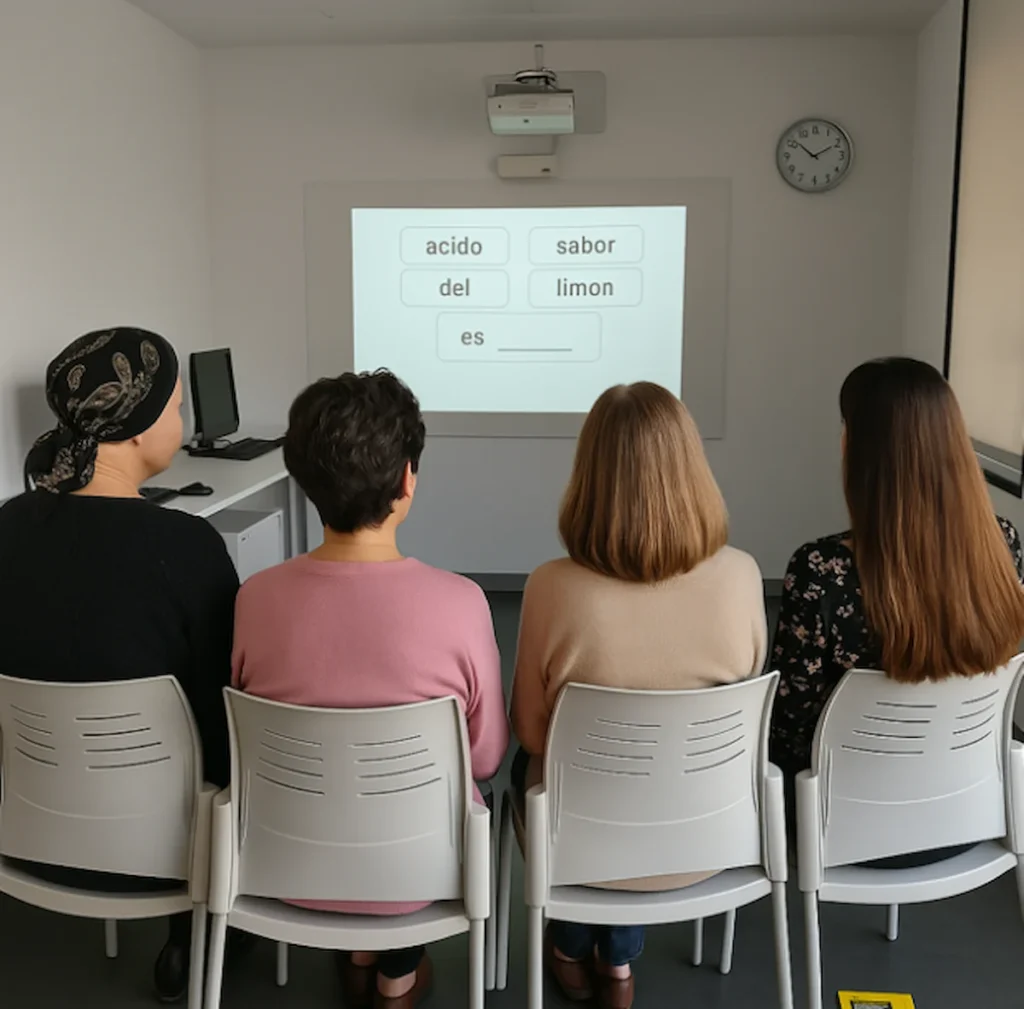
NeuronUP activities used in these group interventions for oral expression and comprehension
- Form sentences, an adult activity for expression, working memory, flexibility, planning, and comprehension.
- Objects, establishments, and professionals, worksheets for adults aimed at training spatial orientation and shopping.
- Match a noun with an image and match a verb with an image, worksheets for adults to train vocabulary.
- Correct name for an image, worksheets for adults focused on naming.
- Relate concepts, worksheets for adults aimed at working on reasoning.
- Select elements from a category, worksheets for adults to work on selective attention and semantic memory.
- When would you show the following emotion?, worksheets for adults focused on social cognition.
- Organize the kitchen, an adult activity aimed at training reasoning, sustained attention, semantic memory, and episodic memory.
- Pairs by categories. an adult exercise to train reasoning.
- Organization by categories, an adult activity aimed at semantic memory.
- Pairs of items and categories, an adult activity to train semantic memory.
- Reading comprehension with questions, True and false written sentences, and True and false spoken sentences, worksheets for adults designed to work on comprehension.
- Put steps in order in activities, worksheets for adults in text and image format aimed at training planning, reasoning, and comprehension.
Summary of this group therapy for oral expression and comprehension
- Goal: improve oral communication.
- Observed results: patients made progress in verbal fluency and discourse structuring, improving their ability to communicate effectively in everyday situations.
Day center unit: executive functions group
Lastly, we addressed a group therapy with a mixed group made up of men and women with diverse conditions:
- A 53-year-old woman with traumatic brain injury (TBI).
- A 59-year-old man with multiple sclerosis (MS).
- A 55-year-old woman with stroke (CVA).
- A 63-year-old man with early-stage dementia.
The goal of the workshop was to increase participation in daily activities, improving planning, organization, and decision-making skills. This workshop was carried out by the neuropsychologists in the day center unit, twice a week, and lasted an hour and a half each day.
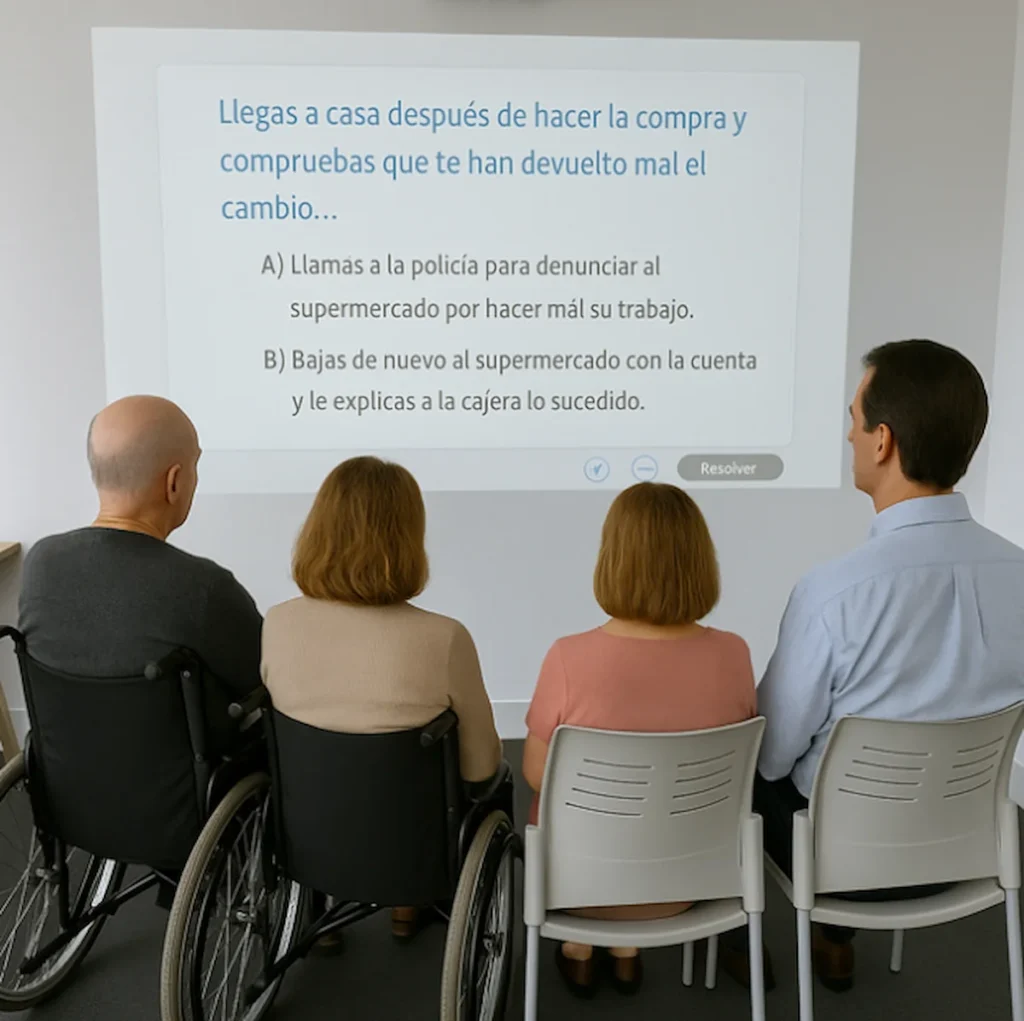
To achieve this, they used NeuronUP with activities that simulated everyday situations, such as managing a shopping list, planning tasks, and solving real-life problems. During the sessions, patients not only worked on their cognitive skills, but also supported and motivated each other, creating an enriching and collaborative environment—this is the great thing about being able to work with a group of people.
NeuronUP activities used in these group interventions for executive functions
- Schedule task planning, a worksheet for adults focused on training time estimation and planning.
- Time estimation, worksheets for adults aimed at training time estimation.
- Acting in situations, worksheets for adults to work on decision-making and reasoning.
- Put steps in order in activities, worksheets for adults in text and image format aimed at training planning, reasoning, and comprehension.
- Consequences, worksheets for adults to train reasoning.
- Home delivery, an activity designed to train working memory and episodic memory.
Summary of this group therapy to work on executive functions
- Goal: achieve functional ability in activities of daily living.
- Observed results: over time, patients demonstrated a greater ability to structure their daily activities, such as organizing their medication or planning the weekly grocery shopping, increasing their autonomy and confidence.
The benefits were evident:
- The woman with TBI was able to structure her daily routines better.
- The man with MS improved his planning and anticipation of events.
- The woman with stroke increased her ability to organize activities.
- The man with early-stage dementia strengthened his decision-making ability in social contexts.
These cases reflect how technology applied to speech and language therapy and cognitive rehabilitation in groups can enhance the recovery of patients with ABI, promoting their independence and quality of life.
Learn more about
NeuronUP


Conclusion and reflections
A personal perspective from speech and language therapy
When I arrived at Lescer Center 17 years ago, adult rehabilitation for acquired brain injury (ABI) was based on classic methods: exercise notebooks, memory worksheets, and repetition therapies. Today, after incorporating NeuronUP in 2018, not only have our practices been modernized, but what it means to support an adult in their struggle has been redefined to recover what acquired brain injury (ABI) took from them.
Reflections from experience: NeuronUP and the essence of ABI rehabilitation
Acquired brain injury is an abrupt journey. One day, a person is fully themselves; the next, they face the loss of their language, their memory, or their ability to plan a simple task, in addition to possible motor impairments. Over these years, I have learned that rehabilitation is not only restoring functions; it is, as we say at Lescer, reinventing lives. And this is where NeuronUP has become an exceptional ally.
I remember the case of Antonio, a 48-year-old engineer who had a stroke in 2021. He arrived at the center with severe aphasia: he could barely articulate frequently used words. We used NeuronUP’s “Word–Picture Matching” activity to reactivate his functional vocabulary. Over time, Antonio not only recovered isolated terms, but also began to use these words in his conversations.
I also value how the platform has improved the effectiveness of group sessions. In adults with ABI, social interaction is therapeutic, but designing activities that respect different levels of impairment was a challenge. Now, with NeuronUP, we organize workshops where each patient works on a specific cognitive function (attention, memory, language) on their device, but with shared goals. For example, in the “Solve the Enigma” activity, some decipher lexical clues, others number sequences, and in the end they combine their answers to “open a virtual chest.” The satisfaction of achieving something together, despite their limitations, is an invaluable emotional driver.
A heartfelt conclusion
Working with brain injury is like climbing an extremely tough mountain. But when you see someone take a tiny step, no matter how small, you feel like you’ve won something huge. In my years as a speech and language therapist, I have seen someone cry with emotion when they manage to say their name, the name of their family and friends after months without being able to speak, or how their face lights up when they suddenly remember their child’s birthday. And you know what? NeuronUP hasn’t come to take the magic out of those moments; on the contrary, it has made them bigger—like adding an amplifier to a song you already loved.
Sometimes people ask me whether technology takes us away from the essence of therapy. My answer is clear: it depends on how you use it. A tool is cold only if you forget that behind every exercise there is a person who lost their previous life and is fighting to build a new one. At Lescer Center, we never lose sight of that.
To finish, I’ll share an anecdote that sums up my view. In 2023, a patient with aphasia said to me after a session with NeuronUP: “Patri, today I felt like my brain… is turning on again”. That hesitant but hope-filled sentence is the reason we will keep innovating. Because every brain “switching on” is a step toward reclaiming autonomy, identity, and dignity.
And on that path, tools like NeuronUP are not a luxury: they are a bridge back to the life they deserve to live again.
If you liked this blog post about how NeuronUP has changed the therapeutic approach at Lescer Center, you’ll probably be interested in these NeuronUP articles:
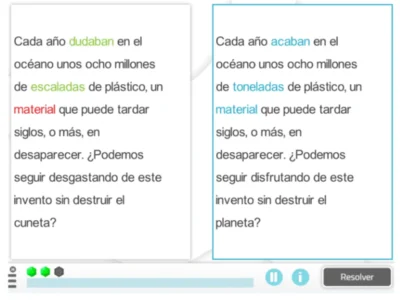
“This article has been translated. Link to the original article in Spanish:”
Cómo ha optimizado el Centro Lescer sus intervenciones terapéuticas con NeuronUP

 NeuronUP wins the 2025 SME of the Year Award in La Rioja



Leave a Reply