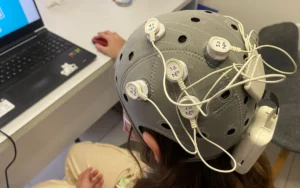
Clinical neuropsychologist Gabriel Perea Guzmán analyzes how non-invasive neuromodulation (tDCS, tACS, tRNS, TMS) enhances neuropsychological rehabilitation, its clinical applications and its future outlook in cognitive stimulation.
Introduction
For hundreds of years, humanity has altered brain activity through different methods and for various purposes, for example, the ritual use of mescaline and ayahuasca, the recreational use of opium, or the therapeutic use of cannabis. The history of using plants for ritual, medicinal, or recreational purposes is extensive.
However, humanity has also attempted to modify brain activity using electricity. The Egyptians knew about the electric properties of the catfish, but it was not until Aristotle and Plato that the medicinal use of the torpedo fish was documented; it was used to treat migraines, gout attacks and other ailments. Yes, the first source of electricity for neuromodulation was a fish.
Several centuries passed before Otto von Guericke built the electrostatic generator in 1660, considered the first electric stimulator of non-animal origin. From that moment on, the history of neuromodulation has been rapid, more so in some eras than in others.
What is neuromodulation in neurorehabilitation?
Part of the functioning of the central and peripheral nervous systems relies on two subsystems, one electrical and one chemical. Both are interdependent and, if you alter one, you alter the other. Epilepsy is the best example of how excitatory hypersynchronization alters glutamate and dopamine levels.
Of course, other neuropsychiatric conditions involve a profound electrochemical disruption of different brain networks that translates into cognitive and behavioral impairments.
Definition of neuromodulation
The ability to modify brain activity for therapeutic purposes is called neuromodulation, and the term refers to the induction of changes in neuronal activity by administering electrical or magnetic agents to more or less specific areas to produce changes in cognition, emotional regulation, and behavior.

Subscribe
to our
Newsletter
Types of neuromodulation: invasive and non-invasive
Two types of neuromodulation are distinguished: invasive and non-invasive.
Within invasive neuromodulation is Deep Brain Stimulation or DBS by its English acronym (Deep Brain Stimulation), a technique used for decades in conditions such as Parkinson’s disease or obsessive-compulsive disorder (OCD), which involves placing one or more stimulators through a surgical procedure; these stimulators deliver electrical pulses that modify brain activity.
On the other hand, when we talk about non-invasive neuromodulation, we mainly refer to transcranial magnetic stimulation (TMS) and transcranial electrical stimulation (tES).
Both use an electric field to regulate or modify the activity of circuits and brain networks, but they do so in different ways.
Transcranial magnetic stimulation (TMS)
The TMS uses a coil through which a high-intensity current is passed creating a magnetic field; this coil is placed on the head so that the primary vector is perpendicular to the area to be stimulated.
This magnetic field travels through the skin, bone and meninges and, once it reaches the neurons, it becomes a secondary electric field causing action potentials that propagate through circuits or networks. Depending on certain parameters such as frequency, greater or lesser excitability can be induced.
TMS received the first Food and Drug Administration (FDA) approval for the treatment of depression in 2008 and is the most used in the psychiatric field.
However, it has also been used in clinical neurology for the rehabilitation of aphasias and motor disorders secondary to cerebrovascular events.
Transcranial direct current stimulation (tDCS)
Meanwhile, transcranial electrical stimulation (tDCS) uses an electrode configuration that forms a circuit through which an electrical stimulus is delivered to the neurons of the cerebral cortex. Its main mechanism of action is the subthreshold modulation of resting membrane potentials.
Unlike TMS, which produces changes in action potentials, transcranial electrical stimulation (tDCS) modulates spontaneous neuronal activity, that is, it changes the firing threshold and thus alters the probability of discharge. The underlying physiological mechanism for the induction of plasticity is mainly a glutamatergic process that involves NMDA receptors.
Conclusion
The combination of traditional neuropsychological rehabilitation and non-invasive neuromodulation begins to transform therapeutic approaches, opening a landscape full of possibilities. Increasingly more hospitals and specialized centers are incorporating these techniques into their programs, supported by growing scientific evidence and empirical results that show faster progress in patients’ recovery.
In pediatric and adolescent populations, the most used technique is transcranial electrical stimulation. Its non-invasive nature, portability and ease of application make it an accessible and safe alternative, especially when compared to transcranial magnetic stimulation, which requires greater motor control from the patient. Electrical stimulation has also evolved into more specific variants such as tACS, which promises positive effects on cognition given its potential to induce oscillatory synchronization between different networks that enhances certain cognitive processes.
However, to consolidate these advances it becomes essential to have rigorous evaluation systems that allow measuring the real impact of interventions. This implies assessing changes at multiple levels: behavioral, through instruments such as the BRIEF or the SENA; electrophysiological, through EEG recordings; and cognitive, with the application of neuropsychological tests and tasks. Only in this way will it be possible to clearly establish the scope of neuromodulation in clinical practice.
It is important to remember that these techniques, by themselves, do not constitute a therapy. Their true potential emerges when they are integrated into broad, coordinated rehabilitation programs, where the collaboration of multidisciplinary teams ensures a comprehensive approach. Thus, non-invasive neuromodulation stands out as a valuable resource, not isolated but in synergy with other strategies, marking the beginning of a new era in neuropsychological rehabilitation.
Bibliography
- Bayona Prieto, Jaime A. Bayona, Edgardo León-Sarmiento, Fidias. (2011). Neuroplasticity, Neuromodulation and Neurorehabilitation: Three distinct concepts and one true purpose. Salud , 27, 95–107.
- Cohen, S. L., Bikson, M., Badran, B. W., & George, M. S. (2022). A visual and narrative timeline of US FDA milestones for Transcrania Magnetic Stimulation (TMS) devices. Brain Stimulation, 15(1), 73–75. https://doi.org/10.1016/j.brs.2021.11.010
- Ditye, T., Jacobson, L., Walsh, V., & Lavidor, M. (2012). Modulating behavioral inhibition by tDCS combined with cognitive training. Experimental Brain Research, 219(3), 363–368. https://doi.org/10.1007/s00221-012-3098- 4
- Gildenberg, P. L. (2005). Evolution of neuromodulation. Stereotactic and Functional Neurosurgery, 83(2–3), 71–79. https://doi.org/10.1159/000086865
- González Rodríguez, B., Marrón, E. M., Ríos-Lago, M., Arroyo Ferrer, A., González-Zamorano, Y., Sánchez Cuesta, F. J., De Noreña, D., & Romero, J. P. (2025). Randomized, triple-blind, and parallel-controlled trial of transcranial direct current stimulation for cognitive rehabilitation after stroke. Journal of Visualized Experiments: JoVE, 220. https://doi.org/10.3791/67809
- Grover, S., Fayzullina, R., Bullard, B. M., Levina, V., & Reinhart, R. M. G. (2023). A meta-analysis suggests that tACS improves cognition in healthy, aging, and psychiatric populations. Science Translational Medicine, 15(697), eabo2044. https://doi.org/10.1126/scitranslmed.abo2044
- Lu, H., Zhang, Y., Qiu, H., Zhang, Z., Tan, X., Huang, P., Zhang, M., Miao, D., & Zhu, X. (2024). A new perspective for evaluating the efficacy of tACS and tDCS in improving executive functions: A combined tES and fNIRS study. Human Brain Mapping, 45(1), e26559. https://doi.org/10.1002/hbm.26559
- Rushworth, M. F. S., Hadland, K. A., Paus, T., & Sipila, P. K. (2002). Role of the human medial frontal cortex in task switching: a combined fMRI and TMS study. Journal of Neurophysiology, 87(5), 2577–2592. https://doi.org/10.1152/jn.2002.87.5.2577
- Sarmiento, C. I., San-Juan, D., & Prasath, V. B. S. (2016). Brief history of transcranial direct current stimulation (tDCS): from electric fishes to microcontrollers. Psychological Medicine, 46(15), 3259–3261. https://doi.org/10.1017/S0033291716001926
- Woods, A. J., Antal, A., Bikson, M., Boggio, P. S., Brunoni, A. R., Celnik, P., Cohen, L. G., Fregni, F., Herrmann, C. S., Kappenman, E. S., Knotkova, H., Liebetanz, D., Miniussi, C., Miranda, P. C., Paulus, W., Priori, A., Reato, D., Stagg, C., Wenderoth, N., & Nitsche, M. A. (2016). A technical guide to tDCS, and related non-invasive brain stimulation tools. Clinical Neurophysiology: Official Journal of the International Federation of Clinical Neurophysiology, 127(2), 1031–1048. https://doi.org/10.1016/j.clinph.2015.11.012
Frequently asked questions about neuromodulation in neuropsychological stimulation
1. What is non-invasive neuromodulation?
Non-invasive neuromodulation is a set of techniques that modify brain activity through electrical currents or magnetic fields without the need for surgery. Its applications include cognitive, motor and emotional rehabilitation in various neurological disorders.
2. What does DBS mean in neurorehabilitation?
DBS (Deep Brain Stimulation) is an invasive technique that requires surgery to implant electrodes in specific brain areas. It is mainly used in Parkinson’s disease and obsessive-compulsive disorder (OCD).
3. What is TMS or transcranial magnetic stimulation?
TMS (Transcranial Magnetic Stimulation) is a non-invasive technique that applies magnetic fields to generate electrical activity in the cerebral cortex. It is FDA-approved to treat depression and is also used in aphasia and post-stroke rehabilitation.
4. What is tDCS used for in cognitive rehabilitation?
tDCS (Transcranial Direct Current Stimulation) applies low-intensity currents that modulate neuronal excitability. It is effective in improving functions such as attention, inhibitory control and working memory, and is used in ADHD and brain injury.
5. What is the difference between tACS and tDCS?
While tDCS uses continuous low-intensity current to increase or decrease cortical excitability, tACS employs oscillating alternating current to synchronize brain rhythms (alpha, beta, theta), with applications in memory and attention.
6. What is tRNS in neurorehabilitation?
tRNS (Transcranial Random Noise Stimulation) uses electrical currents with random amplitude and frequency. Although fewer studies are available, it shows potential to boost brain plasticity and improve cognitive processes.
7. What are the benefits of neuromodulation in neuropsychology?
Neuromodulation, especially non-invasive, accelerates neuropsychological rehabilitation by enhancing brain plasticity. Its benefits include: faster recovery after brain injury; improvement in executive functions and memory; reduction of symptoms in depression and ADHD; and an effective complement to traditional cognitive stimulation programs.
If you liked this article about the neuromodulation in neuropsychological rehabilitation, you will likely be interested in these NeuronUP articles:




“This article has been translated. Link to the original article in Spanish:”
Neuromodulación en la rehabilitación neuropsicológica: aplicaciones, beneficios y futuro de la estimulación cerebral no invasiva

 More Brain, Less Fatigue: The Hidden Secret of High Performance



Leave a Reply