
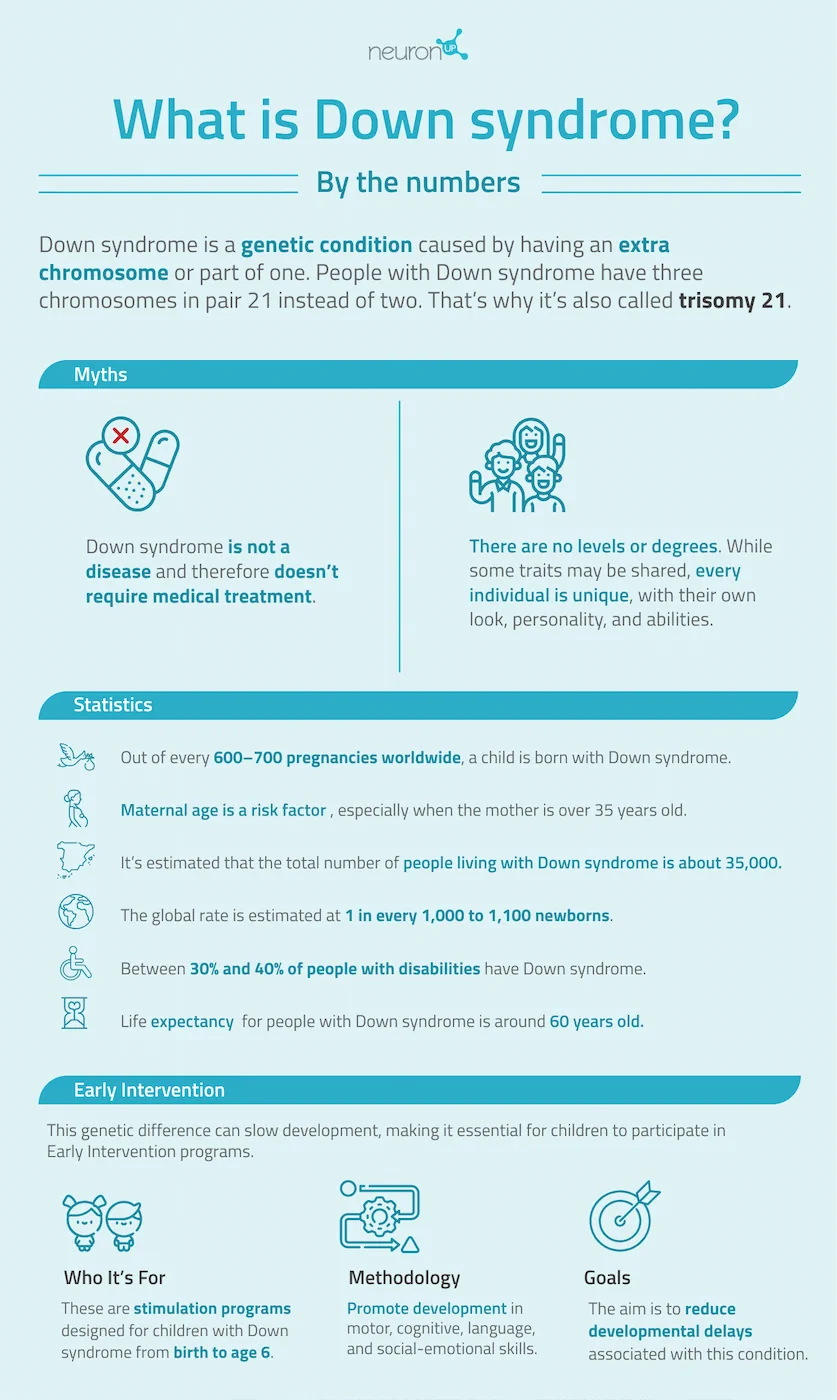
Down syndrome, or trisomy 21, is the most frequent viable chromosomal alteration in humans and one of the main genetic causes of intellectual disability. It is caused by the presence of a full or partial extra copy of chromosome 21 and affects brain development, physical health and ageing. Its global incidence is estimated at around 1 in every 1,000–1,100 live births.
Down syndrome cannot be explained simply as “an extra chromosome”, but rather as a gene dosage disorder: the overexpression of genes on chromosome 21 alters key processes in neurodevelopment, cardiogenesis, immunity and brain ageing.
There are three main forms:
- Free trisomy 21: accounts for approximately 95% of cases.
- Translocation: represents around 2–4% and may be relevant for genetic counselling.
- Mosaicism: appears in around 1–2% of cases and is usually associated with greater clinical variability.
One of the best-known risk factors is advanced maternal age, especially from the age of 35 onwards, although most births still occur in younger women for demographic reasons.
Most frequent clinical features
Down syndrome shows great variability between individuals, but there are some frequent features and comorbidities. These include muscular hypotonia from birth, delay in some developmental milestones, and a cognitive profile usually of mild or moderate intellectual disability.
Various associated medical conditions are also frequent:
- Congenital heart disease: affects around 40–50% of cases.
- Thyroid problems: very common throughout life.
- Obstructive sleep apnoea: with a high prevalence and often underdiagnosed.
- Hearing and visual impairments: frequent from childhood.
- Greater immunological and haematological vulnerability.
From a cognitive point of view there is no uniform profile. The most common picture is greater difficulty with expressive language, verbal working memory and executive functions, with relative strengths in visual processing, learning with structured support and, in many people, social interaction.
Prenatal and postnatal diagnosis
Prenatal diagnosis has advanced considerably in recent years. In current clinical practice, screening usually begins with the first-trimester combined test and, when indicated, with the analysis of cell-free fetal DNA.
This last test offers very high sensitivity for trisomy 21, but it is important to remember that it is not a definitive diagnostic test. If the result is positive, it must be confirmed by invasive techniques such as amniocentesis or chorionic villus sampling.
After birth, the diagnosis is confirmed by karyotype, which makes it possible to identify whether it is a free trisomy, a translocation or mosaicism.
Early intervention and support
One of the keys to the current approach is early intervention. During the first years of life, brain plasticity makes it possible to improve development significantly if there is appropriate support and coordination between professionals and family.
The most common interventions include:
- Physiotherapy, to work on muscle tone, postural control and motor development.
- Speech and language therapy, to support feeding, orofacial motor skills and language.
- Occupational therapy, to enhance independence and participation.
- Protocol-based medical follow-up, to detect and treat comorbidities from an early stage.
Current evidence shows that early, coordinated intervention improves functional prognosis and quality of life, although it does not “correct” the underlying genetic alteration.
Inclusive education and learning
The educational approach has changed radically. Today it is argued that inclusion does not consist only of being in a mainstream classroom, but of participating, learning and progressing with real support.
The most effective strategies usually include:
- Visual supports.
- Multisensory learning.
- Explicit, structured teaching.
- Individualised curricular adaptations.
In the Spanish-speaking world, the Troncoso method has been particularly relevant in literacy, since it draws on the global visual recognition of words rather than on purely phonetic teaching. This fits well with the cognitive profile of many pupils with Down syndrome.
Employment, independence and adult life
Adult life is no longer understood in terms of permanent dependence, but of self-determination with support. Access to employment, supported housing and social participation are key factors for quality of life.
In this context, the supported employment model has proved particularly useful. Its aim is not to wait for “perfect” preparation, but to make it easier to join mainstream working environments with individualised support and professional follow-up.
Employment brings much more than income: it improves self-esteem, the social network, independence and mental health.
Mental health: an often invisible dimension
One of the most damaging stereotypes is to think that people with Down syndrome are always happy or emotionally simple. Current evidence refutes that idea: problems of anxiety, depression, stress and functional regression can appear and are frequently underdiagnosed.
Psychological distress is often not expressed verbally, but through changes in behaviour, withdrawal, loss of skills or sleep disturbances. That is why a specialised, contextualised assessment is essential.
Ageing and Alzheimer’s disease
The increase in life expectancy is one of the great advances of recent decades. In Europe, the recent median is around 58 years, and many people today live beyond 60.
However, ageing brings with it a particularly important challenge: the high risk of Alzheimer’s disease. This is because the APP gene, related to the production of beta-amyloid, is located on chromosome 21. As there is an additional copy, an early accumulation of this protein in the brain is favoured.
Alzheimer-type neuropathology appears very frequently and early in people with Down syndrome, although the clinical course varies between individuals. For this reason, this population has become a key model for researching biomarkers and possible therapies for Alzheimer’s.
Research and the future
Current research is exploring very promising avenues, such as the modulation of overexpressed genes —for example DYRK1A—, the study of Alzheimer’s biomarkers and, at an experimental level, strategies for silencing the extra chromosome 21.
Even so, caution is needed: there is no cure for Down syndrome today, nor any therapy capable of reversing it in humans. The priority continues to be comprehensive, evidence-based care, with a rights-based approach and support throughout life.
Conclusion
Down syndrome does not define a single destiny. It is a complex genetic condition that involves specific medical vulnerabilities, but also a capacity for learning, development, participation and citizenship.
The great paradigm shift of recent decades has been moving from a model centred on limitation to one centred on support, inclusion and quality of life. Today the challenge is not only to live longer, but to live better: with health, education, opportunities, independence and full recognition of rights.