

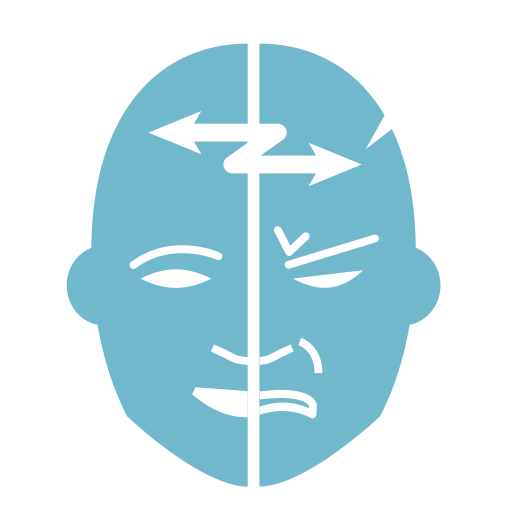
Huntington’s disease is a hereditary, progressive neurodegenerative disorder that affects movement, cognition and emotional health. Although many people associate it only with involuntary movements, it is in fact a complex disease that also alters behaviour, reasoning ability and independence in daily life. It usually begins in adulthood, most often between the ages of 30 and 50.
What is Huntington’s disease?
Huntington’s disease causes the progressive deterioration of certain neurons in the brain, especially in areas involved in movement control, thinking and emotions. Among the most affected regions are the caudate nucleus and the putamen, which form part of the basal ganglia. As the disease advances, the cerebral cortex may also be compromised, which explains the appearance of cognitive and behavioural symptoms in addition to motor ones.
Genetic cause
The cause lies in an alteration of the HTT gene, located on chromosome 4. This gene contains a repeated DNA sequence called CAG. In the general population this repeat usually appears between 10 and 35 times, but in people with Huntington’s disease it is expanded. When it reaches 36 or more repeats, the disease may appear; with 40 or more, it usually does develop.
Inheritance is autosomal dominant. This means that inheriting a single altered copy of the gene is enough to be at risk of developing the disease. For that reason, each child of an affected person has a 50% chance of inheriting the mutation.
There is also an important phenomenon called genetic anticipation. When passing from one generation to the next, the number of CAG repeats can increase, and the higher that number, the more likely it is that symptoms will appear earlier. This helps explain why some cases begin at younger ages, especially when transmission is paternal.
What happens in the brain
The altered huntingtin protein gives rise to toxic fragments that accumulate inside neurons and interfere with processes essential to their functioning. That toxicity promotes neuronal dysfunction and death, above all in the striatum and other brain networks related to movement, decision-making and emotional regulation. This is why the disease is not limited to “tremors” or “spasms”, but affects the person as a whole.
Early symptoms: they do not always begin with movement
One of the most important aspects of Huntington’s disease is that its first symptoms are not always motor. In many cases the earliest signs are changes in behaviour or mood: irritability, depression, apathy, impulsivity, anxiety or difficulty making decisions. Clumsiness, small involuntary movements, balance problems or difficulty learning new information may also appear.
As the disease progresses, motor symptoms become more visible. Facial grimacing, sudden involuntary movements of the arms, legs or trunk, an unsteady gait, coordination problems and falls may appear. Later on, difficulties speaking and swallowing are frequent, which increases dependence and the risk of complications.
Cognitive and emotional changes
On the cognitive level, the disease usually affects executive functions above all: planning, organising, solving problems, sequencing tasks or adapting to change. Working memory, processing speed and judgement may also deteriorate. In parallel, personality changes, disinhibition or social withdrawal may intensify. All of this has a direct impact on working, family and social life.
How the disease progresses
Huntington’s disease follows a progressive course. In general terms, people with the adult-onset form usually live between 15 and 20 years after symptoms begin. In the early stages a fair degree of independence can still be maintained; in the intermediate stages more problems appear with mobility, communication and organising daily life; and in the advanced stages rigidity, difficulty speaking and swallowing and the need for continuous support increase.
The juvenile form
There is a less frequent variant, juvenile Huntington’s disease, which begins in childhood or adolescence. In these cases the picture is usually different: there is more slowness of movement, rigidity, clumsiness, frequent falls and worsening school performance. Seizures may also appear, something far less common in the adult form. It also tends to progress more quickly.
How it is diagnosed
Diagnosis is based on a combination of clinical history, neurological examination, neuropsychological assessment and the study of family history. Imaging tests such as MRI or CT can help assess brain changes or rule out other causes, but definitive confirmation comes from a genetic test that measures the number of CAG repeats in the HTT gene.
In people with family risk who do not yet have symptoms, predictive testing must be carried out with genetic counselling. Knowing the result has a strong emotional, personal and family impact, so it requires professional support before and after the test.
Current treatment
To date, Huntington’s disease has no cure, and the available treatments focus on relieving symptoms and preserving quality of life for as long as possible.
Pharmacological treatment
For chorea, drugs such as tetrabenazine or deutetrabenazine may be used. Both help reduce involuntary movements, although they require monitoring because they may increase the risk of depression or suicidal thoughts in some people.
A multidisciplinary approach
In addition to pharmacological treatment, the approach must be multidisciplinary. Physiotherapy can help maintain mobility and balance; speech and language therapy, to work on communication and swallowing; occupational therapy, to adapt daily life; and nutritional support is key when eating problems or weight loss appear. Psychological and psychiatric support is also essential, both for the affected person and for their family.
Research and new therapies
Research into Huntington’s is moving towards strategies that attempt to act on the cause of the disease, not only on its symptoms. Among the most promising lines are therapies aimed at reducing mutant huntingtin, gene-silencing approaches and the study of mechanisms such as somatic expansion, which could influence the progression of the disease.
Although these advances open up a hopeful path, they still belong to the field of research and do not yet amount to a generally available cure. Clinical practice today still rests on early diagnosis, symptom control and comprehensive care.
The impact on the family
Huntington’s disease does not affect only the person who has it. Its hereditary nature means that every diagnosis has a strong impact on the whole family. Questions arise about genetic risk, the future, family planning and the role of carers. That is why emotional support, genetic counselling and a well-coordinated care network are as important as medical treatment.
In summary
Huntington’s disease is a hereditary, neurodegenerative condition that affects movement, behaviour and cognition. It is caused by an expansion of CAG repeats in the HTT gene, has an autosomal dominant inheritance pattern and, although it still has no cure, there are treatments and supportive therapies that can improve quality of life. Current research is focused on slowing the biological process of the disease, which opens up a stage of real hope for the future.
