
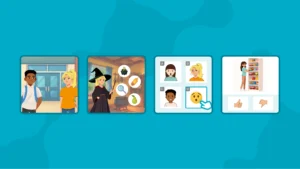
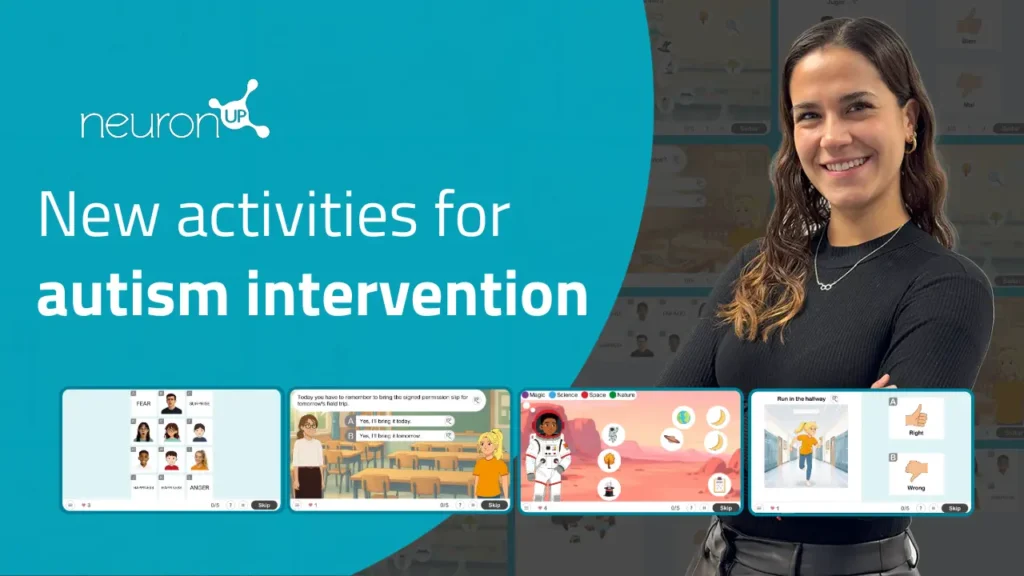
At NeuronUP, we are expanding our children’s catalog with four activities for children with autism, specially designed for autism intervention.
These children’s activities for autism stand out for their high ecological value, as they allow key skills to be trained in contexts very close to everyday life, promoting the generalization of learning beyond the therapeutic setting.
The activities enable intervention in areas such as cognitive flexibility, social cognition, inhibition, and selective attention, always within a structured, safe, and functional environment.
Activities for children with autism
1. Switching hats
What does it involve?
Switching hats is a game-based activity included among NeuronUP’s activities for children with autism. It involves identifying and selecting stimuli that meet a specific instruction (for example, elements from nature), while a character wearing a hat changes color at regular intervals, indicating a new selection criterion.
The child must dynamically adjust their response, attending to changes in category and maintaining active attention throughout the entire process.
What does this activity train?
This children’s activity for autism primarily trains cognitive flexibility and adaptation to unpredictable changes. Complementarily, it stimulates inhibition and selective attention, key skills in intervention with children on the autism spectrum.
Ecological value
The activity recreates, in a controlled way, everyday situations in which rules change without prior notice, promoting cognitive and emotional adaptation to uncertainty.
This type of training is useful for improving responses to unexpected events in real-life contexts, such as changes in school routines, modifications to daily activities, or variations in reference figures. Practicing these situations in a safe environment facilitates direct transfer to everyday life.
Which children is it recommended for?
Children on the autism spectrum and other children with difficulties in cognitive flexibility, behavioral rigidity, or problems adapting to changes in routine.
Available languages
Spanish, English, French, Brazilian Portuguese, European Portuguese, and Catalan.
2. Scramble of basic emotions
What does it involve?
Scramble of basic emotions is a worksheet aimed at emotional intervention in children with autism. It involves identifying and matching basic emotions represented through different visual formats, such as photographs, pictograms, drawings, and emojis.
What does this activity train?
This children’s activity for autism makes it possible to work on social cognition and vocabulary; in doing so, it also reinforces social perception, social norms, and emotional processing and recognition, facilitating the discrimination of basic emotions in a progressive and structured way.
Ecological value
It helps the child identify facial expressions, gestures, and emotional cues present in everyday life. By learning to associate emotions with words and images, the child expands their emotional vocabulary and improves their ability to express how they feel.
The use of real visual stimuli and a predictable environment facilitates the generalization of emotional recognition to natural contexts such as the classroom, the home, or everyday interactions.
Which children is it recommended for?
Autistic children and other neurocognitive profiles who need a visual, clear, and structured approach to recognizing and classifying basic emotions, regardless of support level.
Available languages
Spanish, English, French, Brazilian Portuguese, European Portuguese, and Catalan.
💬 What would you say?
What does it involve?
What would you say? is a game designed for social cognition intervention in children with autism. It involves observing a social situation accompanied by a dialogue and selecting the most appropriate verbal response from several possible options.
What does this activity train?
This activity for children with autism trains social cognition, context interpretation, understanding others’ intentions, and cognitive flexibility, promoting responses that are aligned with social and emotional norms.
Ecological value
The activity recreates real communicative situations such as greeting, asking for help, apologizing, responding to a mistake, or expressing emotions. Training these situations in a safe environment facilitates transfer to everyday contexts and improves communicative autonomy and social competence.
Which children is it recommended for?
Children on the autism spectrum and other children who present difficulties in social cognition, social interaction, pragmatic communication, or adaptation to conversational norms.
Available languages
Spanish, English, French, Brazilian Portuguese, European Portuguese, and Catalan.
✔️ Is it right or wrong?
What does it involve?
Is it right or wrong? is a worksheet that involves recognizing whether a behavior is appropriate or inappropriate in everyday situations, based on realistic visual scenes.
What does this activity train?
This children’s activity for autism allows work on social perception, understanding of basic social norms, emotional recognition, and socio-emotional regulation, promoting socially adaptive responses.
Ecological value
It is based on scenes from school, family, and community environments. The norms addressed are directly applicable to daily life, which promotes the generalization of learning and improves the child’s social autonomy.
Which children is it recommended for?
Autistic children and other neurocognitive profiles who need structured and visual support to interpret social interactions and differentiate appropriate from inappropriate behaviors.
Available languages
Spanish, English, French, Brazilian Portuguese, European Portuguese, and Catalan.

 The most used NeuronUP games in 2025



Leave a Reply