
In this article, César Ortea Suárez (CTO & Software Architect at NeuronUP), Jorge M. Corada (Chief Product Officer at NeuronUP) and Jesús Cortés (Research Director at NeuronUP), Elina Maltseva (Data Leader at NeuronUP) and Marta Arbizu Gómez (Industrial PhD Student at NeuronUP) present the differences between Performance and Score in NeuronUP, how they can be interpreted together, and what their applications are in clinical practice.
Why do we need two different metrics?
In digital cognitive rehabilitation, measuring the patient’s performance is not as straightforward as counting correct or incorrect answers. A person may respond with great accuracy in the early phases of a task but get stuck when difficulty increases. Another may get far in the activity but make more mistakes.
To capture these differences, NeuronUP employs two complementary metrics: Performance and Score. Both provide valuable information, but their true power emerges when they are interpreted together.
What is Performance?
Performance is a metric that measures the user’s overall execution quality. Specifically, it reflects the proportion of correct responses relative to the total number of attempts made (that is, adding correct responses, errors, and omissions).
The mathematical formula that defines it is the following:
Where:
- Cp: correct responses in phase p
- Ep: errors in phase p
- Op: omissions in phase p
As it is a ratio between correct responses and the total attempts, its value always lies between 0 and 1.
In practice, a Performance close to 1 indicates very precise execution, while values near 0 reflect a low level of correct responses relative to attempts.
For example, a user who only completes the initial phases but does so with great accuracy can obtain a high Performance, even if they do not progress to more difficult phases.
Clinical interpretation: Performance reports on the patient’s overall accuracy at any phase, without taking into account the level of difficulty reached.
What is Score?
The Score is a metric that measures the user’s overall skill and expertise throughout an activity. Unlike Performance, it not only values the accuracy of responses but also the ability to progress to more complex phases, giving more weight to advanced phases and penalizing early dropouts.
The formula that defines it is the following:
Where:
- Sp: score in phase p (value between 0 and 1)
- P: set of completed phases
- N: total number of phases
- maxP: highest phase reached
By construction, the Score always takes values between 0 and 100.
In practical terms, a high Score means that the user was not only accurate but also managed to advance to more demanding phases. For example, someone who reaches advanced phases, even if they make some errors, can achieve a high Score.
Clinical interpretation: the Score reflects the complete evolution of performance and is especially sensitive to performance in higher-difficulty phases, making it a suitable indicator for assessing progress in neuropsychological interventions.
Performance and Score: how to interpret them together?
The true value of these metrics appears when they are analyzed together. Performance and Score are not mutually exclusive but complementary, and their combination allows a better understanding of the patient’s performance profile.
As shown in Graphic 1, there are four possible combinations between the two parameters:
- High Performance and low Score: indicates that the person responds with great accuracy but only in initial or simple phases. This is a profile that masters the basics but has not yet managed to advance to more complex levels.
- Low Performance and high Score: indicates that the patient has reached advanced phases, although committing more errors. In this case, there is the capacity to face difficult challenges, but still room for improvement in accuracy.
- Both high: shows a solid and balanced performance, with precise and consistent execution throughout the activity.
- Both low: indicates difficulties both in maintaining accuracy and in progressing in the activity, which may guide the professional to adjust the intervention or redesign the work strategy.
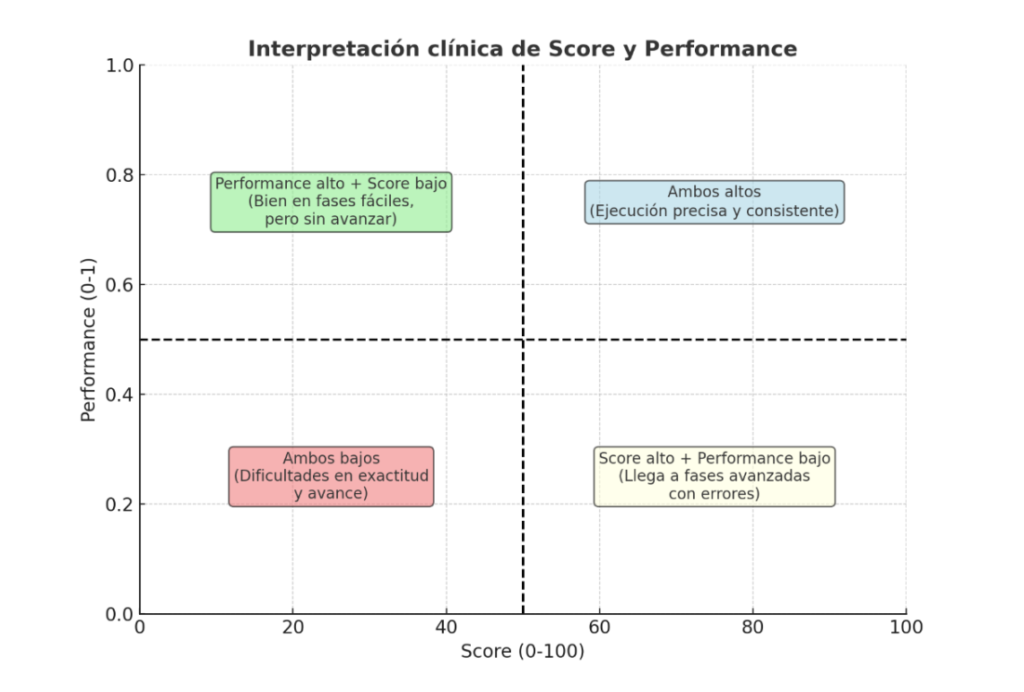
This joint reading turns Performance and Score into a powerful tool to identify each patient’s strengths and weaknesses, and to adapt the therapeutic plan in a personalized way.
Applications in clinical practice
The combined use of Performance and Score adds great value to the daily work of neuropsychology and cognitive rehabilitation professionals.
On one hand, Performance allows adapting the difficulty of activities in real time, adjusting them to the accuracy each user shows in their responses. This ensures that the task is neither too easy nor excessively difficult, maintaining motivation and engagement.
On the other hand, Score is especially useful for evaluating clinical progress over time. Comparing values obtained before and after a neuropsychological intervention offers an objective measure of the therapy’s impact, beyond subjective observation.
When interpreted together, both metrics provide a comprehensive view of cognitive performance: they allow personalization of stimulation programs, adjustment of activity progression, and precise monitoring of each patient’s evolution.
Conclusion
Correctly interpreting Performance and Score is key to leveraging the potential of digital cognitive rehabilitation. While Performance reflects execution accuracy, Score provides a view of overall ability and progress toward more complex phases.
At NeuronUP, the combination of both metrics turns data into meaningful clinical information, facilitating personalized decisions and more precise monitoring of the patient’s progress.
Frequently asked questions about NeuronUP’s Performance and Score
1. What is the difference between NeuronUP’s Performance and Score?
Performance and Score are two NeuronUP metrics.
Performance measures the user’s overall execution quality, reflecting the proportion of correct responses relative to the total attempts made (that is, adding correct responses, errors, and omissions). In other words, it informs about the patient’s overall accuracy at any phase, without taking into account the level of difficulty reached.
On the other hand, Score measures the user’s overall ability throughout an activity. That is, it reflects the complete evolution of performance. Unlike Performance, Score not only values the accuracy of responses but also the ability to progress to more complex phases, giving more weight to advanced phases and penalizing early dropouts.
2. What Performance value is considered “good” in digital cognitive rehabilitation?
There is no universal value, as it depends on the activity, the clinical profile, and the therapeutic goal. In general, a Performance close to 1 indicates very precise execution. However, it is important to always interpret it together with the Score to obtain a complete view of performance.
3. Why can a patient have high Performance but a low Score?
This happens when the patient responds accurately in initial phases but does not manage to advance to more difficult phases. It is a typical profile in people who master the basic requirements of the task but have difficulties when cognitive demand increases (for example: working memory, cognitive flexibility, or processing speed).
4. Is it possible to have a high Score even if Performance is low?
Yes. A patient can reach advanced phases and, although they make more errors, obtain a high Score because they demonstrate the ability to face higher complexity levels. This pattern frequently appears in users with good problem-solving ability but low accuracy.
5. How can I use Performance and Score to adjust the therapeutic intervention?
A low Performance suggests working on accuracy or lowering difficulty, while a low Score may indicate the need to train progression, endurance, or executive skills. Analyzing both allows tailoring tasks, dosage, and difficulty level more precisely.
If you liked this article about the interpretability of Performance and Score in NeuronUP, you will likely be interested in these NeuronUP articles:






“This article has been translated. Link to the original article in Spanish:”
Interpretabilidad de Performance y Score en NeuronUP

 AI and neuroscience: How artificial intelligence is transforming cognitive stimulation and neurorehabilitation



Leave a Reply